
Author
No results available
Dubai’s shared-housing framework makes written registration, licensing and accurate resident records central to a compliant arrangement. A tenant or operator should first identify who is authorised to offer the space, whether the unit can be used for shared accommodation and what document has actually been registered. Rental dispute lawyers in Dubai can review those records before payment or occupancy assumptions become a dispute.
The shared-accommodation rules apply within a Dubai-specific framework and should not be confused with an ordinary whole-unit lease. A practical shared housing file contains the property and operator details, permit information, registered agreement, resident entry, payment record, house terms, inspection notices and communications about renewal or exit.
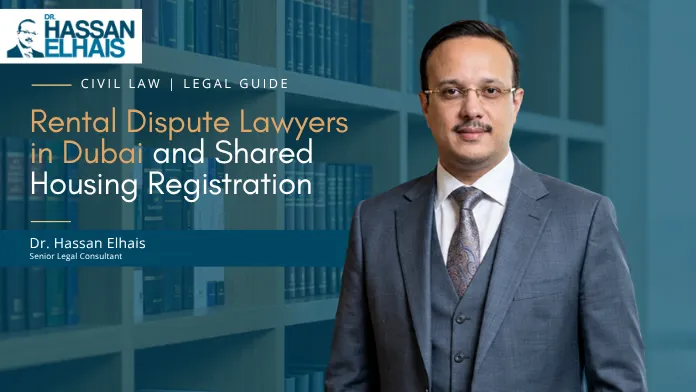
Dr. Hassan Elhais is a Dubai-based Senior Legal Consultant at Amal Alrashedi Lawyers and Legal Consultants. Practising in the UAE since 2006, he advises UAE nationals, expatriates and international clients on complex disputes. His role is advisory and includes UAE-law analysis, evidence assessment and coordination in matters involving more than one legal framework.
A person collecting rent may be an owner, authorised operator, manager or another resident without authority to sublet. The prospective occupant should ask who controls the unit and what document permits the arrangement. Payment to a familiar person does not prove that the underlying use is approved.
Landlord and tenant advice can compare ownership, management and occupancy documents. An authority check should record names, identity details, trade or permit information where relevant, and the account receiving payment. Rental dispute lawyers in Dubai can flag inconsistencies without assuming that every informal household is unlawful.
The resident should receive terms that identify the space, payment, deposit, services, occupancy period, house rules and exit process. The registered record and the document handed to the resident should match. If the operator changes a term later, the date, notice and legal basis should be preserved.
Tenancy dispute guidance can examine the effect of missing or inconsistent registration. A contract comparison should place the signed version, registry entry and payment description side by side. A screenshot of an online status is useful only if its source, date and unit can be identified.
Shared accommodation may be subject to permits, occupancy limits, health and safety requirements and official inspections. Residents should not remove safety equipment, create partitions or add occupants merely because a private payment arrangement exists. Operators should communicate the approved capacity and emergency rules clearly.
Property advice can help distinguish a contractual dispute from a regulatory compliance issue. A resident register should be accurate and updated through the proper process. It should not be used for public disclosure or unrelated monitoring. Rental dispute lawyers in Dubai can assess an inspection or complaint record while keeping privacy and safety questions separate.
Cash or transfers should identify the month, resident and purpose. A deposit receipt should state who holds the money, the conditions for deduction and the return process. Shared utility or service charges need a stated calculation method rather than an unexplained monthly figure.
Rental-dispute advice can review a payment ledger against the agreement and registry. The resident should keep proof of every transfer and any notice that an account changed. The operator should issue consistent receipts. A new bank account communicated only through an unverified message should be checked before payment.
An exit notice should identify the intended date, inspection, key return, outstanding payments and deposit process. The parties should make a dated condition record for the allocated room and shared areas. Damage attributed to one resident needs evidence; ordinary wear and a building-wide problem should not be charged automatically to that person.
Property litigation guidance can assess the proper forum and connected claims. A move-out record should preserve photographs, meter or service information, key receipt and forwarding contact. If an operator’s licence or authority is disputed, that issue should be documented separately from the calculation of rent or damage.
Residents should know how official or authorised inspections are communicated, who may attend and what part of the unit will be examined. An operator should preserve the notice, inspector identification and resulting report. A resident should not obstruct a lawful inspection, but may record a concern about identity, scope or handling of private belongings through the proper channel.
Routine house checks by a manager are not automatically the same as an official inspection. The agreement should explain reasonable access, notice and emergencies. Cameras or monitoring inside private sleeping areas raise separate concerns and should never be justified merely by calling the property shared housing.
If a notice alleges overcrowding, an illegal partition or an unregistered resident, the response should address the exact unit and current occupancy. Remove inaccurate names through the proper registry process and retain proof. Photographs, plans and dated resident entries can answer the allegation more clearly than a general denial.
Any corrective step should be documented. Payment of a penalty, removal of a partition or reduction of occupancy does not decide a resident’s separate contractual claim. The records should keep compliance action, rent calculations and deposit issues in distinct sections. Each notice should be matched to its response and completion evidence. This helps show whether a problem remained active when a renewal, exit or payment dispute later arose.
Shared housing is safer when authority, licensing, registration, resident information and payments all point to the same arrangement. Rental dispute lawyers in Dubai can compare those records, identify contractual and regulatory issues and plan an orderly exit or response. Dr. Hassan Elhais can provide an advisory assessment without promising that registration alone resolves every occupancy or payment dispute.
About the Author
Dr. Hassan Elhais publishes analysis of UAE civil law matters, including civil disputes, contractual obligations and compensation claims. For readers researching lawyers in Dubai, his writing offers insight into the legal questions surrounding these topics. Explore his published work and practice-area information for further context.
Copyright © of this article is retained by the author and/or other copyright owners. We explicitly grant you permission to download a copy, without any alteration, of this article for personal non-commercial research or study, without prior permission or any charge. This article can be utilized on your website or for marketing, however, we grant you permission to host this article on your website and no other rights. This content should not be altered in any way or sold commercially in any format without prior permission of the copyright holder. During reference of this article, full biographic details entailing the name of the author, his designation, the institute and the publishing date of the article shall be provided.

posted 7 minutes ago

posted 9 minutes ago

posted 23 minutes ago

posted 27 minutes ago

posted 1 hour ago

posted 1 hour ago
posted 2 hours ago

posted 2 hours ago
posted 2 hours ago

posted 2 hours ago
posted 2 hours ago

posted 2 hours ago
No results available
Find the right Legal Expert for your business

Send welcome message