
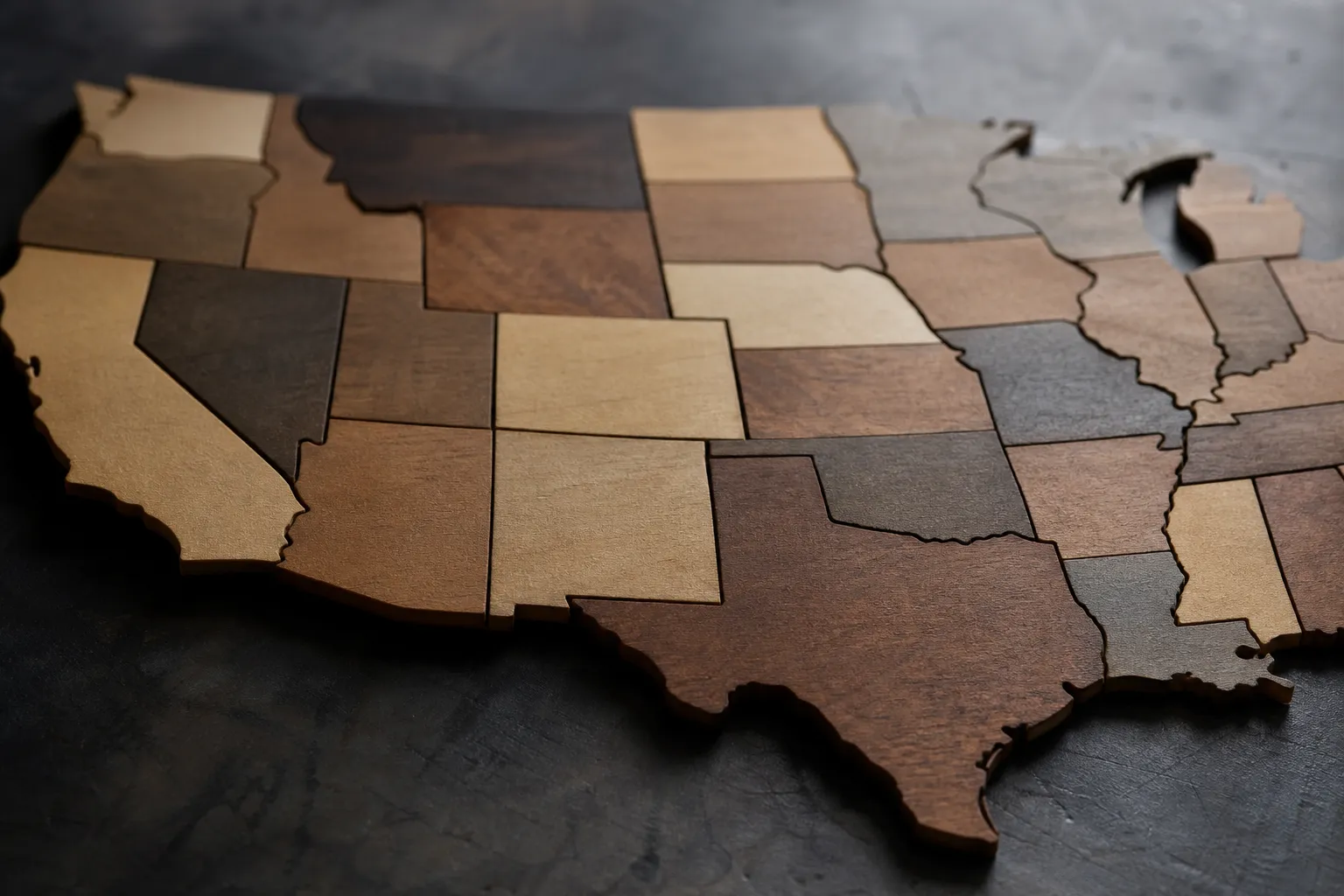

A reliable us llc state comparison has become essential for non‑resident entrepreneurs who once chose a US state on fee tables and anonymity marketing alone. The landscape shifted sharply after the Corporate Transparency Act’s beneficial ownership information (BOI) reporting regime began phasing in, and after banks intensified Know Your Customer (KYC) and customer due diligence (CDD) scrutiny. The promises of “fully anonymous” LLCs that circulated for years are now materially outdated, and any serious us llc state comparison must reckon with federal reporting, bank acceptance realities and state tax nexus together, not in isolation.
This guide is written for non‑resident individuals, foreign entities, company formation intermediaries and high‑value international clients weighing where to incorporate. It delivers a lawyer‑led, organisation‑level analysis of Delaware, Wyoming and New Mexico that balances privacy, cost, litigation readiness, federal compliance and, crucially, the practical pathway to opening and keeping a US business bank account. Rather than recycling fee tables, this us llc state comparison connects the dots between what a state records publicly, what FinCEN requires under the CTA, and what a bank will actually ask for. Where we cite figures, verify them against each state’s official page at the time you file, because fees and deadlines change.
If you want a one‑line answer, use the grid below, then read the detailed sections for nuance. The short version of any honest us llc state comparison is that no single state is “best”, the right choice depends on your risk profile, your business activity and your banking ambitions, not on the headline filing fee.
The table below is a compact, scannable us llc state comparison for non‑residents. Treat the fee figures as indicative ranges and confirm current numbers on the official Secretary of State or Division of Corporations page before filing, as each agency updates its schedule periodically.
| State | Initial filing fee | Annual fee / franchise tax | Owners disclosed publicly? | BOI/CTA reporting | Banking practicality | Typical formation timeline |
|---|---|---|---|---|---|---|
| Delaware | ~US$110 (Certificate of Formation), verify on corp.delaware.gov | Flat annual LLC franchise tax (~US$300), verify current amount | Members not listed on the Certificate of Formation; registered agent is public | Applies to most LLCs; file BOI with FinCEN | Well‑recognised by banks and fintechs; strong brand familiarity | Standard filing in days; expedited options available |
| Wyoming | ~US$100 (Articles of Organization), verify on sos.wyo.gov | Annual report with license tax (minimum ~US$60), verify | Members generally not required on public formation record | Applies to most LLCs; file BOI with FinCEN | Accepted by many fintechs; some banks less familiar than Delaware | Typically a few business days |
| New Mexico | ~US$50 (Articles of Organization), verify on sos.state.nm.us | No annual report or annual fee for LLCs (historically), verify | Members not listed; strongest state‑level non‑disclosure of the three | Applies to most LLCs; file BOI with FinCEN | More scrutiny from some banks; fintech access varies | Typically a few business days |
Image alt: Comparison table of Delaware, Wyoming and New Mexico LLCs for non-residents, a us llc state comparison of fees, privacy and banking.
Delaware’s enduring appeal flows from its legal infrastructure. The Court of Chancery offers specialist, business‑focused adjudication, and decades of precedent give investors and counsel predictability. These delaware llc benefits matter most where outside investment, equity instruments or complex governance are contemplated. The Division of Corporations does not list members on the Certificate of Formation, so member names are not on the public formation document, though a registered agent appears on record (verify filing requirements on corp.delaware.gov).
The trade‑offs are cost and complexity. Delaware imposes a flat annual LLC franchise tax that is higher than Wyoming’s or New Mexico’s maintenance costs, and an LLC doing business in another state will often need to foreign‑qualify there too. For banking, Delaware’s name recognition tends to smooth account opening, many US banks and fintechs are comfortable with the jurisdiction. In any practical us llc state comparison, Delaware is the “serious business” option whose extra cost buys legal certainty rather than secrecy.
Wyoming built its reputation on low fees, no state personal or corporate income tax, and a formation record that does not require member names, the core of its wyoming llc privacy proposition. The Secretary of State’s Business Division keeps initial and annual costs modest (confirm current figures on sos.wyo.gov). Registered agents are mandatory and appear on record, and some providers market nominee or privacy services layered on top.
The important caveat is that state‑level privacy is not federal anonymity. Under the CTA, most Wyoming LLCs must still report beneficial owners to FinCEN, and banks will independently identify beneficial owners during onboarding. Nominee arrangements that purport to conceal real owners from a required BOI filing create legal exposure, not protection. Banking outcomes are generally positive with fintechs, though some traditional banks are less familiar with Wyoming than Delaware. For cost‑conscious holding and online businesses, Wyoming remains a strong entry in any us llc state comparison.
New Mexico offers the strongest state‑level non‑disclosure of the three and is frequently marketed for new mexico llc anonymity. Its formation filings do not list members or managers, and historically the state has required no annual report or annual fee for LLCs, an unusually low ongoing‑cost profile (verify on sos.state.nm.us). For a dormant holding vehicle, this can be the cheapest structure to maintain.
Two realities temper the anonymity narrative. First, the CTA’s BOI regime applies to New Mexico LLCs as it does elsewhere: beneficial ownership must be reported to FinCEN even though it stays off the public state record. Second, because New Mexico is less commonly used by mainstream operating businesses, some banks apply additional scrutiny, and fintech acceptance varies. A balanced us llc state comparison therefore treats New Mexico as excellent for low‑cost, privacy‑sensitive holding structures, but one where you should validate a concrete banking pathway before relying on it for active operations.
The following numbered steps describe a realistic workflow for llc formation non residents, including the banking stage that trips up many applicants. Each step is sequenced so compliance obligations are addressed before, not after, you approach a bank.
This is where most non‑residents underestimate the gap between forming an entity and operating it. Banking and compliance, not the filing fee, determine whether your structure actually functions, and they are the most important dimension of any modern us llc state comparison.
The CTA created a federal beneficial ownership reporting obligation administered by FinCEN. Most LLCs that are “reporting companies” must disclose each beneficial owner’s identifying information and keep it current. The statutory framework sits at 31 U.S.C. 5336 (see the legislative text via Congress.gov), and the operational detail, who must file, what to file and by when, lives on FinCEN’s BOI resource. Because scope, deadlines and enforcement have evolved, confirm the current position directly with FinCEN before filing. The practical consequence for a us llc state comparison is decisive: state‑level non‑disclosure no longer equals anonymity, because federal reporting applies regardless of the formation state.
US banks operate under Bank Secrecy Act/AML obligations, including customer due diligence and beneficial ownership identification. Interagency and supervisory guidance on CDD is published through the FFIEC and Treasury’s financial‑crime resources. In practice, a bank will identify owners of 25%+ and a controlling person, assess the customer’s risk, and seek to understand the nature and purpose of the account. There is meaningful overlap between the information you supply for BOI and what a bank collects, consistent, verifiable records across both reduce friction. For us llc banking nonresident applicants, discrepancies between the state record, the BOI filing and the bank application are a common cause of delay or refusal.
State choice influences cost, legal environment and public disclosure. It does not override federal BOI reporting, and it does not guarantee a bank account. A thoughtful us llc state comparison treats state selection and banking strategy as a single decision: picking the cheapest state is a false economy if your banking pathway stalls.
Understanding llc taxes by state requires separating federal obligations from state‑level exposure. Both apply, and a low‑tax formation state does not exempt you from federal filing duties.
A foreign‑owned LLC generally needs an EIN and must consider US‑source income, withholding and treaty positions. Non‑resident members may face withholding on certain US‑source payments, and foreign‑owned single‑member LLCs have specific information reporting duties. The authoritative starting points are the IRS pages for international taxpayers and EIN procedures. Tax treaties can reduce withholding and clarify where income is taxable; see our planned deep dive on tax treaties, withholding and federal filing obligations for foreign members (create this). Treat every federal tax statement here as general information, not advice for your facts.
State exposure depends on nexus, where the business operates, employs people or sources income, rather than solely on the formation state. Delaware imposes an annual LLC franchise tax but does not levy state income tax on income earned outside the state by a passive entity in many cases. Wyoming has no state personal or corporate income tax. New Mexico may impose gross receipts tax and income tax nexus where business is conducted in‑state. Confirm specifics with the relevant state tax authority, and remember that operating in a different state can trigger foreign‑qualification and tax filings there regardless of where you formed.
Compliance is an ongoing discipline. The checklist below is designed to be converted into a downloadable “Compliance checklist (first 12 months).” Confirm every deadline against the primary source at the time you act, because BOI timing and state schedules change.
US LLCs are open to a broad range of owners, which is part of why a us llc state comparison is so relevant to international founders. Understand who qualifies and what the structure does, and does not, confer.
The most frequent mistakes in this area follow a predictable pattern, and most are avoidable.
The right outcome from this us llc state comparison is a decision that aligns state choice with your compliance and banking reality. Delaware suits litigation‑ and venture‑ready ventures that value legal certainty; Wyoming suits cost‑conscious operators wanting no state income tax; New Mexico suits low‑cost, privacy‑sensitive holding structures. Across all three, the decisive factors in 2026 are BOI/CTA reporting, a workable US banking pathway, and accurate federal and state tax positioning, not the headline fee. Treat formation, FinCEN reporting and banking as one coordinated plan, verify every fee and deadline against the official source before you act, and keep your beneficial ownership records consistent across state, FinCEN and bank filings.
For cross‑border structuring, deeper BOI guidance and realistic banking strategy, consider bespoke advice tailored to your facts.

posted 8 minutes ago

posted 27 minutes ago

posted 45 minutes ago

posted 47 minutes ago

posted 1 hour ago

posted 2 hours ago

posted 2 hours ago

posted 3 hours ago

posted 3 hours ago

posted 3 hours ago
posted 3 hours ago

posted 4 hours ago
No results available
Find the right Legal Expert for your business

Send welcome message