
Author
No results available
By Corelex Global – Legal Advisors for International Property Owners in Spain
Imagine that your Spanish home has a current market value of approximately €700,000. You have owned it for many years, you are comfortable there and you have no intention of moving. At the same time, a substantial part of your wealth may now be tied up in the property.
For many international homeowners who have retired in Spain, this raises an increasingly relevant financial question: could part of that accumulated property value be converted into capital without selling the home conventionally and having to leave it? A sale of the bare ownership, or nuda propiedad, can provide one possible solution by allowing an owner to sell the ownership of the property while retaining an agreed lifetime right to continue living there.
The practical concept is relatively straightforward. The homeowner receives capital from the property today, while the purchaser acquires the bare ownership and generally waits to obtain full possession and enjoyment. However, for an owner considering this option, understanding the legal structure is only the beginning. The more important question is usually: how much could I actually receive?
There is no universal percentage that provides the answer. The conventional market value of a home and the value of its bare ownership are two different things, and determining the latter requires an individual assessment of the property, the owners, the rights they intend to retain and the economics of the proposed transaction.
The conventional market value of a property generally reflects the value of full ownership together with possession. In a bare ownership transaction, the economic proposition is different because the purchaser acquires the property subject to rights retained by the existing owners. Where those owners retain the right to occupy the property for life, the purchaser may have to wait before obtaining possession and full enjoyment of the asset.
This difference means that a €700,000 property does not automatically have a bare ownership value of 50%, 60%, 70% or any other predetermined proportion of its market price. The current value of the property provides the starting point, but other considerations will influence what the bare ownership could realistically achieve in the market. These include the age and profile of the owners, the nature and duration of the rights being retained, the location and characteristics of the property, its future marketability and the expected investment horizon for a purchaser.
The legal and economic structure must also make sense from both sides of the transaction. The homeowner needs to receive sufficient capital for the sale to be worthwhile, while a potential purchaser must be able to identify an appropriate investment opportunity despite not obtaining immediate possession. Tax implications, transaction costs and the eventual marketing strategy can also affect the overall result. The objective is therefore not simply to apply a discount to the property’s conventional value, but to establish a commercially realistic figure at which the interests of the homeowner and a potential bare ownership purchaser can meet.
Consider an anonymised example inspired by a current Corelex Global matter. A British couple in their late 70s and early 80s have owned a detached villa on the Costa Blanca for many years. They are settled in the property and wish to continue living there, but they would also like to understand how much of the wealth accumulated in their home could potentially be converted into capital during their lifetime.
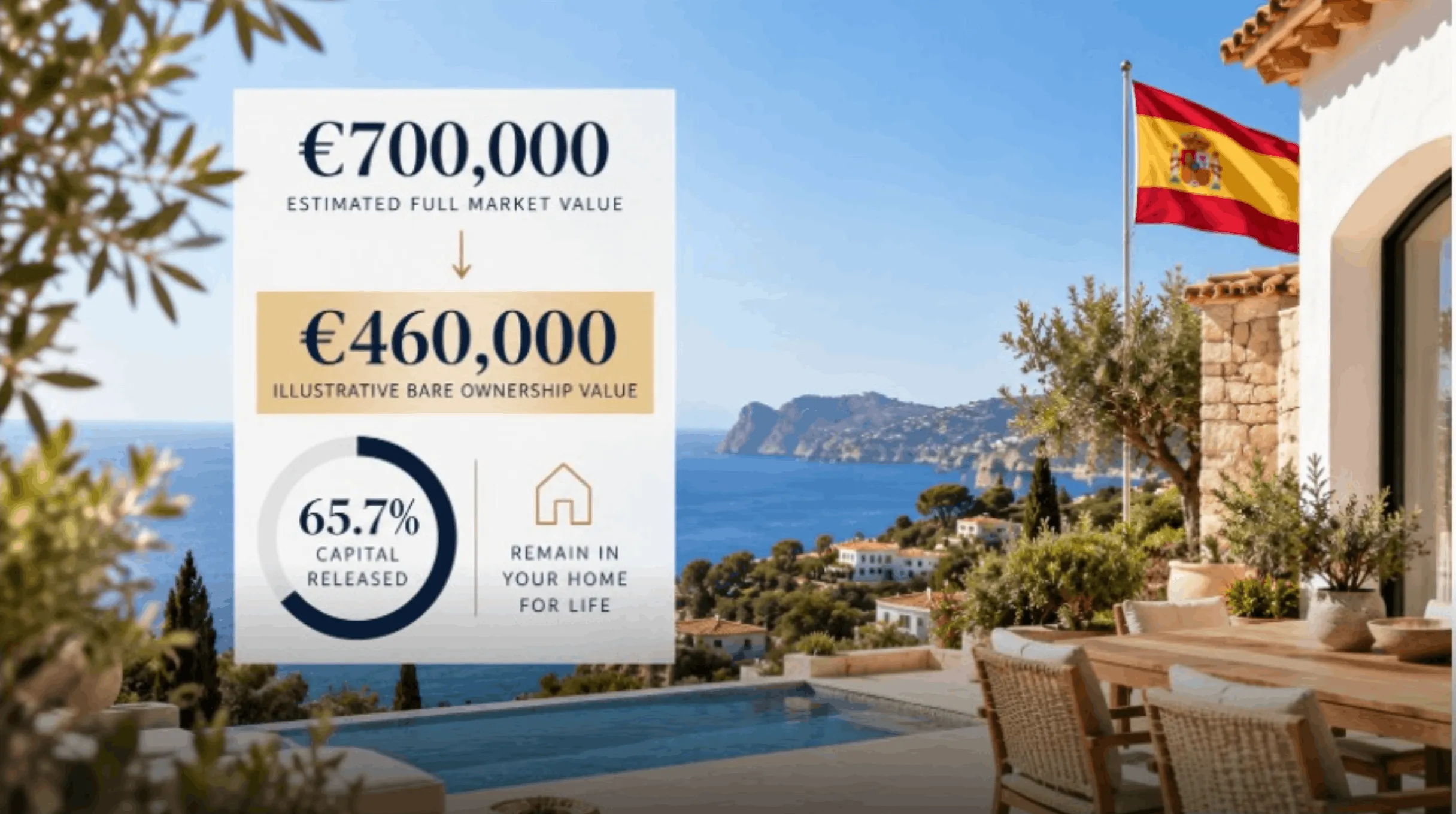
The villa has approximately 155 m² of built area on a plot of around 830 m², with three bedrooms, two bathrooms, a private pool and storage. For the purposes of this illustrative example, its estimated conventional market value is €700,000. Following an assessment of the property, the owners’ circumstances, the rights they wish to retain and the relevant economic and investment considerations, assume that its bare ownership could be positioned at approximately €460,000.
In this example, the owners could therefore potentially convert approximately 65.7% of the current market value of their home into capital, while retaining the agreed lifetime right to continue living there. The economic value associated with the retained rights would represent the remaining 34.3%. This distinction is important because the difference between the €700,000 full market value and the €460,000 bare ownership value should not simply be understood as a discount or loss. The owners continue to receive an economic benefit through their occupation of the property, while the purchaser accepts that full possession may only become available at a later stage.
However, 65.7% is specific to this illustrative case and should not be treated as a general rule. Another property, another owner profile or a different arrangement regarding the rights retained by the sellers could produce a materially different result. This is precisely why knowing the conventional market value of a home is only the first stage in determining what its bare ownership might actually be worth.
There are different ways of attributing values to usufruct and bare ownership for legal or tax purposes, but a theoretical or tax valuation does not necessarily represent the price that an investor would be willing to pay in the market. For a homeowner considering a sale, the more useful question is not simply what percentage a particular formula attributes to the bare ownership, but what amount could realistically be achieved under the proposed structure.
This is also why valuation should take place before the property is marketed. Beginning with an arbitrary offer or applying a general percentage reduction to the property’s value can leave an owner negotiating without knowing whether the proposed figure properly reflects the property, the rights being retained or their own financial objectives. Instead, the process should begin by establishing the property’s realistic market value and then assessing the proposed retained rights and the economic factors affecting the bare ownership. Only once the owners understand the likely financial outcome do they need to decide whether proceeding with a sale makes sense for them.
Importantly, obtaining that assessment does not require an owner to commit to selling. For someone who has lived in the same Spanish home for many years, changing the ownership structure can be a significant financial and personal decision. Establishing an indicative bare ownership value first allows the owners to compare the capital that could potentially be released with the rights they would retain and decide whether the arrangement fits their retirement, lifestyle, family or succession objectives.
At Corelex Global, a bare ownership assessment therefore begins with the owners’ objectives and the property itself. Once the property’s current market value has been established, the rights the owners intend to retain and the economic and investment considerations surrounding the transaction can be assessed. This provides the basis for an indicative value and appropriate market positioning. If the owners then decide to proceed, the process can move into marketing and investor identification, negotiation, legal structuring, taxation and eventual completion.
For international homeowners who have owned Spanish property for many years, bare ownership can offer an alternative way of approaching wealth tied up in the home. However, the decision should begin with understanding the numbers rather than deciding to sell first. A €700,000 property may produce a very different result depending on who owns it, what rights they wish to retain and how attractive the resulting investment is to the market.
If you own a property in Spain and are considering releasing part of its value while retaining the right to remain in your home, Corelex Global can prepare a Bare Ownership Valuation & Strategy Assessment. The assessment provides an initial analysis of the property’s current market value, the rights you wish to retain, the factors affecting its bare ownership value, an indicative transaction range, recommended market positioning and the principal legal and tax considerations before proceeding.
You do not need to decide today whether to sell. The first step is to understand what the transaction could realistically mean for you.
Do you have a legal matter or need advice in Spain? Let us review your circumstances and discuss the legal and tax considerations relevant to your case in a free 30-minute consultation.
Contact us at hello@corelexglobal.com.
Stay connected and receive our legal and tax updates for foreign investors in Spain, insights into the Spanish real estate and investment markets, practical guides and expert analysis, as well as invitations to exclusive webinars with lawyers, tax advisors and real estate professionals.
Subscribe here → https://corelexglobal.com/stay-connected/

posted 16 minutes ago

posted 19 minutes ago

posted 33 minutes ago

posted 35 minutes ago

posted 47 minutes ago

posted 55 minutes ago

posted 2 hours ago

posted 2 hours ago
posted 2 hours ago

posted 2 hours ago

posted 2 hours ago
posted 2 hours ago
No results available
Find the right Legal Expert for your business

Send welcome message