
Last updated: Oct 2026
Pollution incident notification norway is one of the most time-critical compliance duties facing industrial and waste operators, and the margin for delay is narrow. Norway enjoys a reputation as an environmentally conscientious country, yet the enforcement reality facing operators has sharpened considerably as the Norwegian Environment Agency (Miljødirektoratet) steps up scrutiny and aligns its practice with wider European environmental policy, including the European Commission’s Environmental Implementation Review. This practitioner-led guide translates the statutory obligations under the Pollution Control Act (Forurensningsloven) and the Pollution Regulations (Forurensningsforskriften) into a prioritised sequence of on-site actions, notification steps and documentary requirements. The aim is simple: to help you act lawfully within minutes, not days, and to limit enforcement exposure.
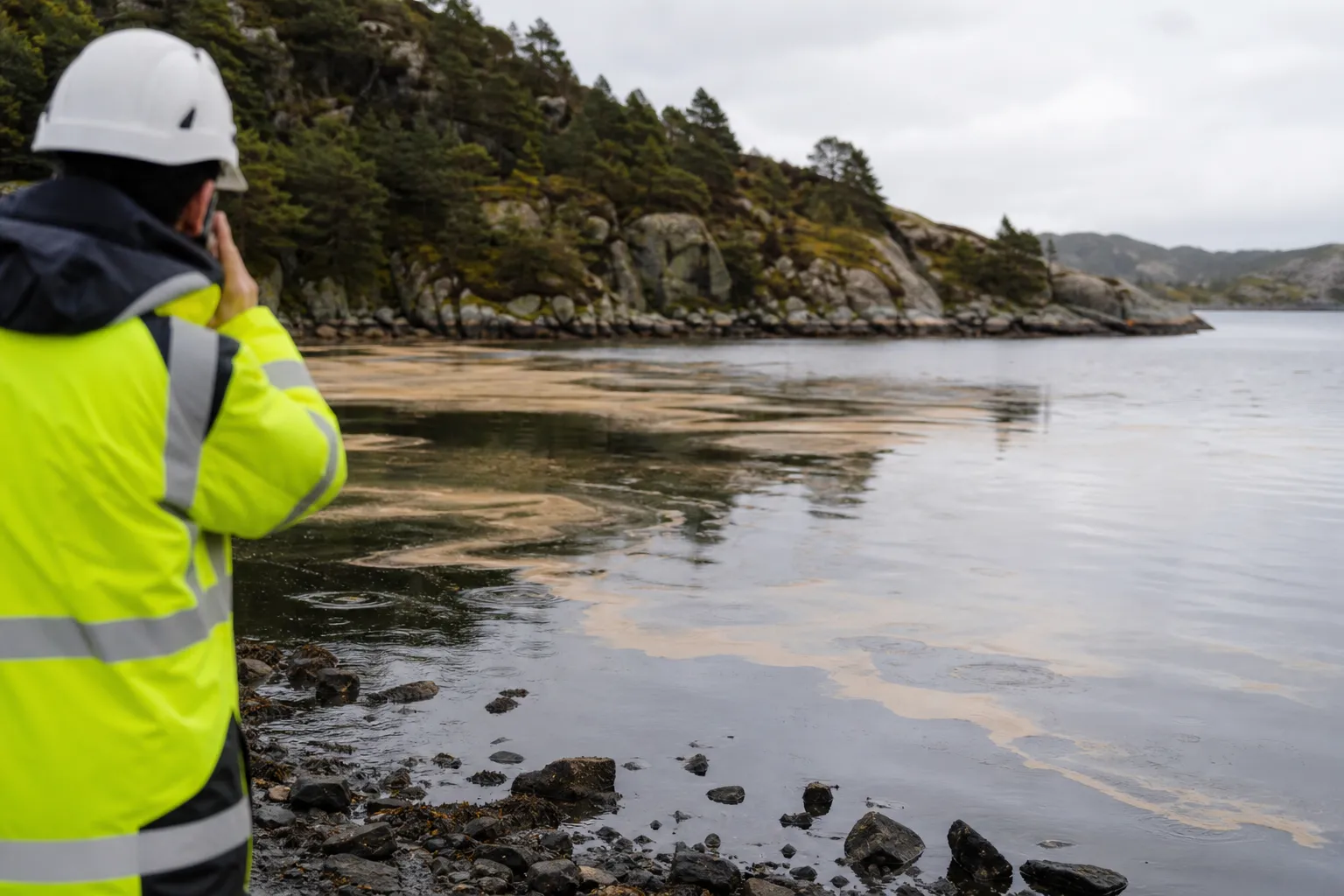
Under Forurensningsloven, the concept that drives urgent reporting is akutt forurensning, acute pollution. This covers any sudden, unplanned release of a substance that threatens, or may threaten, human health or the environment. The duty to notify arises from the Act’s general prohibition on pollution and its linked notification and remediation obligations (notably the duty to avert and limit pollution and the duty to notify the relevant authority of acute pollution), supplemented by the detailed provisions of Forurensningsforskriften. In practice, pollution incident notification norway rules bite across a broad range of release types, and the common thread is that the operator must act without waiting for the situation to be fully understood.
Covered incidents include, among others:
The practical threshold is whether the release could cause harm beyond the immediate point of discharge. If off-site effects are possible, contamination of a watercourse, soil, protected habitat or neighbouring property, the notification duty should be treated as engaged.
This guide is written for the people who have to make decisions in the first minutes: site operators, EHS managers, spill-response leads at waste facilities, and the in-house counsel who must assess legal exposure. It assumes you need to act before every fact is known, which is exactly the position the law expects you to manage competently.
The core duty falls on the party responsible for the activity or installation causing the pollution. Under Forurensningsloven, the polluter bears the primary obligation both to notify and to take measures to avert or limit damage. Pollution reporting duties are not discharged by assuming that someone else, a contractor, the municipality or the fire service, will make the call.
Where a contractor physically causes a release on your site, the operator holding the permit or controlling the activity generally retains the legal reporting duty. Contractual allocation of responsibility between operator and contractor does not override the statutory duty owed to the authorities. The practical rule: if it is your site or your permitted activity, assume the notification duty is yours and notify. Clarify contractor responsibilities for clean-up and cost-sharing separately, after the regulator has been informed.
Waste operators carry heightened responsibilities. Permits for landfills, treatment facilities and transfer stations typically impose specific monitoring, record-keeping and reporting conditions under Forurensningsforskriften. A leachate breach, an uncontrolled emission from a treatment process, or a spill during waste transport will usually trigger both the general acute-pollution duty and permit-specific reporting obligations. Waste operators should map their permit conditions against the statutory baseline so that no reporting trigger is missed.
This is the operational heart of pollution incident notification norway compliance. The sequence below is organised by urgency, minutes, hours, then days. Work through it in order, but run safety, containment and evidence steps in parallel where you have the people to do so.
| Step | Who (responsible) | Typical duration / deadline |
|---|---|---|
| 1. Ensure human safety & call emergency services | On-site supervisor / EHS; call 110 (fire/rescue) | Immediately (minutes) |
| 2. Stop source & secure site (if safe) | Plant operator / technical crew | Immediately (minutes–1 hour) |
| 3. Contain pollutant spread (booms, bunds) | EHS / spill response team / contractor | Within 1 hour |
| 4. Record evidence (photos, measurements) | EHS / site manager | Within 1–2 hours |
| 5. Notify internal incident team & legal counsel | EHS manager / in-house counsel | Within 1–2 hours |
| 6. Notify authorities (initial alert by phone) | Operator / duty officer | Immediately / as soon as possible |
| 7. Submit initial written notification | Operator / environmental officer | As soon as practicable |
| 8. Follow-up reports & remediation plan | Operator, environmental consultant | As set by the authority / per severity |
| 9. Remediation & monitoring | Operator / contractor / permitting authority | Ongoing, per permit conditions |
| 10. Incident review & corrective actions | Management / EHS / legal | 30–90 days post-incident |
Treating this timeline as a drill, rehearsed before an incident, is what separates operators who manage pollution incident notification norway duties well from those who face avoidable enforcement.
| Incident type / priority | Notify (primary) | Secondary / other contacts | Timing |
|---|---|---|---|
| Acute oil/chemical release to the sea or coastal waters | Norwegian Coastal Administration (Kystverket) 24-hour emergency line + 110 | Local municipality, State Administrator (Statsforvalteren), Norwegian Environment Agency, DSB (hazardous substances) | Immediately; written follow-up as soon as practicable |
| Acute inland/site release to watercourse or soil | Fire and rescue service (110) + relevant pollution authority (Miljødirektoratet / Statsforvalteren) | Local municipality, DSB (hazardous substances) | Immediately |
| Air emission causing acute health risk | Emergency services (110 / 113 medical) | Municipal environmental/health authority, relevant pollution authority | Immediately |
| Minor on-site spill contained internally | Site operator log; notify pollution authority if off-site effects possible | Municipal environmental office | As soon as practicable if off-site impact suspected |
You can prepare for environmental emergency reporting Norway situations in advance by building a supporting incident response plan, see our planned guide, How to Prepare an Environmental Incident Response Plan in Norway, for checklists and templates.
Good documentation is the backbone of any defensible notification. The authority, your insurer and, in the worst case, a court will judge your response largely on the records you produce. Assemble the following as the incident unfolds, not afterwards.
| Document / form | Mandatory? | Purpose / what to include | Who prepares |
|---|---|---|---|
| Initial incident notification (phone + written confirmation) | Yes | Brief facts, location, time, pollutant type, volume estimate, immediate measures taken | Operator / environmental officer |
| Site plan / map showing release point & receptors | Yes (for follow-up) | Exact coordinates, sensitive areas (watercourses, reserves) | EHS / consultant |
| Photographic and video evidence (time-stamped) | Strongly recommended | Visual record of release and containment actions | On-site staff |
| Measurement / sampling results (water/soil/air) | As available / required | Lab results, instrument readings, chain-of-custody | Environmental lab / contractor |
| Witness statements and crew logs | Recommended | Names, roles, times, actions taken | Supervisor / HR |
| Incident log (chronology) | Yes (enforcement & insurance) | Minute-by-minute chronology of events and decisions | Operator / incident commander |
| Temporary & full remediation plan | Required for larger incidents | Proposed measures, timelines, responsible parties | Operator / environmental consultant |
| Permits, authorisations & prior monitoring reports | Relevant for permitted activities | Permit limits and compliance history | Operations / permit holder |
| Communications log (authorities, media) | Recommended | Copies of emails, time and content of phone calls | Communications / legal |
A one-page printable notification template and a chronology checklist are invaluable here: keep them pre-filled with your site coordinates and emergency contacts so that, when an incident occurs, staff only have to complete the variable fields.
Forurensningsloven and Forurensningsforskriften together set the framework. The duty to avert and limit pollution, and to notify the authorities, is immediate where acute pollution occurs. Translating the legal text into operational practice produces the practical schedule operators should plan around.
For acute releases that threaten health or the environment, notification must be made immediately, in practice, by phone to the relevant authority as soon as the incident is identified and safety is assured. An initial written confirmation should follow as soon as practicable. More detailed follow-up reporting, including measurement data and an assessment of impacts, is expected within the timeframe set by the authority and in accordance with any applicable permit conditions. Waste operators should check whether permit conditions impose shorter or more prescriptive timelines, and confirm the required reporting format with the authority.
For larger incidents, a remediation plan will be required, and the authority will set a deadline reflecting the scale of contamination, followed by ongoing monitoring tied to permit conditions. Any permit amendments arising from the incident should be addressed in the post-incident review window of roughly 30 to 90 days. Because deadlines are set case-by-case by the regulator, confirm the specific dates in writing rather than relying on generic timeframes.
The financial consequences of a pollution incident extend far beyond clean-up. Direct response costs, remediation, administrative sanctions and potential civil liability can combine into significant exposure, and failure to notify promptly tends to aggravate every category.
| Cost type | Typical payer | Notes |
|---|---|---|
| Notification | Operator | No specific filing fee for an initial acute-pollution notification, verify current practice with the relevant authority |
| On-site emergency response & containment | Operator / insurer | Highly variable with the scale of the release |
| Remediation & monitoring | Operator / polluter | Project-specific, depending on the extent of contamination |
| Coercive fines (tvangsmulkt) & other sanctions | Operator | Set under Forurensningsloven and enforcement practice, amounts vary by case and severity |
| Civil claims / third-party damages | Operator (potentially insured) | Depends on damage to property, environment, third parties |
| Legal costs (defence, permits, appeals) | Operator | Variable, budget for external counsel if enforcement is threatened |
Forurensningsloven provides for enforcement measures including orders to remediate and coercive fines (tvangsmulkt), and aggravated cases can carry criminal liability. Because exact amounts are set case-by-case, operators should not assume a release is “too small to matter.” For an in-depth treatment of post-incident exposure, see our planned article on Environmental Liability and Remediation Obligations after a Pollution Incident in Norway (2026).
A notable feature of the current environment is a firmer enforcement posture. The Norwegian Environment Agency has prioritised compliance across industrial and waste sectors, and Norwegian environmental practice develops alongside wider European policy, including the European Commission’s Environmental Implementation Review, which tracks how environmental law is applied and enforced across the EU/EEA. The practical consequences for operators are tangible: prompt investigation following an incident, close scrutiny of remediation plans, and limited tolerance for late or incomplete notification.
Operators sometimes ask which country has the strongest environmental laws, and Norway is widely regarded as having a rigorous environmental regime. That reputation carries real operational weight, regulators expect the systems behind the reputation to work. In practice, a well-documented, prompt response is best treated as the baseline expectation rather than a mitigating bonus. Pollution incident notification norway compliance should therefore be audited and rehearsed before, not during, an incident.
Most enforcement problems trace back to a handful of avoidable errors. Address these in advance:
Effective pollution incident notification norway compliance comes down to speed, documentation and discipline: protect people first, stop and contain the source, record everything, notify the authorities immediately, and submit written reports as required. With enforcement active in 2026, a rehearsed response and pre-prepared templates are the best defence against fines and liability. If you face imminent enforcement action or need rapid legal advice after an incident, use our directory to Find environmental lawyers in Norway, and explore our Norway, Environmental practice area for related guidance.
This article is general guidance and not legal advice. For advice on a specific incident, contact a qualified Norwegian environmental lawyer.
This article was produced by Global Law Experts. For specialist advice on this topic, contact Cathrine Hambro at BULL, a member of the Global Law Experts network.

posted 37 minutes ago

posted 37 minutes ago

posted 57 minutes ago

posted 1 hour ago

posted 1 hour ago

posted 2 hours ago

posted 2 hours ago

posted 3 hours ago

posted 3 hours ago

posted 3 hours ago

posted 4 hours ago

posted 4 hours ago
No results available
Find the right Legal Expert for your business

Send welcome message