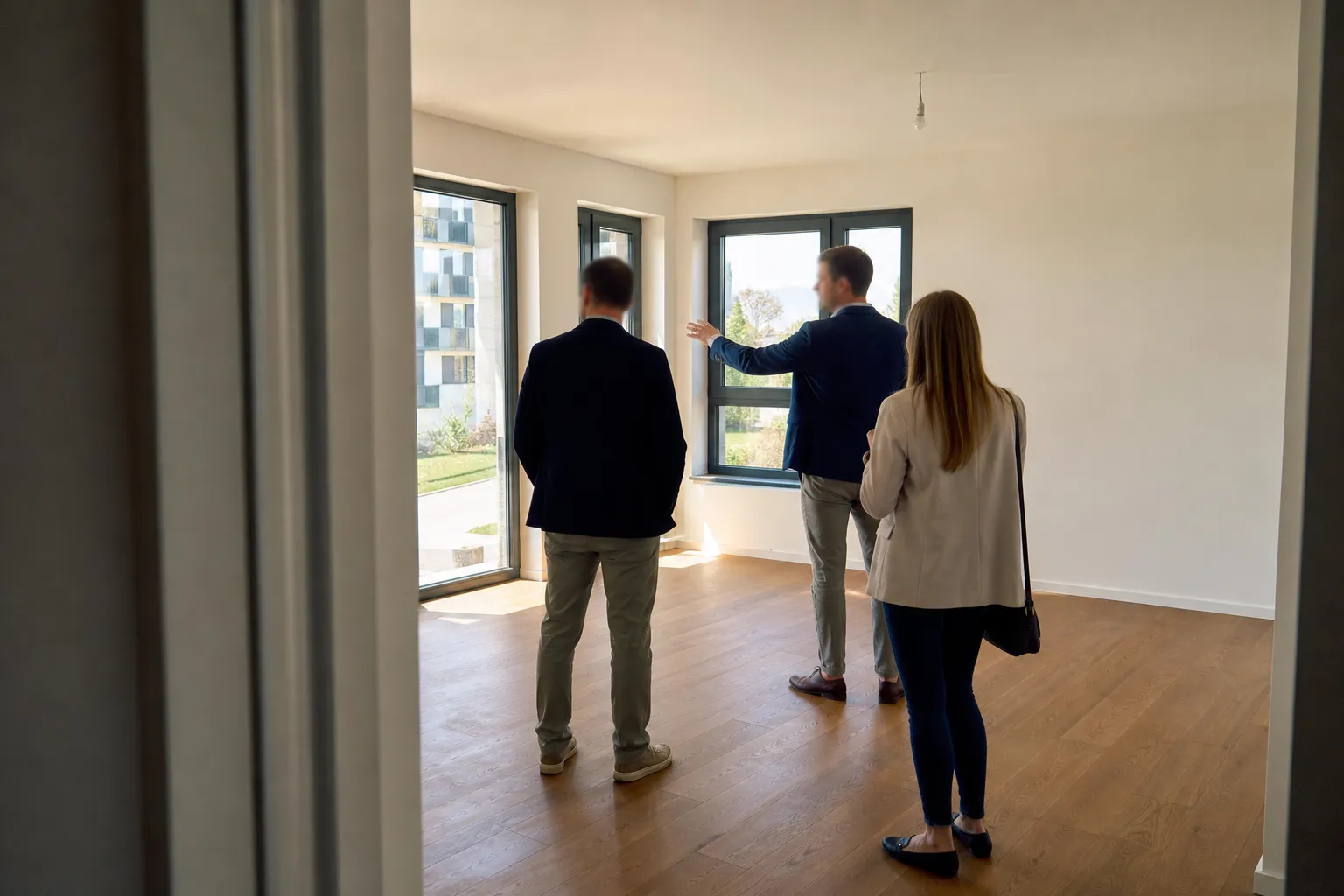
Buying from a developer Czech Republic transactions follow a recognisable path, reservation, purchase contract, staged payments, construction, handover and warranty, but the detail at each stage determines whether your money is protected. In 2026 two regulatory developments make fresh guidance essential: tightened verification procedures for lawyer-held escrow (advokátní úschova) and the continuing rollout of the new Building Act. Whether you are a local buyer, an investor or a foreign purchaser unfamiliar with the Czech cadastral system, this guide walks you through each step, flags the clauses and documents to insist on, and sets out exactly when to instruct counsel. Read it before you sign anything, including a reservation agreement.
Buyers (local and foreign), investors, and advisers purchasing an off‑plan or newly built apartment from a developer in the Czech Republic.
Off‑plan purchases carry more risk than buying a completed, registered property because you are paying for something that does not yet exist. That said, buying from a developer Czech Republic deals are routinely completed safely when buyers use the protections available under the Civil Code (Act No. 89/2012 Coll.) and structure payments properly. The safety of any given transaction depends less on the market and more on four variables: the financial strength of the developer, the state of the title, the planning and permit status, and how your money is secured between signature and handover.
Each risk has a practical counter-measure. Before any payment, pull a cadastral extract through the Czech cadastre’s online portal (ČÚZK, nahlizenidokn. cuzk. cz) to confirm ownership and check for encumbrances. Tie your money to secured mechanisms, lawyer escrow, a bank guarantee or an insurer bond, rather than paying directly into a developer account. Build contractual milestones so that payments track construction progress, and negotiate penalty clauses for delay. For foreign buyers especially, engaging a Czech real estate lawyer at the reservation stage is the single most effective risk reduction, because the lawyer verifies the escrow, reads the standard-form contract against the consumer protection rules enforced by the Czech Trade Inspection Authority (ČOI), and confirms title.
Done properly, buying from a developer Czech Republic is a manageable transaction rather than a gamble.
The reservation agreement (rezervační smlouva) is the first binding document in most developer sales, and it is where many buyers give away leverage without realising it. A reservation agreement Czech Republic buyers sign typically takes the unit off the market, fixes the price and sets a deadline to conclude the full purchase contract, but the terms vary enormously between developers. Treat it as a real contract, not a formality.
At a minimum, your reservation agreement should address:
“The Reservation Fee of CZK [amount] shall be credited in full against the Purchase Price upon execution of the Purchase Agreement. If the Developer fails to present the Purchase Agreement for signature by [date], or fails to satisfy the Conditions Precedent set out in Clause [X], the Buyer may withdraw and the Developer shall refund the Reservation Fee in full within [14] days.” This wording is a template only and must be adapted by a Czech lawyer to your transaction and to the Civil Code (Act No. 89/2012 Coll.).
Walk carefully if you see open-ended completion dates, a fee that is forfeited even when the developer defaults, vague “practical completion” language, or a clause allowing unilateral price increases. Standard-form developer contracts are subject to the Civil Code’s rules on unfair terms and to consumer protection oversight by ČOI; a term that creates a significant imbalance to the buyer’s detriment can be challenged. When the reservation sum is large or the mechanics are unusual, that is your cue to instruct counsel before signing.
How you secure your money is the most important protection in any off-plan purchase. The core question is simple: if the developer collapses after you have paid, do you get your money back or your apartment delivered? The three mainstream mechanisms are lawyer escrow (advokátní úschova), a bank guarantee (bankovní záruka), and an insurer bond, with payment into the developer’s own account being the least protected and best avoided for substantial sums. In addition to lawyer escrow, funds may also be held in notarial escrow (notářská úschova) or bank escrow (bankovní úschova).
Advokátní úschova means your funds are held by a lawyer in a dedicated client account and released only when agreed conditions are met, typically registration of your title in the cadastre. The Czech Bar Association (Česká advokátní komora, ČAK) regulates lawyers holding client funds, and in 2026 the verification expectations around these escrows have tightened: buyers and their advisers can seek confirmation of the escrow from both the holding bank and the Bar before releasing funds. A bank guarantee, by contrast, is the bank’s undertaking to pay you a defined sum if the developer defaults; the Czech National Bank (ČNB) supervises the prudential framework within which banks issue such instruments.
An insurer bond operates on a similar principle through an insurance product.
| Method | Who holds funds | Buyer protection if developer insolvent | Timing of release | Practical downsides |
|---|---|---|---|---|
| Advokátní úschova (lawyer escrow) | Regulated lawyer, in a dedicated client account | Strong, funds sit outside the developer’s estate and release only on agreed conditions | On cadastral registration or defined milestones | Requires 2026 verification steps; lawyer fee applies |
| Bank guarantee (bankovní záruka) | Issuing bank (funds flow to developer) | Strong, bank pays out on default, independent of developer | On demand per guarantee terms | Cost borne somewhere in the deal; terms must be read precisely |
| Insurer bond | Insurer backs performance; funds flow to developer | Moderate to strong, depends on policy terms and exclusions | On insured event per policy | Coverage gaps and exclusions can limit recovery |
| Developer account (direct payment) | Developer | Weak, advances rank as unsecured claims in insolvency | Per contract, no independent gate | Highest risk; avoid for large advances |
With the 2026 verification tightening, confirming a lawyer escrow is no longer a matter of taking the developer’s word. Follow these steps before releasing any funds:
A bank guarantee or insurer bond can be preferable where the developer requires funds to flow into its own accounts to finance construction, but you still need protection against default. Here the independent payer, the bank or insurer, stands behind the developer. Read the guarantee or policy wording for the trigger events, the demand procedure and any exclusions; a developer escrow Czech Republic arrangement is only as good as its release conditions and the solvency of whoever backs it.
Even with good contracts, developers sometimes stop work, breach deadlines or become insolvent. Your position then depends almost entirely on what you negotiated and how your payments were secured. Developer insolvency protection in the Czech market rests on a combination of contractual remedies and the statutory framework of the Civil Code (Act No. 89/2012 Coll.) and the Insolvency Act (Act No. 182/2006 Coll.).
Where the developer breaches, the Civil Code gives the non-breaching party remedies including withdrawal from the contract, claims for damages, and in some circumstances performance remedies, though compelling a distressed developer to complete a building is rarely realistic in practice. This is why your real protection is the payment-security layer: if funds sit in advokátní úschova and release only on registration, they are insulated from the developer’s estate; if you hold a bank guarantee, you call on the bank. Advances paid directly to a developer, by contrast, generally rank as ordinary unsecured claims in insolvency proceedings, which means slow and partial recovery at best.
Contractual breach, warranty of defects and damages are governed by the Civil Code (Act No. 89/2012 Coll.), while the building, permitting and completion process is governed by the new Building Act (Act No. 283/2021 Coll.), which replaced the former Building Act (Act No. 183/2006 Coll.) and has been phased into effect, with the full regime applying from 1 July 2024. Its permitting and completion procedures bear directly on when a developer can lawfully hand over and register a unit. Buyers should read the detail alongside the Czech Building Act amendment analysis, which sets out the regulatory implications in depth. Confirm any effective dates against the consolidated statutory text before relying on them.
Handover is the moment the apartment becomes yours in a practical sense, and a thorough practical completion inspection Czech buyers carry out at this stage is your last clean opportunity to force the developer to fix defects before you take occupation. Distinguish two concepts: practical completion, the building is finished and usable, and legal completion, which includes the occupancy approval (kolaudace) and the registration of your title in the cadastre. Do not treat practical completion as the end of the process.
Before you sign the handover protocol, inspect the unit, ideally with an independent surveyor or engineer rather than relying on the developer’s representative. Record every defect, however minor, on a snagging list and attach it to the protocol. Also collect the documentation you are entitled to: as-built drawings, the energy performance certificate, operation and maintenance manuals, warranty documents for installed equipment, and confirmation of the occupancy approval (kolaudace) where applicable.
A practical snagging list Czech Republic buyers can adapt includes, by area:
The handover protocol (předávací protokol) is the central record. Both parties sign it; it should list the snagging items, the agreed remediation deadlines, the meter readings and the documents handed over. Never sign a “clean” protocol if defects exist, the recorded list is your evidence and leverage for the subsequent warranty claims. Retain a signed copy and photograph every defect on the day.
After handover, your protection shifts to the warranty regime. The defects warranty period Czech Republic buyers rely on derives from the Civil Code (Act No. 89/2012 Coll.), supplemented by any longer contractual warranty the developer offers. Distinguish between obvious surface defects, which should be recorded at handover, and latent defects, which only become apparent later but remain claimable within the applicable time limits.
To preserve your rights, notify the developer of each defect promptly and in writing, describing it precisely and requesting the remedy. Collect evidence, photographs, dated correspondence and, for significant defects, an independent expert report. Typical outcomes are repair, a reasonable price reduction, or, for serious defects, withdrawal from the contract. The appropriate remedy depends on the gravity of the defect under the Civil Code.
If the developer denies liability, misses repair deadlines or offers inadequate remedies, escalate. The route, litigation before the Czech courts or arbitration, depends on the dispute-resolution clause in your contract. Before escalating, ensure your written notices and evidence are complete; a well-documented file materially strengthens your position and often prompts settlement without a hearing.
Many buyers assume they only need a lawyer at signing. In practice, the highest-value involvement is earlier, at the reservation stage, where the terms that determine your protection are set. Instruct counsel without delay in any of the following situations.
When to call your lawyer, trigger list
A standard buyer instruction covers title and encumbrance verification via the cadastre, review and negotiation of the reservation and purchase agreements, escrow verification, handover and snagging support, and registration of title. Fees are commonly fixed for defined transactional scope or charged on an hourly basis for negotiation-heavy or disputed matters. You can find qualified advisers through the Real Estate practice listings for the Czech Republic.
Collect and verify the following before and during your purchase. Independent verification matters more than the developer’s assurances.
Buying from a developer Czech Republic is entirely achievable on safe terms, provided you treat each stage, reservation, payment security, construction, handover and warranty, as a point where your protection is either secured or lost. In 2026, two things deserve particular attention: the tightened verification procedures for advokátní úschova, which mean you should confirm any escrow with the bank and the Czech Bar Association before releasing funds, and the new Building Act regime, which reshapes permitting and completion. Verify title in the cadastre, insist on secured payments, negotiate clear deadlines and refund mechanics, inspect thoroughly at handover, and document every defect.
When the reservation sum is significant, the payment structure is unusual, or you are buying from abroad, instruct a Czech real estate lawyer early, it is the most reliable way to make buying from a developer Czech Republic a secure investment rather than a risk.

This article was produced by Global Law Experts. For specialist advice on this topic, contact Martina Kačerová at Caring Legal, a member of the Global Law Experts network.