
Author
No results available
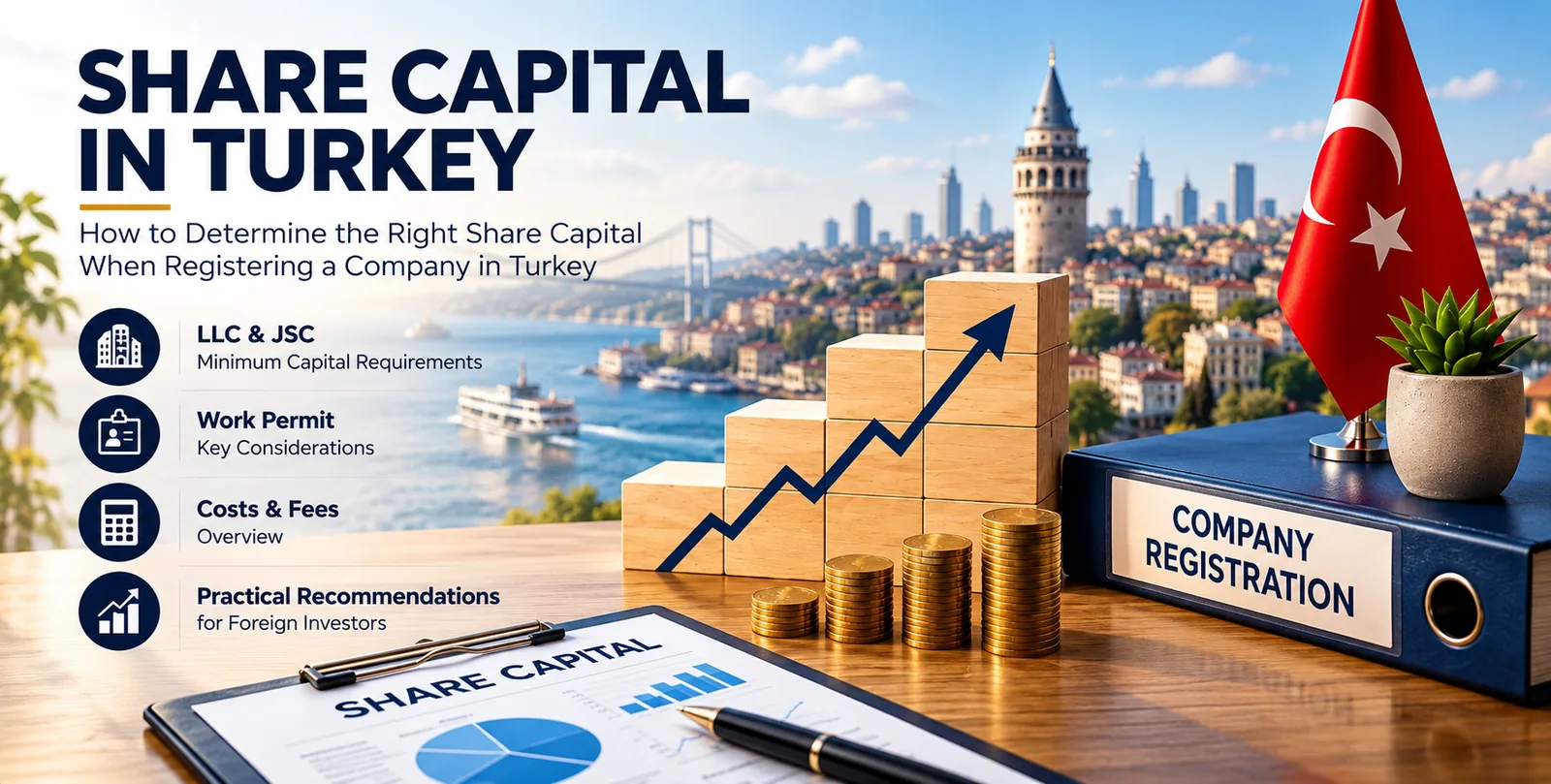
Share capital in Turkey is one of the most important considerations for foreign investors establishing a company in Türkiye. The required amount depends primarily on the company’s legal structure, while the appropriate amount of capital should also reflect the business model, operating costs, licensing requirements, financing plans and future investment objectives.
As of 2026, the statutory minimum share capital is TRY 50,000 for a Limited Liability Company (Ltd. Şti.) and TRY 250,000 for a Joint Stock Company (A.Ş.). A sole proprietorship, branch office and liaison office do not have a statutory minimum share capital requirement.
However, the legal minimum should not automatically be treated as the recommended capital for every business. Foreign investors should determine their capital structure based on both legal requirements and actual business needs.
The minimum share capital required depends on the type of business entity:
| Business Structure | Minimum Share Capital |
|---|---|
| Limited Liability Company (Ltd. Şti.) | TRY 50,000 |
| Joint Stock Company (A.Ş.) | TRY 250,000 |
| Sole Proprietorship | No statutory minimum |
| Branch Office | No statutory minimum |
| Liaison Office | No statutory minimum |
For an LLC, the committed capital does not have to be paid before registration and can generally be paid within 24 months following incorporation. For a JSC, at least 25% of the subscribed cash capital must generally be paid before registration, with the remaining amount payable within 24 months.
Share capital is the amount that shareholders commit to contribute to a company in exchange for ownership shares.
The capital is stated in the company’s Articles of Association and forms an important part of its legal and financial structure.
Share capital should not be confused with:
Once contributed to the company in accordance with the applicable legal requirements, capital can generally be used to finance legitimate business activities.
Typical uses include:
For foreign investors, capital planning should therefore be considered as part of the overall company formation strategy, rather than simply as a registration formality.
For European companies planning to establish a presence in Turkey, share capital is only one part of the overall market-entry process. Legal structure, taxation, banking, employment and ongoing compliance should also be considered before starting operations. A practical overview of these considerations is available in EU Business News’ guide, Expanding into Turkey: A Practical Guide for European Companies.
The statutory minimum share capital for a Turkish Limited Liability Company (Ltd. Şti.) is TRY 50,000.
Unlike a JSC, an LLC does not generally require a portion of its capital to be deposited before registration. The subscribed capital can be paid within 24 months following registration.
This makes the LLC a common structure for foreign investors establishing small and medium-sized commercial businesses in Turkey.
The statutory minimum share capital for a Turkish Joint Stock Company (A.Ş.) is TRY 250,000.
For cash capital, at least 25% of the subscribed capital must generally be paid before registration, while the remaining amount can be paid within 24 months following registration. Alternatively, the capital may be fully paid before registration.
A JSC may be particularly relevant for businesses planning larger investments, multiple investors, investment rounds or more sophisticated capital structures.
A sole proprietorship does not have a statutory minimum share capital requirement because it is not a capital company.
However, the entrepreneur still needs sufficient financial resources to start and operate the business.
A branch office of a foreign company does not have a statutory minimum share capital requirement.
The branch remains connected to its foreign parent company and operates within the scope of the parent’s activities.
A liaison office does not have a statutory minimum share capital requirement.
However, a liaison office is non-commercial and cannot conduct commercial sales or generate commercial revenue in Turkey.
Foreign investors frequently confuse subscribed capital with paid-up capital.
Subscribed capital is the amount that shareholders legally undertake to contribute to the company.
For example, if an LLC is established with TRY 500,000 capital, the shareholders have committed TRY 500,000 to the company.
Paid-up capital is the portion of the subscribed capital that has actually been contributed by the shareholders.
Therefore:
Subscribed Capital = Capital legally committed by shareholders
Paid-Up Capital = Capital actually contributed
The distinction can become particularly important for foreign shareholders applying for work permits or meeting specific regulatory requirements.
The payment rules differ between LLCs and JSCs.
For an LLC, there is generally no requirement to pay 25% of the capital before registration.
The committed capital can be paid within 24 months after incorporation.
For a JSC, at least 25% of the subscribed cash capital must generally be deposited before registration.
The remaining amount must generally be paid within 24 months following registration.
This distinction is important when comparing the two company structures from a cash-flow perspective.
Yes.
Share capital is not a government fee paid permanently to the state. Once properly contributed to the company, it becomes part of the company’s resources.
The company can generally use its available funds for legitimate business expenses, including:
Therefore, investors should not assume that capital paid into the company simply remains blocked indefinitely.
The important point is that the company must comply with the applicable legal requirements concerning the contribution and use of its capital.
Choosing the appropriate capital can have implications beyond incorporation.
Adequate capital can help the company finance its initial operations without immediately relying on additional shareholder funding or loans.
Share capital can form part of the financial profile considered by banks when assessing a company’s overall financial position.
Certain regulated activities may require substantially higher capital than the general statutory minimum.
For example, financial services, payment institutions, insurance and other regulated sectors may be subject to sector-specific capital requirements.
Therefore, investors should not rely solely on the general TRY 50,000 / TRY 250,000 thresholds when entering a regulated industry.
Capital can also become relevant when a foreign shareholder or manager plans to apply for a Turkish work permit.
The applicable work permit requirements should be reviewed separately because the registered capital and paid-up capital may have different practical implications.
Yes.
Foreign investors are generally subject to the same statutory minimum capital requirements applicable to Turkish investors.
However, establishing a company with only the legal minimum does not necessarily mean that the company has sufficient financial resources for its planned operations.
For example, a manufacturing company may require substantial funds for:
In contrast, a small consulting company may require considerably less initial funding.
Therefore, minimum legal capital and recommended business capital are two different concepts.
There is no universal capital amount that is appropriate for every business. The following examples are intended as planning guidance rather than legal requirements.
| Business Type | Indicative Capital Planning Range |
|---|---|
| Consulting / Professional Services | TRY 100,000 – 500,000 |
| E-commerce | TRY 250,000 – 1,000,000+ |
| Trading / Wholesale | TRY 500,000 – 2,000,000 |
| Tourism | TRY 250,000 – 1,000,000 |
| Real Estate | TRY 250,000 – 2,000,000 |
| Construction | TRY 500,000 – 5,000,000+ |
| Manufacturing | TRY 1,000,000 – 10,000,000+ |
| Healthcare | TRY 500,000 – 5,000,000+ |
| Logistics | TRY 500,000 – 3,000,000 |
| FinTech / Regulated Financial Services | Subject to sector-specific rules |
These figures are business-planning examples, not statutory requirements. The actual amount should be determined according to the company’s investment plan, operating costs, regulatory requirements and expected cash flow.
Yes.
A company can increase its share capital after incorporation when additional funding is required.
Common reasons include:
A capital increase requires the appropriate corporate resolution and registration with the Trade Registry.
Yes.
A company may reduce its share capital subject to the requirements and creditor-protection procedures under Turkish company law.
Capital reduction may be considered for several reasons, including:
In some situations, capital reduction and capital increase can be structured together, subject to the applicable legal requirements and Trade Registry procedures.
This can be particularly relevant for companies with significant accumulated losses and negative equity.
Foreign investors should distinguish between share capital and shareholders’ equity.
A company can have substantial registered share capital and still have negative equity if accumulated losses exceed its equity resources.
For example:
Share Capital: TRY 1,000,000
Accumulated Losses: TRY 8,000,000
The company may therefore have a negative equity position despite having TRY 1 million of registered capital.
This is why capital planning should be considered together with the company’s financial statements and accumulated losses.
Under the applicable corporate and accounting procedures, certain shareholder receivables may potentially be converted into share capital.
This can be relevant when a foreign parent company or shareholder has provided substantial funding to its Turkish subsidiary.
Instead of leaving the amount as a shareholder receivable, the parties may evaluate whether the debt can be contributed as capital, subject to the applicable legal, accounting, valuation and Trade Registry requirements.
This structure can strengthen the company’s equity position and may be considered as part of a broader capital restructuring.
Yes.
Depending on the company type and applicable legal requirements, capital can be contributed in cash or in kind.
Potential in-kind contributions may include eligible:
In-kind contributions may require valuation and additional documentation before registration.
Turkey also has a Registered Capital System for eligible Joint Stock Companies.
Under this system, a company can establish an authorized capital ceiling and, subject to the applicable rules, allow its Board of Directors to increase issued capital up to that ceiling without obtaining shareholder approval for every individual increase.
This structure can provide greater flexibility for companies planning:
The Registered Capital System is generally relevant to Joint Stock Companies, rather than ordinary Limited Liability Companies.
The Turkish Ministry of Trade also sets specific conditions for non-public JSCs using this system.
Foreign investors can generally establish Turkish companies with 100% foreign ownership, subject to sector-specific restrictions.
The minimum capital requirements are not increased simply because the shareholders are foreign.
However, foreign investors should consider additional factors before determining the capital amount:
For this reason, capital planning should be completed before the Articles of Association are finalized.
Foreign investors commonly make the following mistakes:
The statutory minimum may allow incorporation but may not provide sufficient working capital.
Foreign shareholders planning to work in Turkey should assess work permit requirements before determining the company’s capital structure.
Registered capital does not represent the market value of the company.
Regulated sectors may require substantially higher capital.
Companies expecting rapid growth may benefit from considering their future capital requirements before incorporation.
Share capital belongs to the company and is different from incorporation fees, taxes and professional service fees.
Before establishing a company, foreign investors should consider:
Answering these questions before incorporation can help create a capital structure that is appropriate for both the company’s immediate needs and its long-term strategy.
| Feature | Limited Liability Company | Joint Stock Company |
|---|---|---|
| Minimum capital | TRY 50,000 | TRY 250,000 |
| Minimum pre-registration payment | ❌ | ✅ 25% generally required |
| Remaining capital payment | Within 24 months | Within 24 months |
| 100% foreign ownership | ✅ | ✅ |
| Separate legal entity | ✅ | ✅ |
| Registered Capital System | ❌ | ✅ Eligible JSCs |
| Suitable for investment rounds | Possible | Generally more flexible |
| Shares | Share interests | Shares |
| Public offering | ❌ | Possible subject to rules |
The choice between an LLC and a JSC should be based on the investor’s business model, financing plans, ownership structure, regulatory requirements and long-term objectives.
Determining the right share capital is an important part of establishing a company in Turkey. Choosing only the statutory minimum may not always be appropriate, particularly where the business requires substantial working capital, sector-specific licensing, foreign employee work permits or future investment.
A&M Consulting Co. assists foreign investors with company formation and capital planning in Turkey, including:
If you are planning to establish or restructure a company in Turkey, our team can assess your business model and help determine a capital structure aligned with your operational and investment objectives.
Contact A&M Consulting to discuss your share capital requirements in Turkey.

posted 13 minutes ago

posted 24 minutes ago

posted 34 minutes ago

posted 53 minutes ago

posted 1 hour ago

posted 2 hours ago

posted 2 hours ago

posted 2 hours ago

posted 2 hours ago

posted 3 hours ago

posted 3 hours ago

posted 3 hours ago
No results available
Find the right Legal Expert for your business

Send welcome message