
Author
No results available
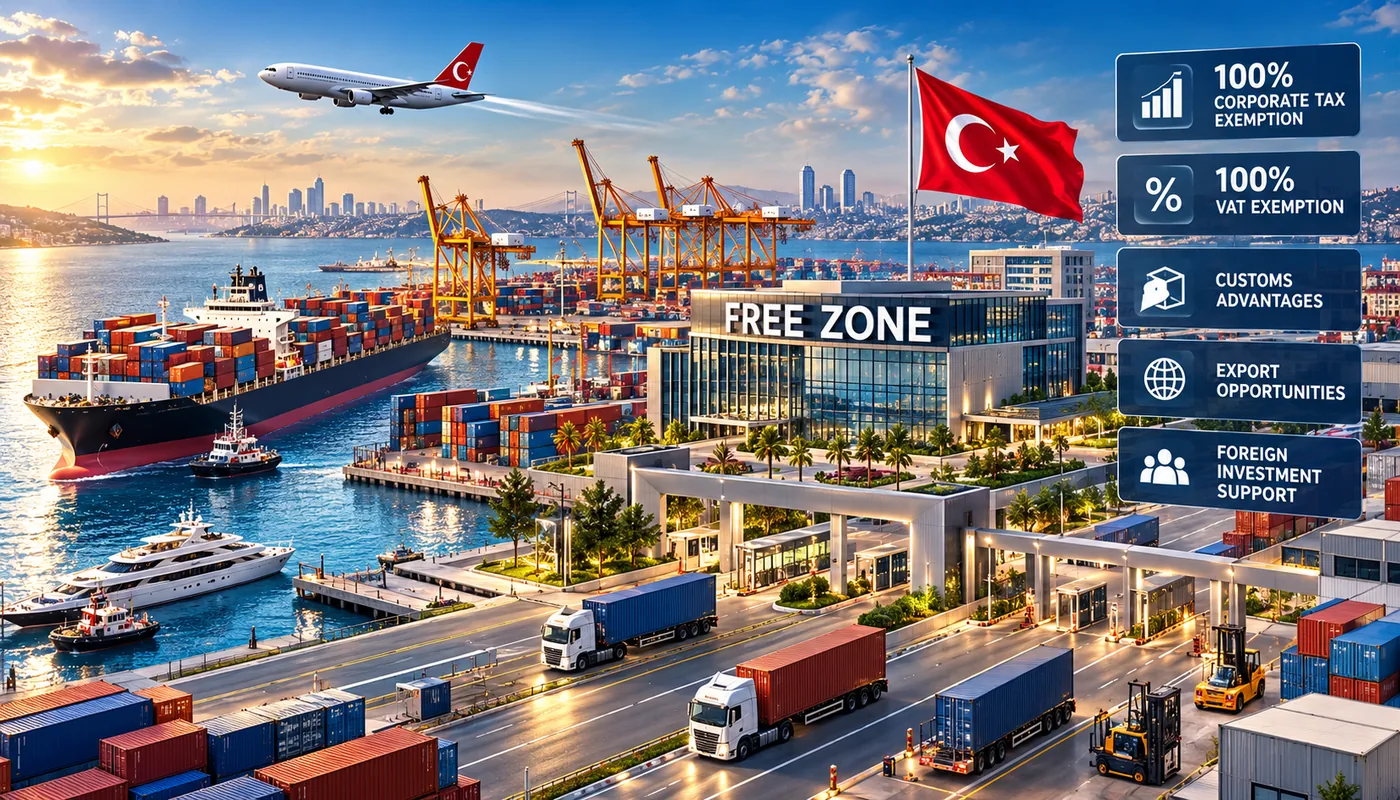
Turkey’s Free Zones have become an important platform for companies looking to combine international trade, export-oriented production, logistics and access to regional markets with a business environment designed specifically to facilitate foreign investment.
For foreign investors considering establishing a manufacturing, trading, logistics, software or other international business in Turkey, understanding how the Free Zone system works is essential before choosing a location and corporate structure.
Free Zones are specially regulated areas located within Turkey’s geographical borders but treated as outside the customs territory for specific customs and foreign trade purposes. Their primary objectives include promoting export-oriented investment and production, attracting foreign direct investment, encouraging technology transfer and developing international trade.
Turkey currently has 19 operational Free Zones, positioned near important ports, transportation networks and commercial centers. The zones support a broad range of activities, including manufacturing, R&D, software, general trading, storage, packaging, assembly, disassembly and maintenance services.
For an international company, the Free Zone structure can therefore be relevant not only for manufacturing but also for international distribution, logistics, technology and export-oriented business models.
One of the principal advantages is the combination of Turkey’s geographical position with the special regulatory framework applicable to Free Zones.
Companies can use Turkey as a production and distribution base for European, Middle Eastern, North African and other international markets while benefiting from access to ports and established transportation infrastructure.
As of January–July 2026, the 19 Free Zones recorded USD 7.7 billion in exports, while 1,934 user companies were operating in the zones, including 474 foreign companies. The zones provided direct employment to 87,655 people during the same period.
The tax treatment of Free Zone companies is an important consideration, but investors should avoid assuming that every company automatically receives a blanket tax exemption.
Under the current framework, qualifying manufacturing companies can benefit from corporate and income tax exemptions on qualifying earnings generated from sales abroad and from sales of goods produced in the Free Zone to other Free Zones, subject to the applicable conditions. Manufacturing companies exporting at least 85% of the FOB value of their Free Zone production may also benefit from an income tax exemption on employee wages.
Other advantages can include exemptions relating to stamp duties and fees for qualifying manufacturing activities, property tax exemptions, and VAT exemptions for certain logistics services supplied to third countries.
Investors should therefore evaluate available tax incentives before establishing the structure, particularly where the business will combine manufacturing, domestic sales and exports.
Free Zones can also simplify certain international trade operations.
Goods supplied from Turkey to a Free Zone are subject to the export regime, while trade between Free Zones and third countries is generally outside the normal foreign trade regime. Certain goods originating in Turkey or the EU can also benefit from customs-related advantages when moving through the relevant customs territories.
This framework can make Free Zones particularly relevant for businesses involved in:
The actual customs treatment should always be reviewed according to the nature and origin of the goods and the intended transaction structure.
There is no single Free Zone that is suitable for every investor.
The appropriate location should be selected according to the company’s:
For example, a manufacturing company with significant maritime exports may have different location priorities from a software or R&D business.
Turkey is also developing specialized Free Zone concepts aimed at technology-intensive, R&D-focused and high-value-added goods and services.
Foreign investors can establish businesses in Turkish Free Zones, subject to the applicable company formation and operating license requirements.
The first step is generally to determine the intended activity and select an appropriate Free Zone. The investor can then establish the appropriate Turkish corporate structure and proceed with the relevant Free Zone authorization.
A&M Consulting supports international investors with company registration in Turkey and can coordinate the corporate establishment process with the requirements of the selected Free Zone.
Depending on the investment structure, a foreign investor may also consider a branch office in Turkey rather than establishing a new subsidiary.
Establishing a Turkish company does not, by itself, authorize the company to conduct every type of activity within a Free Zone.
Businesses must obtain the appropriate Free Zone Operating License for their proposed activities. The application process generally involves defining the business activity, preparing the necessary documentation and business plan, and submitting the application through the relevant Free Zone authorities.
The approved activity is important because the company’s operations, premises and business model should remain consistent with the scope of its authorization.
Foreign investors should also assess whether their proposed activity requires a specific trade license in Turkey or another sector-specific authorization.
Free Zone status does not eliminate the need for proper accounting and statutory compliance.
Companies may need to manage:
Depending on the company’s legal structure, activity and statutory thresholds, Turkish electronic tax systems may also apply. These can include e-Invoice, e-Archive and e-Ledger.
A&M Consulting provides support with Electronic Tax Applications in Turkey as well as ongoing tax and accounting compliance.
Another important feature of the Turkish Free Zone regime is the ability to transfer revenues and earnings generated from Free Zone activities to Turkey or abroad without requiring specific permission under the Free Zone framework.
Operating licenses can also provide relatively long-term planning horizons. Depending on the type of user and activity, operating licenses can extend to 15 years for tenant users, 20 years for manufacturing tenant users, 30 years for investor users constructing their own premises, and 45 years for manufacturing investor users constructing their own premises.
This can be particularly relevant for investors planning manufacturing facilities or long-term export operations.
A Turkish Free Zone can be an effective structure for certain international businesses, but the decision should be based on the entire business model rather than tax incentives alone.
Before establishing a Free Zone company, investors should evaluate:
For foreign investors, obtaining professional advice before incorporation can help ensure that the corporate structure, Free Zone license, tax position and commercial activities are aligned from the beginning.
Turkey’s Free Zones provide an established framework for foreign investment, manufacturing, international trade, logistics and export-oriented businesses. With 19 operational zones, strategic access to international markets and a range of incentives for qualifying activities, they can form an important part of an international company’s Turkey strategy.
However, the benefits and obligations vary according to the company’s activity, operating license and transaction structure. A detailed assessment before establishment is therefore essential.
A&M Consulting Co. assists foreign investors with Free Zone company formation, operating license procedures, tax and accounting setup, electronic tax applications and ongoing statutory compliance in Turkey.
Contact A&M Consulting Co. for Free Zone Services in Turkey

posted 12 minutes ago

posted 34 minutes ago

posted 56 minutes ago

posted 1 hour ago

posted 2 hours ago

posted 3 hours ago

posted 3 hours ago

posted 3 hours ago

posted 3 hours ago

posted 4 hours ago

posted 5 hours ago

posted 6 hours ago
No results available
Find the right Legal Expert for your business

Send welcome message