
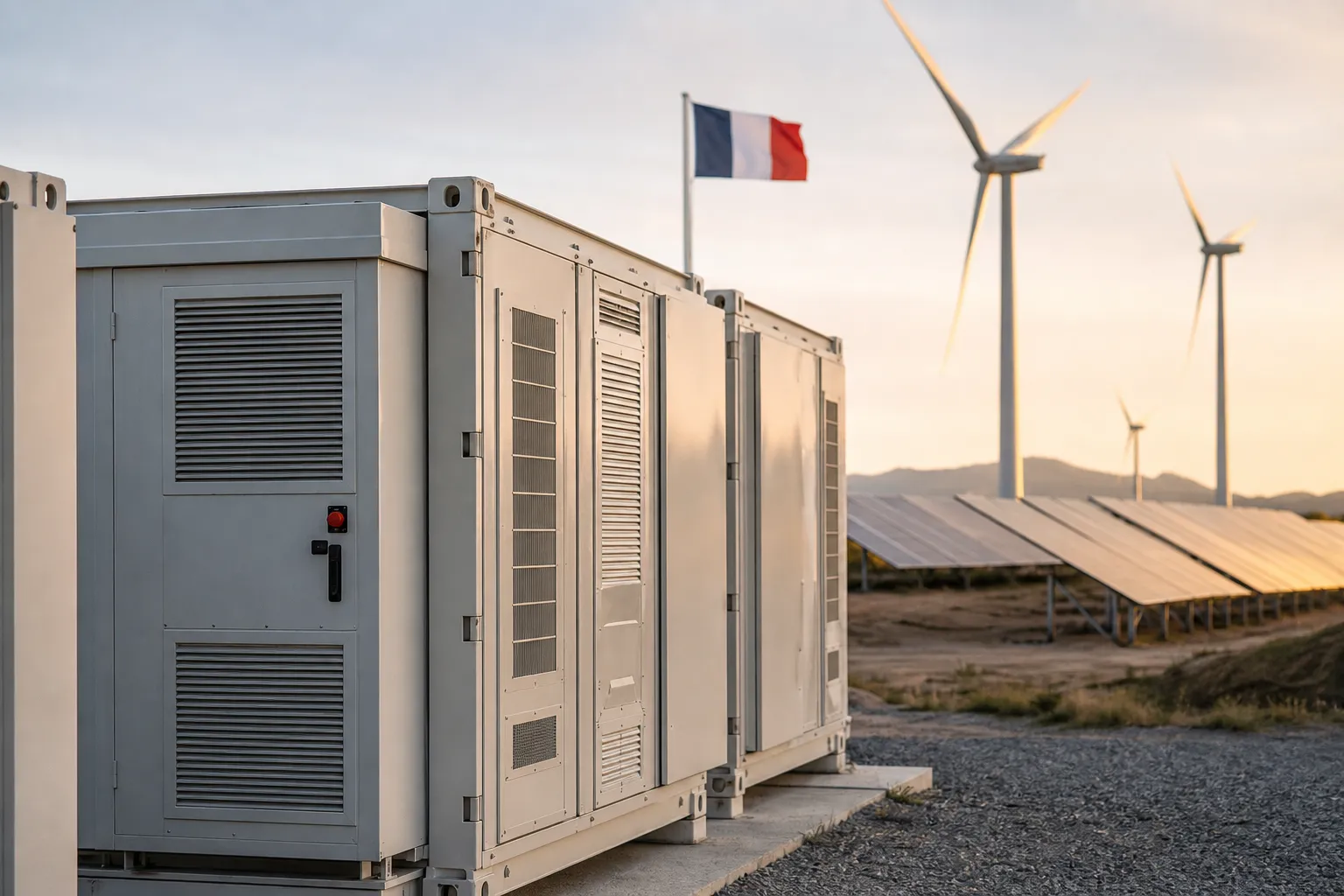
Who this guide is for: developers, investors, grid operators and in-house legal teams planning battery storage systems in France.
What it covers: stepwise authorisations, the grid-connection process, public support eligibility, timelines, costs, 2026 policy updates and common pitfalls.
Estimated read time: 12–15 minutes.
Battery storage projects france sit at the intersection of administrative permitting, grid regulation, environmental law and state aid, and 2026 is a pivotal moment for developers because the third Programmation Pluriannuelle de l’Énergie (PPE3) is expected to elevate flexibility and storage as central pillars of the national energy strategy. A battery energy storage system (BESS) can be deployed as a standalone grid-scale asset connected to the transmission or distribution network, or co-located with generation such as solar or wind to form a hybrid installation. Each configuration carries different legal consequences for authorisation, grid connection and market access. Successful projects treat regulatory strategy as a first-order engineering constraint, not an afterthought.
The core legal framework flows from the Code de l’énergie, which defines electricity storage, market access and the obligations of operators. Market and remuneration rules are set out under the supervision of the Commission de Régulation de l’Énergie (CRE), which oversees storage participation in capacity, balancing and ancillary-service markets. Physical connection is managed by RTE at transmission level and by Enedis and other distribution operators at lower voltages. National policy direction, including the storage and flexibility targets that drive procurement, is published by the Ministère de la Transition Écologique through the PPE.
For any battery storage projects france pipeline, the practical challenge is sequencing. Grid capacity is scarce, curtailment risk is real, and environmental authorisation timelines are long. The guide below sets out the full procedural path, from feasibility to decommissioning, with responsible parties, indicative durations, required documents and costs, so that legal and commercial teams can plan concurrent workstreams rather than a slow linear march. Early engagement with counsel and technical consultants (grid, fire and safety) materially reduces programme risk.
Whether a project is treated as a storage facility, a generation asset or a hybrid installation depends on its technical configuration and capacity. The Code de l’énergie recognises electricity storage as a distinct activity, and specific market rules apply to storage operators. Capacity (in MW and MWh), voltage level of connection, and whether the asset charges from the grid or from a co-located generator all determine which authorisations and market products apply. The connection voltage in particular decides whether RTE or a distribution operator is the counterparty for connection.
The legal characterisation of a project drives its permitting and remuneration route. A pure grid-scale battery is treated as a storage asset for market and connection purposes. A generation asset co-located with a battery raises questions of shared connection capacity, metering and the allocation of support between the two technologies. Hybrid solar-plus-storage projects can, in some cases, follow a permitting route close to that of the underlying solar plant, but the addition of a battery frequently triggers additional safety and environmental obligations that a standalone solar project would not face. Each configuration should be assessed against the applicable classification before committing capital.
Developers of battery storage projects france include independent power producers, energy suppliers, aggregators and infrastructure investors. Aggregators and suppliers may develop storage primarily to access flexibility revenues, while infrastructure funds typically favour contracted or capacity-market-supported assets. Corporate structuring, usually through a dedicated project company, must anticipate grid-operator credit requirements, decommissioning guarantees, and the possibility of state aid or tender participation, all of which have implications for shareholding, financing security and change-of-control provisions.
The operational core of any BESS programme is the sequence of administrative and technical steps below. The workstreams are presented in numbered order, but experienced developers run several in parallel to compress the overall timeline. The consolidated timeline table follows the narrative.
| Step | Who (lead) | Typical duration |
|---|---|---|
| 1. Feasibility & site selection | Developer / technical consultant | 1–3 months |
| 2. Grid-connection application & studies | Developer / RTE or DSO | Several months to over a year (varies with reinforcement needs) |
| 3. Land rights & local planning checks | Developer / notary / municipality | 1–6 months (concurrent with steps 1–2) |
| 4. Environmental screening & ICPE decision | Developer / environmental consultant / préfecture | Several months to over a year (longer with a public inquiry) |
| 5. State aid / tender applications | Developer / legal team | Per tender calendar |
| 6. Construction & grid works | EPC contractor / network operator | 3–12 months |
| 7. Commissioning & market access | Developer / TSO/DSO / market processes | 1–3 months |
| 8. Operations & compliance reporting | Operator | Ongoing |
The single most influential variable is step 2. Where a connection can be accommodated within existing capacity, the connection path is comparatively quick. Where substation upgrades or line reinforcement are required, both the timeline and the cost expand sharply, and this risk should be identified during feasibility rather than after land commitment. When these steps are properly sequenced, battery storage projects france can move from feasibility to commissioning within a well-defined and defensible programme.
Each procedure demands its own dossier, and incomplete submissions are among the most common causes of delay. Assemble documents in parallel with the technical design so that regulatory filings are not gated by late-arriving studies. The table below sets out the typical documentary requirements by procedure.
| Procedure | Required documents (typical) |
|---|---|
| Grid connection (RTE / DSO) | Site plan, single-line electrical diagram, forecasted generation/charging profile, landowner details, environmental constraints, cadastral references |
| ICPE / autorisation environnementale | Environmental impact study (if applicable), technical description, fire/explosion risk assessment, mitigation measures, operating rules, waste management plan |
| Building permit / local planning | Construction drawings, certificat d’urbanisme (where obtained), lease or property deed, environmental study extracts |
| State aid / tender application | Company financials, project timetable, technical specifications, proof of grid access or connection request, equipment conformity certificates |
| Transport & storage of hazardous materials | Safety data sheets, storage plan, transport arrangements, competent person certificate |
| Decommissioning & recycling plan | End-of-life plan, producer-responsibility statement |
Two documents disproportionately determine the outcome: the connection request package, because it sets the developer’s place in the queue, and the fire/explosion risk assessment, because it underpins the ICPE authorisation. Both should be prepared by specialists with direct experience of battery storage projects france rather than adapted from generic templates.
Total programme duration for battery storage projects france typically spans from around a year to two years or more, driven principally by grid queuing and environmental procedure. Grid capacity is generally allocated on a queue basis, so an early, complete connection request is one of the highest-value actions a developer can take. Where reinforcement is required, the connection studies and works can extend the connection element significantly.
The environmental limb runs on its own clock. An ICPE decision may complete within several months to around a year, but where an autorisation environnementale is required with a public inquiry, the process is longer and less predictable, and a CNDP procedure can add further time for larger or more sensitive projects. Public inquiry windows are set by procedure and cannot be freely compressed, so they should anchor the master schedule.
State aid and tender participation is calendar-driven. Tenders open and close on fixed dates, and a project that is not authorisation-ready by the relevant cut-off will miss a cycle and wait for the next. The practical implication is that developers should map tender dates backwards into the permitting programme from the outset.
Concurrency is the principal lever for shortening the total timeline. Land, planning and environmental screening (steps 1, 3 and 4) can proceed alongside the grid application (step 2). Preparing tender documentation (step 5) while authorisations are pending allows a project to submit immediately once permits are granted. Conceptually, the schedule is best visualised as several overlapping bars, feasibility, grid, environmental, and support, converging on a common commissioning date, rather than a single sequential line.
Cost estimation for battery storage projects france must separate soft costs (studies, dossiers, legal and consultancy fees) from hard costs (connection works, reinforcement, safety equipment). The dominant variable is again grid reinforcement, which can move a project’s economics decisively. The ranges below are broadly indicative only and should be refined against project-specific quotes and current operator and regulator estimates.
| Cost item | Indicative range (EUR) | Notes |
|---|---|---|
| Grid studies (initial + detailed) | Low tens of thousands and upward | Depends on complexity and whether reinforcement is required |
| Network reinforcement / connection works | From tens of thousands to several million | Major cost driver for large BESS needing substation upgrades |
| Environmental / ICPE dossier & studies | Tens of thousands to low hundreds of thousands | Includes environmental impact study if required; public inquiry increases cost |
| Building permits / local planning | Low four to five figures | Varies by project and municipality |
| Safety & fire mitigation equipment | Tens of thousands and upward | Depends on scale and safety design |
| Legal, permitting & consulting fees | Tens of thousands to low hundreds of thousands | Driven by legal complexity and tender requirements |
| Decommissioning guarantee / bonds | Project-specific | Often required by authorities |
The most frequent budgeting error is treating reinforcement as a contingency rather than a base-case line item. Because reinforcement costs are only quantified after the connection studies, a project committed to land and design before those studies conclude carries an unhedged cost risk. Building a realistic reinforcement allowance into the initial model protects the investment case and the financing timetable.
The 2026 policy environment is expected to be more favourable to storage than prior periods. The PPE is set to reinforce targets for flexibility and storage, and this is generally expected to translate into greater procurement volume and clearer market signals for battery assets. Because the PPE text and its implementing measures are still being finalised and updated, developers should confirm the current published targets and any associated tender arrangements before relying on them.
On the market side, the CRE continues to refine the rules governing storage participation in capacity, balancing and ancillary-service markets. Developers should verify the current market-access rules for each project, as the revenue stack available to a battery depends directly on these evolving provisions. On support, the European Commission’s state aid framework governs whether national storage schemes are compatible with EU law; projects should confirm that any support they intend to rely on falls within an approved scheme. Given the pace of change, a project-specific legal review of eligibility under the applicable tender and state aid rules is strongly advised before submission.
A disciplined checklist, reviewed at each stage gate, is the most reliable safeguard. For battery storage projects france, the recurring theme is that problems are cheap to fix at feasibility and expensive to fix after land, design or financing commitments have been made.
| Permit type | Triggers | Authority | Public inquiry risk | Typical duration |
|---|---|---|---|---|
| ICPE (declaration / registration / authorisation) | Activities listed in the ICPE nomenclature | Préfecture (with DREAL inspection services) | Possible (mainly for authorisation) | Several months to around a year |
| Autorisation environnementale | Projects subject to ICPE authorisation and combined environmental consents | Préfecture | Possible / more likely | Around one year or more |
| Building permit (permis de construire) | Construction / works above applicable thresholds | Municipality (mayor) / State services | Unlikely (unless PLU conflict) | Typically a few months |
These routes are not mutually exclusive. A single project may require both an environmental authorisation and a building permit. The autorisation environnementale is designed to consolidate several environmental consents (including ICPE authorisation) into a single procedure, which can streamline administration but also raises the likelihood of a public inquiry. Determining the correct combination at the outset, with legal input, avoids duplicative filings and sequencing errors.
Project teams developing battery storage projects france should maintain a live checklist reviewed at each stage gate. A workable structure follows.
Engage counsel at the feasibility and authorisation gates, and technical consultants, grid, fire and safety, from feasibility onward. This disciplined approach is what distinguishes battery storage projects france that reach commissioning on schedule from those that stall in the queue or the préfecture. This guide is for informational purposes only and is not a substitute for project-specific legal advice; readers should seek tailored counsel for individual projects.
This article was produced by Global Law Experts. For specialist advice on this topic, contact Cendrine Delivré at Franklin, a member of the Global Law Experts network.
posted 8 minutes ago

posted 12 minutes ago

posted 36 minutes ago
posted 57 minutes ago

posted 1 hour ago

posted 2 hours ago

posted 2 hours ago

posted 3 hours ago

posted 4 hours ago

posted 4 hours ago

posted 4 hours ago

posted 5 hours ago
No results available

Send welcome message