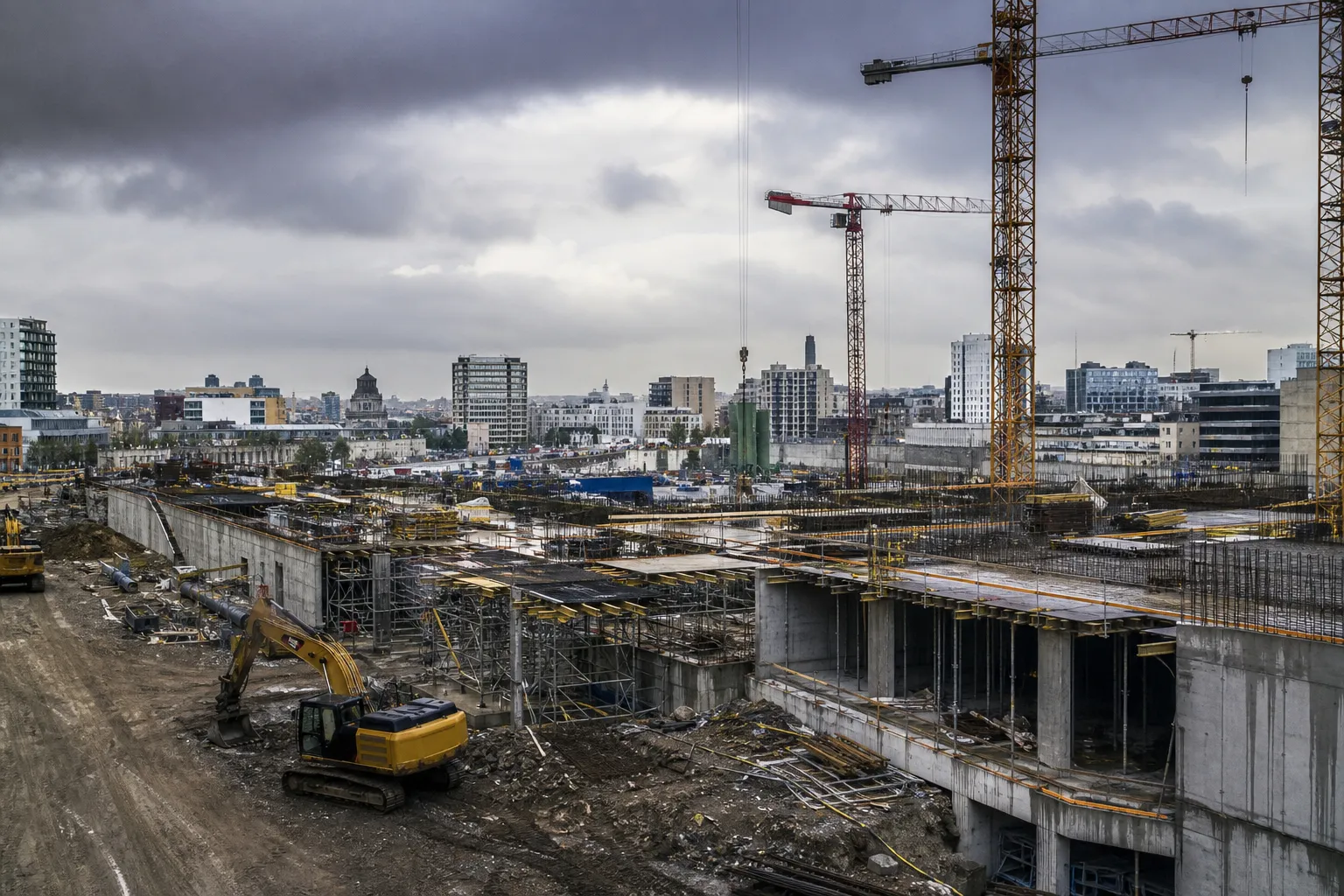
Construction liquidated damages belgium clauses are entering a period of change, as the reforms introduced by Book 7 of the Belgian Civil Code (the reformed law of “special contracts”) reshape how certain contractual arrangements are drafted, reviewed and enforced. For contractors, developers, main contractors, subcontractors and project owners, the practical question is no longer whether a delay clause is theoretically valid, but whether it will survive judicial scrutiny and deliver recovery when a project runs late. This guide sets out a stepwise, jurisdiction-specific method for drafting, serving notices, quantifying delay and enforcing liquidated damages under Belgian law.
It provides sample clause language, calculation logic, a required-documents checklist, indicative cost ranges and an enforcement decision path, anchored to Belgian statutory and case-law sources.
Search intent: Practical, jurisdiction-specific instructions and templates for drafting and enforcing liquidated damages and delay clauses in Belgian construction contracts, including in light of the reform of the Civil Code. Includes sample clause language, notice wording, calculation examples, and enforcement pathways.
A liquidated damages (LD) clause, in Belgian law usually framed as a penalty or fixed-compensation clause (clause pénale / strafbeding), fixes, in advance, the sum payable when a party breaches a defined obligation, most commonly failure to complete works by a contractual milestone. Rather than proving actual loss at trial, the innocent party relies on the agreed figure. In Belgian construction practice the mechanism serves two functions: it gives the employer a predictable remedy for delay, and it gives the contractor certainty over exposure. That certainty holds most reliably where the clause is drafted as a reasonable pre-estimate of loss rather than a purely punitive instrument.
The distinction between a compensatory fixed-sum clause and a manifestly excessive penalty matters because Belgian courts have long held the power, under the Civil Code, to reduce a contractual penalty that is manifestly disproportionate. This judicial power to moderate excessive penalty clauses is a longstanding feature of Belgian law and is carried through in the reformed Civil Code. When drafting construction liquidated damages belgium provisions, the immediate red flags are round-number “penalties” untethered to any loss calculation, missing measurement methods, and rates that escalate without a cap.
This guide is written for the parties who negotiate, administer and litigate construction contracts in Belgium: main contractors and subcontractors managing programme risk, developers and project owners protecting completion dates, in-house counsel updating template suites, and arbitrators or advisers assessing clause enforceability. If you are drafting new agreements for 2026 delivery, or reviewing legacy contracts against the reformed Civil Code framework, the steps below apply directly.
Use this guide to structure your own drafting, notice procedures and evidence preservation. Instruct specialist counsel where the quantum is significant, where cross-border enforcement is likely, where the clause has already been challenged as an excessive penalty, or where an urgent interim measure is needed. To identify an adviser, consult the Global Law Experts country directory filtered to Belgium and construction, or the Belgian Bar (advocaat.be / avocats.be) lawyer search. Market rates for Belgian counsel vary by seniority, city and complexity, so obtain a scoped fee estimate before instructing.
The following eleven steps track a delay claim from clause drafting through to post-judgment recovery. Each step includes substeps, checklists and, where useful, sample wording. The timeline table below summarises ownership and duration; treat the durations as indicative planning figures, not statutory deadlines.
Begin at the template. A defensible construction liquidated damages belgium clause identifies the triggering obligation, the measurement basis, the per-unit rate, and any aggregate cap. Ambiguity at this stage is the single most common cause of failed recovery.
Sample annotated wording:
“If the Contractor fails to achieve Practical Completion of the Works by the Completion Date (as adjusted by any extension of time granted under Clause X), the Contractor shall pay the Employer liquidated damages of EUR [rate] per calendar day of delay, up to an aggregate maximum of [cap] per cent of the Contract Price. This sum represents a reasonable pre-estimate of the loss the Employer is likely to suffer and is the Employer’s [sole / minimum] remedy for delay.”
Delay disputes turn on what “completion” means and how delay is measured. Define the baseline programme, the critical path methodology (typically CPM), and the evidence that establishes a milestone has been met. Record the measurement method in the contract so that quantification later rests on an agreed basis rather than a contested one.
Where legacy contracts predate the reform of the Civil Code, consider issuing addenda that align clause wording with the current framework. Ensure signatories have authority and that the addendum expressly incorporates the revised LD provision and cap.
Evidence preservation is continuous, not reactive. From the moment delay is foreseeable, maintain dated site diaries, progress photographs, correspondence, delivery receipts and minutes. Contemporaneous records carry disproportionate weight in Belgian delay disputes because they establish causation on the critical path.
Notice requirements for delay claims are contractual first and statutory second. Follow the contract’s notice clause to the letter: correct recipient, correct address, prescribed delivery method and prescribed timing. If the contract specifies a window, missing it can bar or weaken the claim. Note that, as a general matter of Belgian law, a formal notice of default (mise en demeure / ingebrekestelling) is often a precondition to claiming contractual remedies unless the contract or the circumstances dispense with it.
Sample notice wording:
“We hereby give notice under Clause [X] that a delaying event occurred on [date], namely [description]. This event is likely to delay Practical Completion. We reserve all contractual rights, including liquidated damages / an extension of time, and will submit a detailed claim with supporting analysis in accordance with the Contract.”
The substantive claim quantifies delay and links it to the LD formula. A worked example: if the contract sets LD at EUR 2,000 per calendar day, capped at 10 per cent of a EUR 5,000,000 contract price, and the works complete 40 days late after accounting for a granted 10-day extension, the recoverable sum is 30 net days × EUR 2,000 = EUR 60,000, which sits below the EUR 500,000 cap. The forensic delay analysis must demonstrate that the 30 days lie on the critical path and are not concurrent with employer delay.
Where delay threatens irreparable prejudice, for example, imminent dissipation of assets or continuing loss, an urgent application (such as summary proceedings, référé / kort geding) may be brought before the President of the competent court, or interim relief may be sought from an arbitral tribunal. Emergency applications typically move on a scale of days to weeks and require a clear, evidenced case for urgency.
Choose the forum the contract dictates. Belgian construction contracts frequently provide for institutional arbitration (for example under CEPANI or ICC rules); others default to the ordinary courts. The substantive interpretation of the clause follows the Civil Code in either forum, but this does not remove the parties’ agreed choice of dispute resolution mechanism.
A judgment or award is only as good as its enforcement. Belgian enforcement routes include attachment and seizure of assets and execution against the debtor via judicial enforcement officers (huissiers de justice / gerechtsdeurwaarders), and, for arbitral awards, recognition and enforcement procedures under the Judicial Code and applicable treaties. Plan enforcement strategy before judgment, including asset identification.
After enforcement, reconcile recovered sums against the claim and pursue asset tracing where recovery falls short. Account for any set-off against sums the debtor claims in return.
Close the loop by feeding lessons back into the template suite. Each dispute reveals where trigger definitions, notice windows or measurement methods failed under pressure.
| Step | Who (owner) | Typical duration / deadline |
|---|---|---|
| 1. Update contract template & LD clause language | Contracting parties / in-house legal | 1–2 weeks per template cycle |
| 2. Insert milestone definitions and measurement method | Commercial team / project manager | 1–3 days per project |
| 3. Agree & sign amendments / addenda | Parties / contracting counsel | 1–4 weeks (negotiation dependent) |
| 4. Preserve evidence (site diaries, photos, correspondence) | Site manager / contractor | Continuous, start immediately on notice of delay |
| 5. Serve formal delay notice (preservation) | Claimant contractor / counsel | As contract requires; promptly after the delay event |
| 6. Submit detailed delay claim with calculation & expert report | Claimant / delay analyst / expert | 4–12 weeks (depends on complexity) |
| 7. Seek interim relief (if urgent) | Claimant / counsel / court or tribunal | Emergency application: within days–weeks |
| 8. Commence arbitration or court proceedings | Claimant / counsel | 1–4 years to final award/judgment (varies) |
| 9. Enforcement / execution (seizure, recognition of award) | Claimant / counsel / enforcement officers | Weeks–months after final award or judgment |
| 10. Post-judgment recovery & accounting | Claimant finance / counsel | Months, follow asset tracing if required |
A construction liquidated damages belgium claim stands or falls on documentation. Assemble the full evidential bundle before serving a substantive claim; gaps discovered later are difficult to remedy credibly. The checklist below groups documents by category and explains why each matters.
| Document category | Examples / why needed |
|---|---|
| Contract documents | Main contract, annexes, general conditions, pricing schedules, to show the agreed LD clause and measurement method |
| Project programme & milestones | Baseline programme, revised programmes, to establish critical path and delay windows |
| Notices & correspondence | All delay notices, notices of default, emails, letters, to prove notice compliance and mitigation attempts |
| Site records | Daily reports, attendance logs, weather logs, photos, delivery receipts, factual evidence of delay |
| Financial records | Interim payment applications, variation orders, invoices, to quantify cost impacts |
| Technical reports | Forensic delay analysis, CPM schedules, expert statements, to prove causation and quantum |
| Meeting minutes & site instructions | To track instructions causing delays and instructions from client / architect / engineer |
| Permits & approvals | Delays due to authorities must be evidenced by permit communications |
| Insurance & bonds | Performance bond, decennial liability insurance, to plan recovery and offset |
| Arbitration / litigation papers | Notices of arbitration, exhibit bundles, witness statements, required for filing and enforcement |
Two clocks run in parallel: the contractual notice clock and the statutory prescription clock. Contractual notice periods are frequently short, sometimes days rather than weeks, and non-compliance can weaken or bar recovery regardless of the merits. Prescription (the limitation period) governs the outer limit for bringing a contractual claim; the applicable period depends on the nature of the obligation and when the cause of action accrued. In addition, special mandatory liability regimes apply in construction, notably the ten-year (decennial) liability of contractors and architects for serious defects affecting the stability of the building. Consult FPS Justice guidance and specialist counsel to fix the applicable period for your claim.
Practically, plan the following lead times: interim relief moves in days to weeks; a detailed delay claim with expert input takes four to twelve weeks to prepare; arbitration or court proceedings typically run one to four years to final award or judgment; and enforcement steps follow over weeks to months. Because these horizons are long, preserve evidence early (Step 4) and serve notices promptly (Step 5), the earliest actions have the greatest effect on eventual recovery.
Cost exposure in a construction liquidated damages belgium dispute divides into drafting, claim preparation, expert evidence, forum costs and enforcement. The ranges below are broad planning indications only; actual figures depend on quantum, complexity and forum, and should be confirmed by a scoped quotation.
| Cost item | Indicative range (EUR) | Notes |
|---|---|---|
| Counsel drafting / advice fees (contract update) | 1,000–5,000 | Fee for a standard LD clause / template update |
| Counsel fees (claim preparation) | 5,000–50,000+ | Depends on complexity and quantum |
| Forensic delay expert report | 10,000–80,000 | CPM analysis and quantified schedule impacts |
| Arbitrator fees / institutional admin | 10,000–150,000+ | ICC / CEPANI / other institutional costs depend on claim size |
| Court fees & enforcement costs | 500–10,000+ | Filing costs and enforcement execution charges |
| Interim measures (emergency applications) | 5,000–30,000 | Fast-track costs including urgent counsel fees |
| Enforcement (judicial officer, auctions) | 1,000–20,000 | Execution costs vary with assets |
| Translation / document certification | 500–5,000 | For cross-border enforcement or non-Dutch/French filings |
The reform of the Belgian Civil Code has been rolled out in successive Books. Book 5 (the general law of obligations) and Book 6 (extra-contractual liability) are already in force, while Book 7 on “special contracts”, which is relevant to construction-related contracts such as contracts for works (contrat d’entreprise / aanneming), is being finalised. Practitioners should verify the enacted text and its date of entry into force via the official Belgian Official Gazette (Moniteur belge / Belgisch Staatsblad) before relying on any specific provision, as the reform is being enacted in stages.
For practitioners, the central practical point is the judicial power to reduce a contractual penalty that is manifestly disproportionate to the harm it is meant to compensate, a power that already exists under the current Civil Code and is preserved in the reformed framework. Where a court concludes that an agreed sum manifestly exceeds the foreseeable loss, it may reduce it (though not, in principle, below the actual loss suffered).
The drafting implications are concrete. First, evidence the pre-estimate: keep a contemporaneous record of how the per-day rate was calculated so the clause can be defended as compensatory. Second, cap aggregate exposure, since an uncapped, escalating figure attracts scrutiny. Third, align the extension-of-time machinery with the LD trigger so that damages do not accrue during excusable delay. Fourth, avoid purely punitive framing, which increases the risk of judicial reduction.
For interpretation and the limits of judicial revision, the guiding reference points remain the judgments of the Court of Cassation (Cour de cassation / Hof van Cassatie), which shape how far courts may go in reviewing agreed sums. Academic commentary from Belgian law faculties provides doctrinal analysis of how the reformed Code interacts with construction-specific remedies. In practice, well-evidenced and capped clauses tend to fare better than open-ended, penalty-style provisions.
Most failed construction liquidated damages belgium claims fail for avoidable reasons. The list below sets out the recurrent traps and their remedies.
| Feature | Compensatory LD (reasonable pre-estimate) | Excessive / punitive clause |
|---|---|---|
| Purpose | Pre-estimate of loss agreed by the parties | Punitive or deterrent excess beyond foreseeable loss |
| Enforceability under Belgian law | Generally enforceable if a reasonable pre-estimate and proportionate | Courts may reduce a manifestly disproportionate sum (in principle not below actual loss) |
| Drafting cues | Clear trigger, calculation formula, per-day rate, cap/aggregate | A round figure untethered to loss increases the risk of reduction |
| Recovery approach | Contractual entitlement; may be set off against sums owed | Risk of judicial reduction toward a compensatory sum |
| Evidence required | Baseline programme, proof of delay, calculation method | Same, plus greater risk of dispute on reasonableness |

Getting construction liquidated damages belgium clauses right is a discipline that starts at the drafting table and ends at enforcement. Belgian law rewards clauses that read as reasonable, capped, calculation-backed pre-estimates of loss and exposes manifestly punitive figures to judicial reduction. Preserve evidence from the first sign of delay, serve notices exactly as the contract requires (including any notice of default), quantify delay on the critical path, and plan the enforcement route before judgment. Contractors, developers and subcontractors who align their templates and procedures with the current framework will recover more reliably and expose themselves to less risk of reduction.
This article is general guidance on Belgian law and does not constitute legal advice; verify the enacted Civil Code provisions via the official sources below and seek qualified local counsel for any specific matter.
This article was produced by Global Law Experts. For specialist advice on this topic, contact Wim Nackaerts at Strada Legale, a member of the Global Law Experts network.