
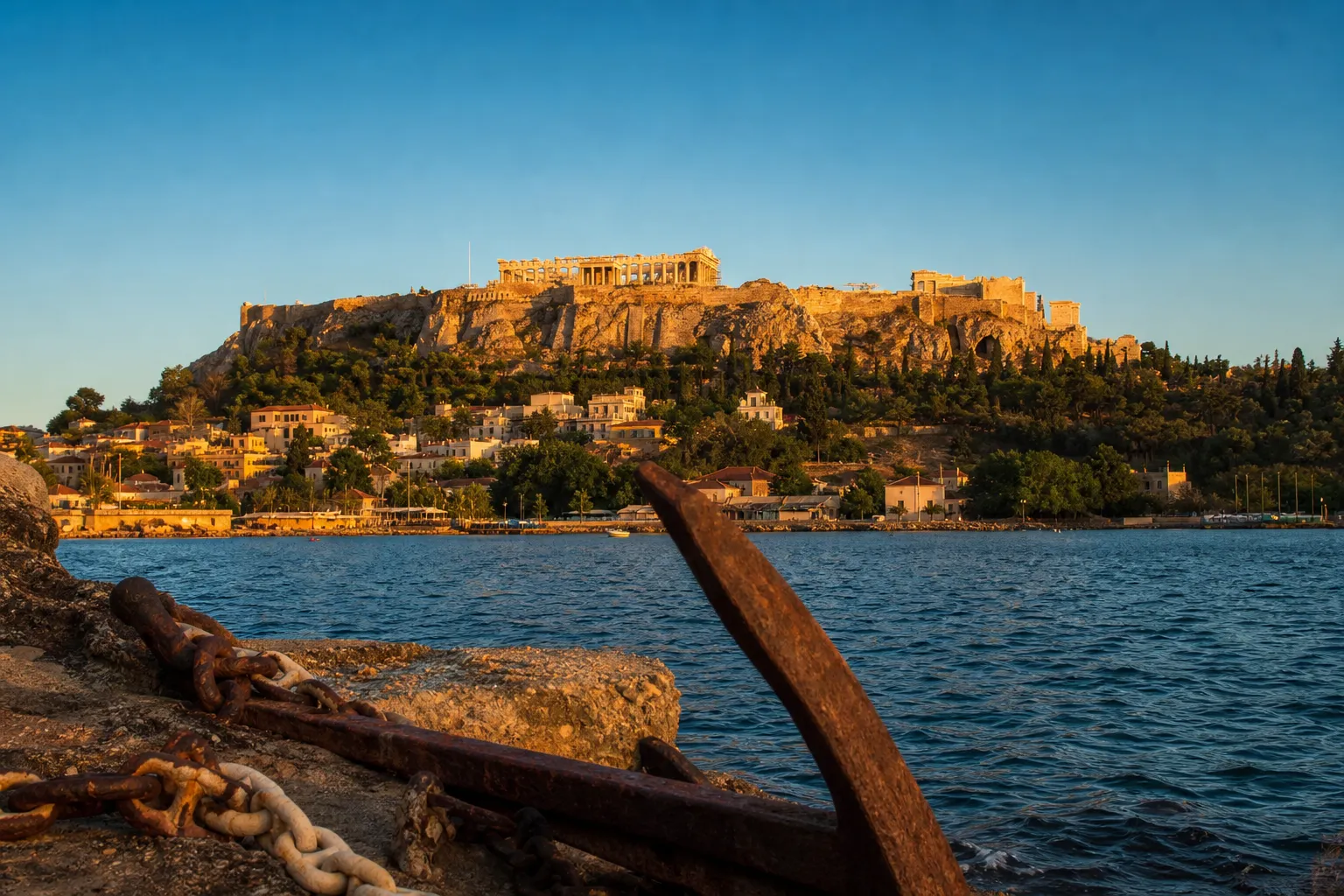
Salvage claims Greece practitioners have rarely faced a busier moment than the 2025–26 casualty cycle, with an uptick in Eastern Mediterranean incidents pushing owners, salvors, P&I clubs and casualty responders into more Lloyd’s Open Form (LOF) and SCOPIC disputes than at any point in recent memory. This guide sets out, in practical terms, how salvage rewards are agreed, computed and evidenced under LOF, how SCOPIC operates as a fallback remuneration mechanism, and how a salvor can secure and enforce a claim or award against a ship or its cargo in Greece. It is written for frontline stakeholders who need actionable steps rather than abstract theory.
You will learn how to run an on-scene LOF properly, how to build a defensible SCOPIC claim packet, how a Greek arrest is obtained, and how LOF arbitral awards are recognised and executed here. The emphasis throughout is on decisions that must be taken in hours, not weeks.
Understanding salvage claims Greece work requires two layers: the international legal framework that fixes the substantive right to a reward, and the domestic procedural machinery through which that right is enforced. The two operate together, the treaty tells you what you are owed, while Greek procedure and reporting obligations tell you how to protect and realise it.
The substantive law of salvage is governed by the International Convention on Salvage 1989, to which Greece is a party, and which codifies the core principles that underpin every reward claim. Two ideas dominate. First, a salvor who confers a benefit by rescuing a vessel or property in danger is entitled to a reward, but only where the operation had a useful result, the “no cure, no pay” principle. Second, the amount of that reward is fixed by reference to a defined set of factors, including the skill and efforts of the salvors, the value of the property salved, the degree of danger, and the time and expenses reasonably incurred.
The Convention also introduced a limited exception to strict “no cure, no pay” for operations that prevent or minimise environmental damage, in the form of special compensation. This exception is the conceptual ancestor of the SCOPIC clause discussed below. For salvors operating in Greek waters, the Convention supplies the analytical spine of any reward argument, whether the dispute is resolved by negotiation, arbitration or court.
In Greece, salvage disputes and the interim measures that support them are handled through the ordinary civil and maritime jurisdiction, with the Piraeus courts occupying a central role given Piraeus’s status as the country’s principal shipping hub. Practitioners will typically pursue arrest and security applications, and ultimately recognition and enforcement, before these courts.
Alongside the courts sits the regulatory layer. The Hellenic Coast Guard coordinates casualty response in Greek territorial waters and administers reporting obligations that attach the moment an incident occurs. Prompt and accurate reporting to the Coast Guard and the relevant port authority is not merely a compliance formality, it creates a contemporaneous official record that later supports the salvor’s account of danger, timing and conduct. Because Greek procedural and statutory detail can turn on specific provisions, any case-critical citation should be verified against primary sources before it is relied upon.
The Lloyd’s Open Form is a standard-form salvage contract used worldwide. Its defining feature is that it is signed quickly, on-scene, without prior agreement on the amount of the reward, that figure is left to be assessed later by arbitration. This “agree now, quantify later” structure is what makes LOF so valuable in a casualty: it lets salvage begin immediately while preserving both parties’ rights to argue the reward at leisure. In Greece, an LOF executed at the scene of a casualty creates a binding contractual rescue agreement, and the reward is usually resolved through the arbitration mechanism embedded in the form (traditionally seated in London under English law) rather than through Greek court litigation.
The single biggest determinant of a strong reward claim is the discipline applied in the first hours. Masters and salvage masters should treat evidence preservation as an operational priority equal to the salvage itself.
This packet, logs, timings, imagery, personnel and equipment records, is the raw material from which a reward or SCOPIC account is built. Gaps in it are exploited later by paying interests.
LOF traditionally provides for arbitration in London under English law, and the seat and applicable rules should be understood before signature rather than after a dispute crystallises. Where a casualty is handled from a Greek port, salvors should be alert to how the LOF’s arbitration provisions interact with any parallel Greek court steps taken to obtain security. Emergency notices, including notice of a SCOPIC invocation, must be given in the correct form and within the correct window to preserve rights. Preserving the arbitration route while simultaneously taking protective measures in Greece is a routine but delicate exercise; the two tracks must be coordinated, not run in ignorance of each other.
For the mechanics of commencing the arbitral process, see How to commence maritime arbitration in Greece.
SCOPIC, the Special Compensation P&I Clause, is an optional, tariff-based remuneration mechanism that can be incorporated into an LOF and invoked by the salvor. Its purpose is to give the salvor a floor of guaranteed, time-and-rate-based remuneration, calculated by reference to an agreed tariff of daily rates for personnel, tugs and equipment, plus a percentage uplift and out-of-pocket expenses. It replaces the more open-ended and evidentially demanding special compensation concept with something salvors can calculate and cost with confidence.
The key practical point is that SCOPIC is triggered by the salvor’s written invocation, not automatically. A salvor invokes SCOPIC when there is a real risk that a traditional Convention reward will fall short of the operation’s cost, typically where the salved values are low relative to the effort required, or where environmental exposure is significant. Once invoked, security must generally be provided by the property interests, and the account runs from that point.
A SCOPIC claim stands or falls on documentation. Because the mechanism is tariff-driven, the dispute is rarely about principle and almost always about hours, resources and rates. The salvor must therefore keep a claim-ready record from the moment of invocation.
Present the SCOPIC claim as an ordered packet: invocation, tariff calculation, supporting time sheets, logs, invoices and witness statements. A claim assembled this way is far harder to whittle down.
Paying interests rarely dispute that SCOPIC applies once it is validly invoked; they dispute the quantum. The most common objections are over-manning, inefficient deployment, idle time and inflated equipment usage. The counter to each is evidence. Over-manning allegations are answered by showing the operational rationale for the resources deployed at each phase, supported by the salvage plan and the master’s assessment of danger. Inefficiency arguments are met with a narrative log demonstrating that time lost was attributable to weather, sea state or the casualty’s condition rather than the salvor’s conduct.
Independent evidence carries disproportionate weight. A jointly appointed or well-instructed surveyor who attended the operation, and marine engineering input on the resources genuinely required, will frequently resolve a SCOPIC accounting dispute more quickly than adversarial correspondence. The strategic lesson is to build the audit trail during the operation, not to reconstruct it afterwards under challenge.
Where a claim proceeds as a conventional salvage reward rather than on the SCOPIC tariff, quantum is assessed against the factors set out in the Salvage Convention 1989. These include:
These factors are weighed together; no single one is decisive. A modest salved value can still support a substantial reward where danger and skill were high, precisely because the Convention is designed to encourage salvors to intervene in difficult cases.
The value of SCOPIC becomes clear when the salved values are low. Consider two simplified scenarios.
Example A, LOF without SCOPIC. A salvor refloats a laden vessel where the combined salved value of ship and cargo is high. An arbitrator, applying the Convention factors, assesses a conventional reward as a proportion of the salved fund. Because the fund is large, the reward comfortably exceeds the salvor’s costs, and there is no need to invoke SCOPIC. The reward is a percentage of a substantial value.
Example B, LOF with SCOPIC invoked. A salvor spends days working on a low-value casualty with significant pollution risk. The salved fund is small, so a Convention reward assessed as a percentage of that fund would not cover the operation’s cost. Having invoked SCOPIC, the salvor is instead entitled to the tariff-based sum: daily rates for personnel, tugs and equipment, plus the agreed uplift and expenses. This guarantees the salvor a remuneration floor that reflects effort rather than salved value. Where the SCOPIC assessment exceeds the Convention reward, the SCOPIC figure protects the salvor from working at a loss.
The two examples illustrate the strategic choice: SCOPIC is a safety net, invoked when the salved values may not justify the effort, and it converts an uncertain equitable reward into a calculable, time-based entitlement.
The larger the reward sought, the more the claim must be evidenced. Persuasive material typically includes an independent surveyor’s report on the casualty’s condition and the danger it faced, marine engineering analysis of the operation and the resources required, a salvage plan showing the reasoning behind key decisions, charts and positional data, and witness statements from the salvage master and key personnel. Expert reports that quantify the peril and demonstrate the skill deployed frequently move an arbitrator’s assessment upward, because they translate operational reality into the Convention factors that govern quantum.
Yes. Greek practice permits arrest and security applications in support of salvage claims, and this is one of the most powerful tools available to a salvor pursuing salvage claims Greece courts will recognise. A salvage claim is a maritime claim that can found an arrest of the vessel, and in appropriate cases the salved cargo may also be made the subject of protective measures. The distinction between a maritime lien and a purely contractual claim matters for priority and for the reach of the remedy, and the analysis should be undertaken early with local counsel.
Practically, arrest is time-critical. Vessels move, and a ship that sails before security is in place may leave the salvor chasing enforcement across borders. The salvor should therefore have an arrest dossier ready to file the moment a target vessel is within, or expected to enter, Greek jurisdiction. Speed of instruction to Piraeus counsel is frequently the difference between clean security and a protracted enforcement campaign.
Arrest is not always the objective; often it is a lever to obtain security. Where the property interests and their P&I club are cooperative, a negotiated guarantee or bank guarantee may be obtained without the disruption and cost of an actual seizure. Arrest is the appropriate route where there is a genuine risk of the vessel leaving, where the paying interests are unresponsive, or where security offered is inadequate. For foreign-flagged vessels, consular notification and coordination with the club may be required, and interlocutory applications should be prepared with the value of the claim carefully estimated so that the security sought is proportionate and defensible.
An effective arrest in Greece depends on a properly assembled dossier and fast local execution. The core components are:
Costs include local counsel fees, court fees and any bond or counter-security requirements. The dominant variable is speed: a dossier prepared in advance and filed the moment the vessel is in range converts a theoretical right into realised security. For casualties involving smaller craft or pleasure vessels, related considerations arise that overlap with yacht disputes in Greece.
Because LOF resolves the reward by arbitration, the practical question for a successful salvor is how to convert an arbitral award into recovered money in Greece. Greece is a party to the New York Convention on the Recognition and Enforcement of Foreign Arbitral Awards, which provides the framework for recognising and enforcing foreign arbitral awards, subject to the limited grounds for refusal set out in the Convention. In practice, the award-holder applies to the competent Greek court for recognition and a declaration of enforceability, submitting the award and the arbitration agreement in the required form. Once recognised, the award is enforced through the domestic execution machinery in the same way as a domestic title.
Understanding the arbitral route from the outset, including how proceedings are commenced, helps ensure the award that emerges is enforcement-ready; see How to commence maritime arbitration in Greece.
Not every salvage entitlement arrives as an arbitral award. Where a salvage-related claim is resolved by the court judgment of another EU Member State, enforcement in Greece is governed by Regulation (EU) No 1215/2012 (Brussels I Recast), which provides for the recognition and enforcement of judgments in civil and commercial matters across the Union with streamlined procedures. The essential distinction is therefore between instruments: arbitral awards travel under the New York Convention, while EU court judgments travel under Brussels I Recast. Identifying which regime applies at the outset dictates the enforcement pathway and the documents required.
A disciplined enforcement workflow runs roughly as follows: secure the claim early through arrest or a guarantee; obtain the award or judgment; apply promptly for recognition and a declaration of enforceability under the applicable regime; and then execute against the secured assets. The single most important tactical point is to run security and enforcement in parallel. Obtaining security while the merits proceed means that, once recognition is granted, there is an asset, or a guarantee, against which to execute, rather than a paper victory chasing a vessel that has long since sailed.
Careful drafting and notice management preserve rights that sloppy handling forfeits. Confirm at signature which clauses are incorporated and whether SCOPIC is engaged. Where SCOPIC may be relied upon, prepare the invocation wording in advance so it can be served immediately and correctly, and diarise every deadline attaching to invocation and to the provision of security. Security and guarantee wording should be reviewed so that it covers the full claim, including interest and costs, and does not inadvertently narrow the salvor’s recourse. All sample wording should be run past qualified counsel before use; the difference between a preserved and a lost entitlement is frequently a matter of precise language and timing rather than substantive merit.
Paying interests deploy a recurring set of arguments, and each has an evidential answer. Owners may allege that the salvor’s own negligence caused or aggravated the loss, or that the salvage was performed improperly or excessively; they may also contend that the sum claimed is inflated. Insurers frequently challenge the reasonableness of resources and rates, particularly in a SCOPIC account. The effective rebuttal is always evidential: contemporaneous logs, the salvage plan, independent survey evidence and expert engineering analysis demonstrating that the resources deployed and the time taken were justified by the danger and the casualty’s condition.
Where the salvor has maintained a disciplined record from the first hour, most defences lose their force, because the paying interests are reduced to argument without evidence against a claim built on documentation.
The two tables below summarise the strategic choices at the heart of salvage claims Greece stakeholders face: whether to rely on SCOPIC, and which enforcement route to pursue.
| Feature | LOF (no SCOPIC) | LOF + SCOPIC |
|---|---|---|
| Basis of reward | Equitable salvage award under the Salvage Convention 1989 | SCOPIC tariff rates plus uplift and expenses, once invoked |
| Speed of settlement | Often longer, subject to negotiation and arbitration on quantum | Quicker interim certainty through the tariff |
| Evidence burden | High, salved value, danger and effort must all be proven | Still needs time sheets and invoices, but the tariff simplifies quantum |
| Typical user | High-value or complex salvage where the salved fund justifies a percentage reward | Salvors needing a guaranteed, time-based remuneration floor on low-value or high-risk casualties |
| Feature | Arrest / security in Greece | Recognition & execution of award |
|---|---|---|
| Primary purpose | Secure the claim before or during proceedings | Convert a final award or judgment into recovered money |
| Speed | Fast, time-critical, deployed while the vessel is in jurisdiction | Follows the merits; depends on the recognition procedure |
| Cross-border reach | Territorial, the asset must be within Greek jurisdiction | Broad, New York Convention (awards) or Brussels I Recast (EU judgments) |
| Best used | As an early lever to obtain security or a guarantee | In parallel with security, to execute once the entitlement is final |
Three checklists distil the operational discipline this guide advocates. Each should be prepared before it is needed, not assembled under pressure.
Salvage claims Greece stakeholders will navigate in 2026 turn less on legal theory than on operational discipline and timing. The salvor who signs the LOF correctly, checks the SCOPIC position, keeps contemporaneous logs and time sheets, notifies the authorities and insurers, and prepares arrest and enforcement dossiers in advance will consistently recover more, faster, than one who reconstructs the case under challenge. Whether a reward is assessed under the Convention or guaranteed through the SCOPIC tariff, and whether it is enforced through arrest, the New York Convention or Brussels I Recast, the winning approach is the same: build the evidence during the operation and run security and enforcement in parallel.
This guide is general guidance and not formal legal advice; for case-specific assistance with salvage claims Greece practitioners handle, obtain a case assessment from qualified admiralty counsel before acting.
This article was produced by Global Law Experts. For specialist advice on this topic, contact Konstantinos Bachxevanis at BAX LAW, a member of the Global Law Experts network.

posted 4 minutes ago

posted 26 minutes ago

posted 2 hours ago

posted 3 hours ago

posted 3 hours ago

posted 3 hours ago

posted 3 hours ago

posted 4 hours ago

posted 5 hours ago

posted 5 hours ago

posted 6 hours ago

posted 6 hours ago
No results available
Find the right Legal Expert for your business

Send welcome message