
Succession planning helps to create a predictable future while also, paradoxically, planning for the unexpected.
Succession planning is one of the most important areas of planning for any family business, indeed for any business at all. It is a key requirement to agree a succession plan. Once this is in place, and wealth passes to the next generation, family offices may be considered in relation to the family business and investments.
As an indicator, PwC conducted research in 2022 which revealed that only 30% of family businesses have a formal succession plan in place. Many reported, as primary impediments to not having one, that they were unwilling to deal with change or were sensitive about dealing with the issue of succession planning. In 2025, according to a Bank of America Family Office Study, 87% of family offices have yet to undertake a leadership transition. Nearly six out of ten expect to do so within the next decade. Furthermore, one-third expect it within five years. This very short timeline is amplifying the need to address the pressures around governance, technology, transparency and operations into a much shorter period.
It is human nature to stick our heads in the sand and hope that an issue will go away if we ignore it, and furthermore to optimistically imagine it will never happen. Unfortunately, as death, tax, and change are life’s constants, we have to deal with them and, if possible, even embrace them.
Disasters that strike other businesses are conveniently rationalized on the basis of that won’t happen to us, notwithstanding research indicating the contrary. Such non-acceptance of reality extends the disruption that acceptance would otherwise lessen. In the process a façade of self-control and esteem is maintained. Furthermore, because we are more adept at identifying bias in others than in ourselves, we and our advisors need to look beyond the bias blind spot to ensure that succession planning actually happens in a meaningful way. We should not try to rationalize this away.
It is clear that preserving family wealth across generations is difficult. Shirt sleeves to shirt sleeves in three generations is an American translation of a Lancashire proverb, there’s nobbut three generations atween a clog and clog. Some attribute Andrew Carnegie, the well-known 1800s industrialist from Scotland, with taking the proverb’s message to the New World. In fact, the adage is not unique to any one country or culture.
The Italian iteration is dalle stalle alle stelle alle stalle, from stalls to stars to stalls. The Spanish say, quien no lo tiene, lo hance, y quien lo tiene, lo deshance; who doesn’t have it, does it, and who has it, misuses it. The Scottish saying is The father buys, the son builds, the grandchild sells, and his son begs. Non-western cultures, including the Chinese, have a similar proverb.
The many languages conveying this message illustrate that it is a common theme to be avoided. It is a fact that only a small percentage of family businesses survive the transition to their second generation. Many intergenerational businesses fail soon after the second generation takes over. We examine the reasons for some of these failures and what can be done to obviate them.
Statistics also support the reluctance of families to engage in proper succession planning, if at all. John Ward’s statistics on the topic, which remain largely unchallenged, suggest that 30% of firms survive through the second generation, 13% survive the third generation, and only 3% survive beyond that. The 30/13/3 finding appears to suggest that there is something fundamentally wrong with family businesses and that they will invariably fall into the three-generation pattern of decline. This statistic is by no means unique to family businesses as non-family listed companies reflect a similar trend.
Before we consider mechanisms to improve the pattern of decline, it is worth looking at the definition of succession planning.
If you fail to plan, you are planning to fail.
— Benjamin Franklin
Succession planning and what prompts it does not only arise on death; retirement or departure from roles may also trigger succession arrangements. The planning associated with succession, centres around having suitably qualified or skilled individuals, positioned to replace their seniors when the latter are no longer in their roles.
Broadly speaking, succession planning is about having new leaders to replace existing leaders. This is achieved by sourcing and developing a pool of talent to provide leadership for filling business-critical positions into the future. From an employee’s perspective, it provides clear career paths and certainty for staff members coming up the line. In the face of skills shortages, succession planning has gained popularity, and is now carried out in both large and smaller organisations.
A question that often arises is whether the term succession planning is still appropriate. Some may argue that the notion of succession planning is outmoded. Also it can be seen as being exclusive to the top of the corporate tree and aimed only at a specific set of circumstances. On the other hand is a view that modern business has changed and the number of variables has increased. Furthermore, it is contended that the depth and breadth of a business now requires that it not be only the top role that is considered for company succession planning but all key strategic roles, and that the range of threats to business continuity also be considered. The terms intentional pathway planning or workforce planning can also be used in the context of succession planning.
As a concept, succession planning falls near the middle of a continuum of succession processes. The focus is on forecasting, with no attention to developmental issues. It is more systematic and extensive than replacement planning (discussed in the next paragraph) as it is linked to intentional development initiatives targeted at successors. However, this is mainly for the top two or three management levels.
At the most simplistic end of the continuum, replacement planning denotes a minimal succession approach in which successors, i.e. replacements, are identified for the top two or three managerial levels. However, they are given little or no development other than ad-hoc on-the-job experience, much like succession planning.
Alternatively, succession management represents the most comprehensive end of the continuum in that it identifies successors (replacement planning), develops them (succession planning), and is also directed at all managerial levels. The overarching goal of succession management is to have a pool or pipeline of prepared leaders to fill vacancies in key positions across all organisational levels when needed, and not just a list of prospective candidates.
Organisational survival in a globally competitive environment depends, in part, on having identified and developed replacements, i.e. successors, for key positions.
A more formal definition of succession planning is the process of identifying one or more successors for key positions, and preparing them for expanded organisational responsibilities through job assignments and other developmental activities.
The part of this definition regarding preparing individuals for expanded responsibilities, overlaps with what is typically considered as leadership development: broadening the capacity of an individual to be effective in leadership roles and processes.
When an event such as a surprise resignation occurs, it is impossible to jumpstart a dormant succession system. This is because effective succession planning involves more than just a replacement planning process. It also includes a comprehensive employee development system. When there is a sudden leadership void, it makes no sense to start the development process at that juncture. It is too late because proper development may take months or even years. For this and other reasons, succession planning and leadership development initiatives must be linked in explicit and coherent ways to best manage leadership requirements.
Leadership bench strength, the leadership pipeline, and leadership capacity are popular metaphors for the underlying issue of ensuring that an organisation’s leadership is adequately developed to face current and future challenges.
It is important to identify the individuals relevant to succession planning. By considering and defining these different parties, it becomes easier to identify the roles they should play.
When the company is bequeathed to a family member, the person concerned should become involved in the business as early as possible so that they are suitably prepared to take the reins. In instances when there is no plan for a family member to take over, it is still important to include the family in succession decisions, as the business is a large part of their lives and will affect them.
The management team is the backbone of the company, irrespective of the number of people involved. They understand the policies and procedures, they know the staff and will ensure the company continues to function efficiently in the event of succession.
It is important to keep staff advised of changes in the company and the impact on them, as this facilitates the transition. This does not mean the entire team needs to be involved in the planning stages, but that there should be awareness that the process is taking place.
These parties will have detailed knowledge of the business for which they have run accounts and provided funding to it previously. They frequently offer succession planning advice, which may be useful in the context of their having specific knowledge of the business in question.
Whilst bankers and financiers may not necessarily be involved in decisions on the direction of the business, once a decision has been made, they may offer financing for a possible sale of the business, taking into account the business climate on which they also provide guidance.
Accountants are an integral part of determining the value of a business. They will be aware of tax implications or mitigation thereof in the event of a possible sale.
Lawyers may play a key role in the succession planning process. This may include drafting of purchase or sale agreements, preparing wills, assisting with powers of attorney (if relevant), setting up trusts, and offering advice on taxation and possible business restructuring.
Their roles are to prepare a business for sale and to source a purchaser to this end. They will also assist in valuing the business, and offer advice on making the company more attractive to potential buyers.
Facilitators do what their title implies. They will assist the process by defining goals, discussing potential hurdles and resources needed, identifying key risks, and offering alternatives.
This individual is possibly the most important person in the succession planning process. To ensure the plan functions, the incumbent needs to participate in its creation, confer with key players, and provide any information required to finalise the plan. If the incumbent is not fully engaged in the plan and the planning process, it will not succeed.
The list of dramatis personae is by no means exhaustive, and it remains that the succession plan provides useful guidance to the players and groups that may be needed in the future. A vital ingredient is to ensure open and honest communication with all players. This will ensure that everyone involved understands the process and why it is important to the incumbent and the company.
For business families, family governance and succession go way beyond traditional estate and tax planning. This is the mechanism whereby the families agree on the purpose of their wealth and ensure there are decision-making processes that span generations to deliver on the family purpose.
We could spend a great deal of time looking at succession planning as a concept and its relevance to organisations, but the focus here is on family businesses and we need to drill down on these processes.
It is useful to consider succession planning from a practical perspective.
Succession marks a time when a family undergoes changes that mould the remainder of family members’ lives. This cannot happen in a vacuum and must be accepted as a dynamic process that requires frequent changes to planning.
The Three-Circle Model formulated by John Davis and Renato Tagiuri. It is still utilised by families to understand and plan future relationships between themselves, their businesses, and the owners of the businesses.
The model may be extended to succession planning by adding 10-20 years to the age of each person in any particular family. This results in a finite number of different moves each family member can make and these can be more easily mapped. As the prevailing scenario is diagrammatic, it is easier to explain and for each family member to understand the likely moves.
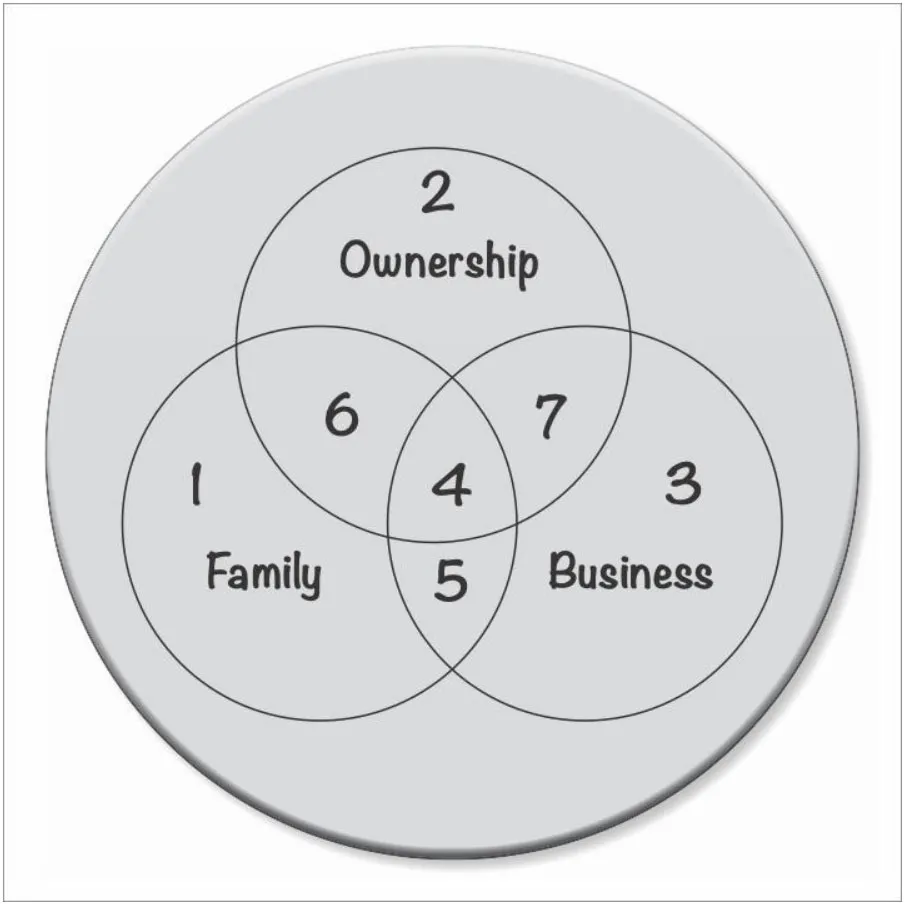
Figure 10.1 The Three-Circle Model.
By way of example, the Controlling Owner (CO) is in Segment 4. In this instance, succession planning occurs on retirement rather than on death. The CO has several choices. They include retirement (moving to Segment 1), staying in the business but transferring all shares (moving to Segment 5), or retiring from the business but keeping a shareholding (which means moving to Segment 6).
In reality, what transpired in this example was that the CO decided to retire, whilst keeping a proportion of his shares. Certain other shares were gifted to a child who was previously employed by the business, so the child moved to Segment 6. Another sibling assumed joint ownership and management responsibility (moving to Segment 4). A non-family member was appointed as a mentor to new family members entering the business, and he received a small number of shares as consideration. As such, whilst the mentor moved to Segment 7 (from Segment 3), the new family members moved to Segment 5 (from Segment 1).
The Three-Circle Model is useful as it serves as a snapshot in time. The lifecycle of the family business is dynamic rather than static. The business in question will have little choice but to change and grow or risk stagnation and a reversal of fortunes. This dynamic position of the model does not operate only at the business level but also at a personal level for business employees.
There is a balance of interests that needs to be maintained. The business may want to change as little as possible, first order change, to allow it to settle. However, in advance of this there may be catalysts for change, e.g. a family member from another family branch joining the business, activating resistance from other family members with existing stakes. This would require restoring harmony through compromise before the business can move on.
Frequently, the business replicates the past in attempting to map the future. It is assumed that someone will simply step into the shoes of a person who has exited, retired or passed away. This is not always possible. The forces of togetherness, which bind the business, may be challenged by the aspirations of individual family members. This is amplified when there is a transition between generations.
The question to be asked in the case of the next generation is whether what worked for the previous generation will continue to do so for the next. The following equation is useful in considering this question:
A + B > C
The role of advisors is to consider B and C and to find practical solutions.
While the Three-Circle Model provides a snapshot, it is not sufficient for any dynamic and changing business. However, it is useful to consider that snapshot in conjunction with a model that better interprets the dynamic environment in which the family business operates.
The types of structures used to hold the family business together (whether family, organisational, legal, or financial) are affected by changes in the lives of the individuals involved, families, ownership groupings, and the business itself. Dr Barbara Murray explains that the family business is a system that is able to change based on a pattern of predictable behaviour, and will do so in order to survive. These elements may apply to three sub-systems within the family business: organisational; family; and ownership (see the Three-Circle Model).
Examples of possible changes that will affect families include:
Senior family members adopting a rigid manner of conducting business because this worked historically. This can lead to business failure.
Unsuitably drafted trust instruments or badly-drafted ownership structures will be questioned by family members and may drive certain members away.
Senior family members using their business to keep the family together. This may be the case even when some members may not be performing adequately. This will place a strain on other family members who feel that their interests are being subordinated to those of the business.
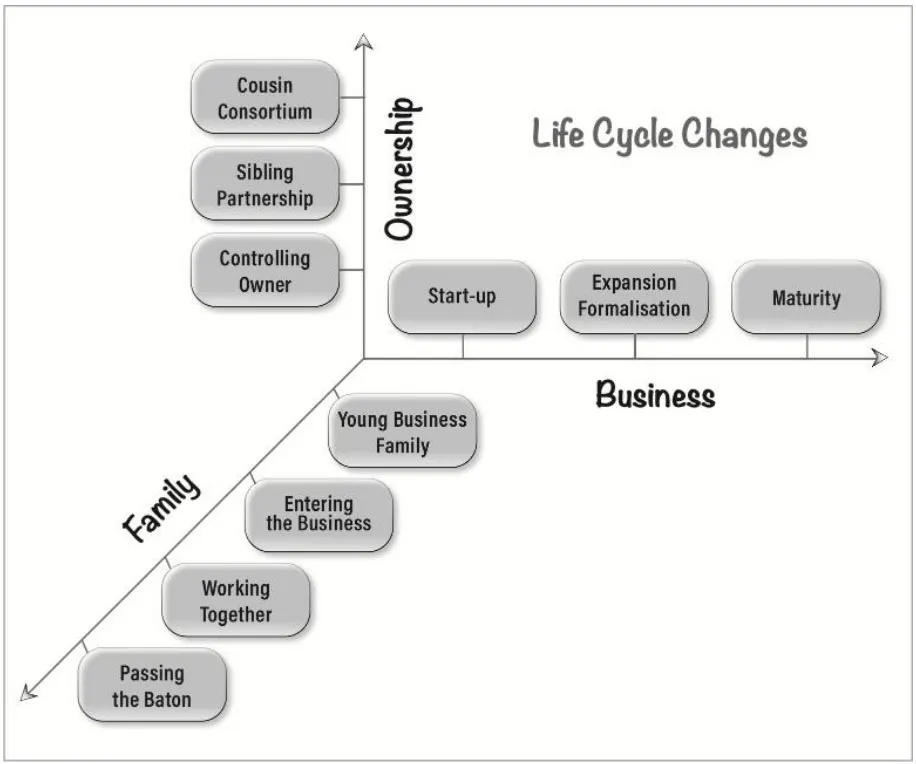
Figure 10.2 Lifecycle changes.
Changes will occur in these three sub-systems so it is useful to ascertain in advance what they may be and how they are likely to manifest. John Ward was one of the first researchers to consider the changing needs of families and businesses over their lifecycles and the ramifications they have on planning and strategic management.
In Generation to Generation: Life Cycles of the Family Business, Gersick, Davis, McCollom, Hampton and Landsberg (1997), the authors describe the ownership lifecycle that can be expected if a business proceeds through its natural evolutionary cycle.
Although the ownership lifecycle may span different forms, there are typically three vital forms, namely: controlling owner; sibling partnership; and cousins’ consortium.
This is frequently the structure that arises when an entrepreneur starts a business that may evolve into a family business. There are generally only one or two owners. If there are other owners, the point of control will be very narrow and limited to one or two owners. One of the challenges in this stage is managing power and accepting that advice and expertise will ultimately be required. Also, the controlling owner will need to consider future-proofing, i.e. considering how and when to let go, and appropriate ownership and structure for the next generation.
If the business passes to one or more siblings in the next generation, it becomes a sibling partnership. This is very different from the controlling owner structure in that the siblings in ownership have to learn how to share control. This is an even greater challenge when certain family members are owners and managers, whilst others are owners only and have not joined the family business, preferring instead to follow their own career paths. Yet again, other siblings may have entered the family business and want to leave it. To ensure that such changes can be undertaken efficiently, governance and management structures are necessary. They should encompass having a proper board, along with a policy on owners’ return on investment. There should also be remuneration commensurate with input, along with overall transparency and accountability.
Needless to say, this is the most complex stage in the development of the family business. By this stage, ownership will have become far more diluted. There will be a broader array of more distant family members involved, some may be owners only, and others may be owners who also participate in the business. This amplifies the need for a proper governance structure. To the extent that governance was not entrenched in the sibling partnership stage, it is paramount in the cousins consortium stage to balance the competing needs of the business, family, and owners.
Given the complexities, a number of professional advisors are likely to be involved. As discussed previously, the advisors need to collaborate to deal with matters at a holistic level. There may be a need for a single person to oversee the entire process.
The original Developmental Model conceived three stages of ownership. The authors of the STEP Advanced Certificate to Family Business Advising added a fourth stage: a Trust. It serves to separate beneficial and legal ownership, with the fiduciary acting for the benefit of the beneficiaries. This differs from a situation in which company shareholders may act in their self-interest, as it takes into account the best interests of the directors and shareholders. An additional layer of complexity is thus added.
At the same time, as changes happen within the ownership structure of the business, changes also take place within the family, and the family has to adapt accordingly. The children become more mature and may enter the business, the parents become older and may have to come to terms with the differing opinions of the children and, indeed, their own mortality. These factors require an understanding of how the different business stages are intertwined with preparing a succession plan.
What is clear is that family businesses are essentially very complex. The Three-Circle Model provides a snapshot of competing self-interests, while the Developmental Model demonstrates how family, business, and ownership structures will inevitably change. These models provide a framework that assists advisors to explain the shifts that occur in family businesses throughout their lifecycles.
However, not all family businesses follow the same pattern of lifecycle development. Other types of transitions may occur, for example:
As already stated, succession is a time for a business to seek more effective mechanisms, structures, and processes through which to operate in terms of planning for the future. This is the reason the models as outlined provide a useful guideline for family businesses.
Transitions in the family business are regarded as examples of punctuated equilibrium. These are sudden shifts in the environment leading to rapid change. Responding to them needs to be swift and efficient and the family business has to adapt quickly to the changing order.
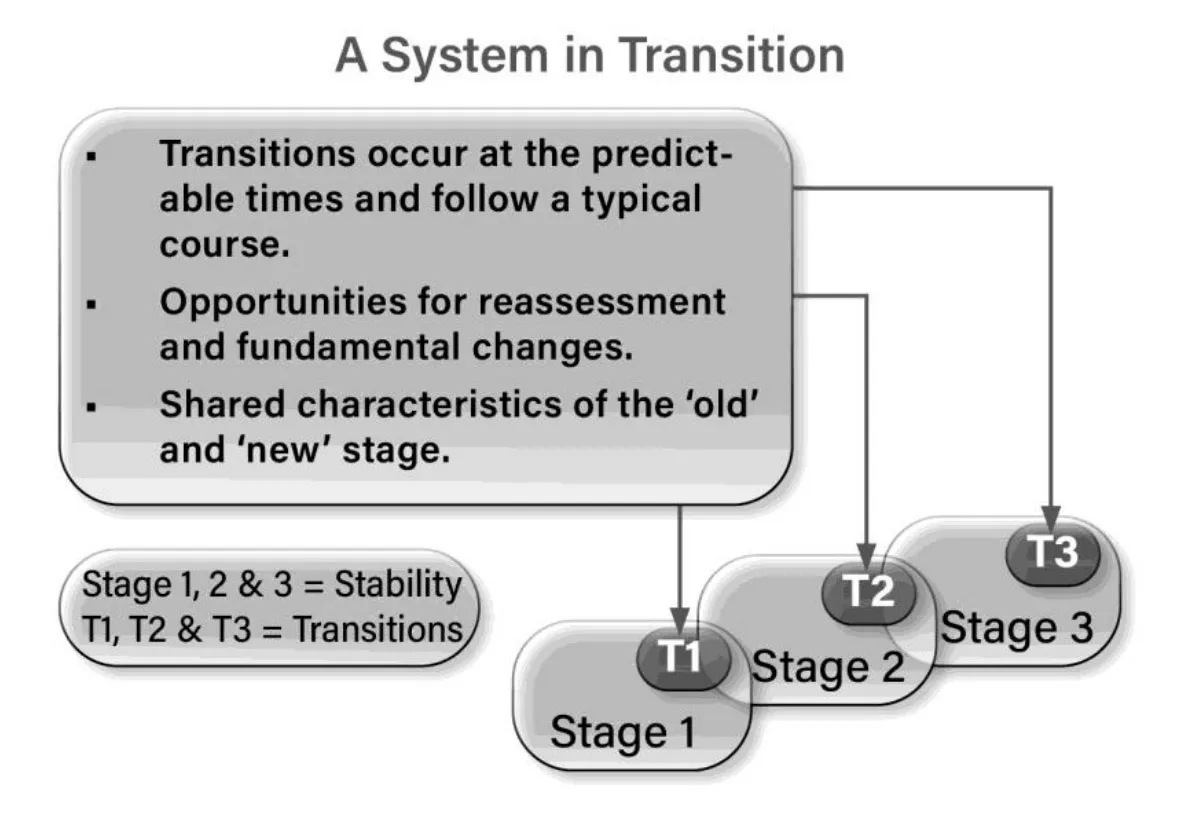
Figure 10.3 A system in transition.
Most businesses prefer making incremental or adaptive changes to their status quo; first order changes. Frequently a family business may resist change or tweak it in an attempt to maintain the old order for as long as possible. If this proves futile and profound, transformative changes are required and it could become a matter of adapt-or-die for the existing business.
The need for a succession plan in every business may initially be muted but, over time, it becomes a very real need demanding to be heard. Often families try to ignore succession or may prefer a do-it-yourself approach, rather than incurring the costs of engaging professional advisors. However, advisory services may become inevitable, especially when succession issues are amplified. The preparation stage is characterised by two traits: resistance and denial. The former is an attempt by those in control to determine the pace of change. As slow as it may be, this is not the same as denial, which totally resists change.
Triggers are events that motivate the family to accept change. Triggers include:
These triggers are often evident in the family business but are ignored just as often. When they are not, the relevant advisor should examine the particular set of circumstances as this may assist in understanding why there is a particular need at that juncture.
Both client and advisor should recognise that a trigger may require a broader response than focusing purely on the trigger. A change in family circumstances may actually require certain personal changes or tweaks to the business in terms of operations or processes. Regardless, it may be time to review broader matters, such as drafting a comprehensive succession plan.
Such transitions can have far-reaching consequences and all affected parties thus have to be considered and consulted. The pace of change may need to be slowed deliberately to ensure that others are not overwhelmed by the process.
An important element in this phase is ensuring that the client’s anxiety to find a solution does not lead to the advisor seeking a quick-fix based on their particular skills. Sufficient time must be allowed to find a well-considered solution to the issues at hand. This may even involve educating and training family members in pursuit of a lasting solution.
This stage is characterised by a melting pot of emotions. The planning can easily be derailed as the family will be unsettled. It is an opportunity for the advisor to take charge from the centre of the Three-Circle Model and so alleviate pressure and allow for a more seamless outcome. By providing support, the advisor will ensure that equilibrium is maintained in the family. Planning, with clear guidelines and related documentation and action plans, will ensure a positive outcome.
This will be the culmination of efforts in the preceding stages. A crucial ingredient is to ensure agreement between all family members. A balance should be sought between best personal outcomes and best possible outcomes in the circumstances.
Making a choice is not itself a final outcome as it has to be actualised. This may involve technical work, drawing up a timetable or action plan, or even an incentive mechanism to facilitate proper finalisation. Mentoring may benefit the different generations involved as both the current and incoming generations should be wholly committed to the process to ensure a smooth transition. This may take time to come to fruition but the delay should never lapse into denial. The role of the advisor is vital in seeing the transition through to its logical conclusion.
The importance of succession planning is that it is a combined challenge and opportunity for the family business owner to pass the business to the next generation. Managing the process is critical because it is intertwined with the emotions of all family members, not least the business owner. He has to come to terms with his own mortality, dreams, hopes, and ambitions, as well as those of the family members who need to be part of the process. Starting with the business owner/incumbent, embarking on succession planning should be clearly articulated and should also be fully embraced by the successor/next generation.
Succession planning should not be viewed in isolation. When an incumbent vacates their leadership role for whatever reason (death, disability, exiting the business) a successor needs to take over. The latter must be developed beforehand and thus leadership development should be part of the process. The two are symbiotic.
The importance of succession planning includes:
Succession planning ensures business continuity. The hopes, plans, and aspirations of the incumbent, the family, and potential successor/s are fulfilled when there is a succession plan in place and it can be successfully implemented.
Changes in the business environment tend to be rapid. They may also be radical and disrupt the continuing operation of the business in the absence of a proper, well-constructed succession plan.
The modern business environment generates increasingly complex challenges. Once appropriate expertise is in place, coordination is needed to ensure these skillsets are effectively passed to the next generation.
Successful businesses often go hand-in-hand with greater leadership responsibilities at lower levels. The incumbent takes an interest in the business as a whole but ensures that leadership responsibility is cascaded to all levels. If this is the case for the current business, it should also be for the next generation. Having a succession plan will ensure that the culture of the business is maintained.
Having a succession plan should encompass detailed consideration of recruitment and retention of the best talent.
There is little point in embarking on a succession plan before understanding the key components that will ensure a successful outcome.
Given the number of businesses that are unable to span generations for want of a succession plan, this initiative warrants priority over other projects. It should be assigned to a senior in the business as a champion. A timetable should be created and communicated. There must be an action plan with pre-defined dates and objectives.
The project should be approached on a holistic basis. The objectives of the company, the incumbent, and relevant stakeholders must all be considered. Both current and future leadership needs must also be taken into account.
There are several aspects requiring alignment: the family’s purpose for their wealth; the business’ current objectives; the incumbent’s vision for the future; and the skillsets of the proposed successor. These should all be coordinated and communicated to ensure effective alignment.
Existing leaders should assist their successors to acquire a good grasp on all facets of their business as early as possible.
Should there be skills gaps, leadership training may be sought from third-party providers in areas in which successors may be deficient or not have had previous experience.
To ensure there is a collective buy-in it is critical that the decision and the process, along with timelines and action points, be communicated as early as possible. This should be done with the business first before engaging with clients and suppliers.
The outgoing incumbent should move away from daily involvement in the business. They should be looking beyond the business and whatever that entails.
There appears to be lethargy in dealing with what is clearly one of the most important issues for family businesses. In the 2019 Family Business Survey conducted by Mazars UK, it was shown that only 27% of family businesses have a documented succession plan in place.
With some five million UK family businesses employing around 12 million people, the scale of the issue becomes apparent. This same trend applies globally. In more recent findings from Wealth-X and IQ-EQ, some US$15.4 trillion of wealth from individuals with a net worth of US$5 million or more, will be transferred from older generations to younger generations by 2030.
There are numerous factors that may affect implementing a succession plan. By understanding what they are, attempts can be made to avoid these in practice.
These may involve the incumbent, current family head or person in a key role, and the successor.
There are several attributes relating to a potential successor that can contribute to a positive outcome:
The role of the incumbent must be carefully considered.
Personal sense of attachment of the incumbent with the business. If the incumbent feels too close to the business, they may be unable or unwilling to let go. This may affect the incumbent’s willingness to ensure that the successor is provided with the necessary training, skills, or respect to assume the role. It may lead to the successor leaving the family business altogether.
This is a major issue for many family businesses, particularly if incumbents feel that they contributed significantly to the success of the business. The need for ongoing communication and incumbent involvement is vital. It is important for the incumbent to have a level of responsibility towards the successor to ensure a proper and smooth transition.
Longevity of the incumbent. The incumbent is usually actively involved in the succession process. Should the incumbent pass away unexpectedly, or otherwise become unable to be involved in the process, this will likely change the company dynamic and stakeholders may decide on a different direction. This is a real risk and the key family members and top executives need to mitigate it by having a succession plan in place, including a mentor to ensure that the planned succession is not thwarted by the untimely demise or exit of the incumbent.
Incumbent’s change in circumstances. Other unexpected events may arise, such as divorce, remarriage, or new children. Such factors can impede a smooth succession plan. While personal factors cannot be ignored, they should never be permitted to unseat the succession plan. To the extent possible, these particular issues should be flushed out and dealt with appropriately.
Avoiding conflicts. It is important that family disharmony such as sibling rivalry or competition among family members is avoided, as this may otherwise unseat a succession plan. Again, ensuring regular communication and involvement at a strategic level may assist to ameliorate the situation.
Positive steps to ensure succession planning. The consensus sensitivity of a family business may pose dangers. In companies where there is consensus sensitivity, a consensus of the majority or absolute consensus is required to make material decisions. This may affect the selection of a suitable person as the successor, and may also impede providing the selected person with the requisite guidance, training, and development, etc. Attempts should be made to provide for certainty in the succession plan and to ensure that decision-making is not unnecessarily onerous.
Succession planning does not occur in a void. It is about people and their relationships. Interpersonal dynamics must, therefore, be considered in compiling and implementing a succession plan. These factors may invariably include:
There is a need for a strong relationship between the incumbent and the successor. In the absence of this, the successor may decide to leave the business or the incumbent might block the appointment. Such a situation should be dealt with by way of a written document, and regular meetings creating a responsibility on the incumbent for the success of the successor.
Family harmony is assumed to help the succession process. If this is absent, the family may block the successor or the person may be unwilling to proceed. Family disputes can be among the worst disputes as they affect both personal and family business dynamics. Psychologist involvement as a mediator may help to resolve the situation.
Integrity and commitment are regarded as key ingredients in a successor, without which it may be difficult to secure the family’s support. Equally, if the successor does not have the commitment of the family/dominant coalition to take on the role, the successor may be denied the opportunities to demonstrate their requisite skills, and the family’s confidence will further dissipate. Such a situation should be dealt with as early as possible. Backing the wrong horse has to be avoided at all costs. Decisions are much more difficult to reverse once an incumbent is no longer in office.
Managing conflicts between incumbents, potential successors, and non-family members is extremely important.
There should be awareness from the early stages of potential conflicts to mitigate their potential serious implications. Dealing with conflict is an acquired skill and as such may be a requirement and to the benefit of the overall process of succession planning.
The costs associated with succession planning should be borne in mind.
This may happen when ownership succession gives rise to inheritance or other taxes. Rather than gearing up the business to cope with the problem, the family/dominant coalition may prefer to sell family assets. All relevant parties should be involved in the decision, one way or the other.
Competent professionals may need to be employed to assist should the successor not have the skills to take the reins, whether immediately or in the medium term. The cost of recruitment may be high and so too the salaries of the professionals, particularly if there are impediments to progress, and all relevant parties should be involved. If these costs mean the business may not be able to continue, that may be the only rational decision.
If the size of the business decreases, the successor may be less willing to lead if the rewards are not sufficient. It has been shown that there is a direct correlation between the size of business and the likelihood of the next generation joining. Financial decisions are always difficult to deal with but such decisions tend to be more cut and dried; it is one or the other! There may be little flexibility for a broad array of options.
Business contexts shift continuously. The incumbent would be well-advised to keep abreast of these shifting arenas as they will influence the manner in which various parties engage with the succession plan.
Changes in market conditions or other variables affecting the business may make it less attractive to the potential successor or for the incumbent to step away. The family, as the dominant coalition, may also reconsider the value of bringing in a successor. Such changes might affect the strategic direction of the business or be beyond the control of the parties, and need to be considered accordingly.
Relationships that the potential successor has with key customers or suppliers should be seriously considered.
If such third parties have established relationships with the incumbent, they may be reluctant to simply switch to the successor, or may want to renegotiate the terms of their existing relationship. This is virtually inevitable when new relationships are introduced, and has to be accepted as part of the different faces and personalities involved. The extent to which the incumbent is able to influence migrating these relationships to the successor, will pave the way for an easier transition.
Considering the required processes before embarking on the actual succession plan will ensure that planning is meaningful and effective.
These roles need to be clearly understood during the transition period and thereafter. The successor needs to comprehend the incumbent’s activities so that he/she is equipped to take over and to get buy-in from the dominant coalition. Clarity also empowers the successor to feel that they have made the correct decision.
The purpose, values and vision of the family concerned need to be communicated. If the successor and other family members are not properly informed, misunderstandings among family members and other stakeholders may arise and impede the succession process. These aspects warrant inclusion in the drafting of the succession plan, how it is updated, and the manner in which it is communicated.
The successor needs to be properly equipped to take on a leadership role. Formal leadership training is vital, along with understanding and working both inside and outside the relevant business. This approach contributes to equipping the successor properly. It is the responsibility of the incumbent and the management team.
The successor needs to be exposed to the business, its customers, suppliers, lenders and other professional relationships to build credibility. The timely drafting of a succession plan and the certainty provided by identifying the parties, as well as their skills and training needs, serve to obviate this as an issue.
The successor should be given periodic feedback regarding progress on succession matters. Factors such as succession goals, changes in strategy, industry context, etc. should be clearly communicated as part of managing expectations on both sides. This again underlines the need for clear, concise, and ongoing communication between the parties concerned.
The criteria for successor selection must be clear and agreed by the relevant parties and family members to ensure there is no perception of unfairness. To avoid conflicts, selection criteria should be part of the succession plan.
The identified team should be recorded in writing and not left to an informal group of family members in the family business. If it is, the expectations of the successor could be frustrated. In a worst-case scenario, this could lead to a potential successor undermining the process.
Before drafting the required documents, the family purpose should be defined. What is the purpose of their wealth? This factor takes the succession plan beyond traditional estate planning and tax and is to the benefit of family governance.
It is about articulating the purpose, vision, and values relating to family wealth, and delivering a decision-making framework to deliver these. Each family is unique, with different sets of challenges and opportunities. Is the wealth intended to build a dynasty with next generation planning in mind, or is it rather ‘ski’, spend the kids’ inheritance? This strategic choice should be enshrined in the family constitution, which is agreed by the broader family and has their buy-in.
The various documents need to be aligned, consistent, and the messages conveyed in one need to tie up with the messages conveyed in the others.
The types of documents may include:
Certain documents depend on the nature of the family business. However, a key document is the will, and there should generally be one will per jurisdiction where there are assets. The will should be updated regularly. All documents should be consistent with the family constitution and purpose.
To the extent that there are family trusts, they are separate from the will of the individual, and may have perpetual succession depending on the jurisdiction in question. Trusts will thus continue, notwithstanding the death of the trust settlor or other trust beneficiaries. It is critical for trustees to have guidelines on who to consult on various family matters and on trust assets after the demise of the settlor or other trust parties. For this reason, the letter of wishes should also be kept updated and should reflect the intentions of the trust parties. Again, this should align with the family constitution and the letter of wishes to the extent that it is relevant. It may be that the family trust (or trustees on its behalf) constitute the shareholder of the family business, in which case it may be easier to ensure documents are appropriate, consistent and up-to-date.
A document that is often not part of the usual set but certainly should be considered is a Lasting Power of Attorney (LPA). This document should ideally be drafted by a lawyer. An LPA will be relevant in the event of incapacity whether through ill-health or some freak accident. The person to be appointed in terms of an LPA should be someone capable of running business affairs.
The succession plan itself should be in writing. It sets out how to continue business operations should the business leader die, exit, or be incapacitated. Family members will know what to do should a trigger event occur. This is important for a family business as its scale may be different from non-family businesses. Obviously, this is a much more personal matter for the family owner.
The succession plan should be documented, well-written, clear, concise and regularly updated. It should have a broad ambit covering more than only key positions. It is vital that the plan be communicated effectively so that relevant individuals in the organisation understand what will happen if there is a trigger event. It is not for everyone and may be limited to human resources, the board, or high-level executives who need to know.
The roles specified in a succession plan typically include only the CEO, CFO, COO, etc. For a family business, it may make sense to have a broader span covering more roles than only executive level. This provides a measure of certainty for the family and next generation planning. The identified employees should be involved in drafting the succession plan. A succession plan framework generally includes the following.
It does not matter what type of company is involved, nor whether the plan is digital or in paper form. The basic provisions that should be included at the outset and with instructions are:
These are considerations that depend on the type of business and the context in which it functions.
Apart from being included in the elite club of family businesses that actually have proper business plans, there are several other advantages:
Wealthy families do not make decisions in isolation. The role of advisors is integral to decision-making. Trusted advisors play a pivotal role in succession processes, given that the milieu in which succession takes place is becoming increasingly challenging. There are complicating factors with new regulations and other issues to consider.
During the past five years there have been in excess of 80 studies on family business advisors. One reveal is that advisors contribute positively to succession processes. They provide valuable mentorship to the incumbent and the successor, as well as with dealing with issues along the way, including facilitating or providing mediation when necessary. (Refer to Chapter 12 on Resolving Family Differences, The Role of Advisors and Trustees).
It is expected that there will be further research on the role of trusted advisors as this is integral to both incumbents and successors during succession processes. Absent the advisors’ provision of and advice to both parties, succession processes may not proceed smoothly. Balancing the needs and requirements of both incumbents and successors is critical to ensuring streamlined and unencumbered succession.
Succession planning requires looking beyond the family office/corporate setting. It should be borne in mind that at the heart of succession planning is the individual. It just so happens that, in our context, succession planning is intensely personal. What is more, each succession plan tends to be bespoke, or at least, it should be.
Every succession plan should have the potential to be unique. What is more, the succession plan should have the potential to consider emotive assets. These may include shares held in closely-held businesses (which is the primary focus of this chapter), but also a family home, long-held chattels, or certain luxury assets. There is a risk in dealing with these assets, irrespective of where and how they are held, particularly if they are illiquid, require maintenance, or are failing. This risk is amplified if certain family members have pre-existing expectations that may not have been verbalised to the family office, fiduciary, other professionals, or indeed, the draftsperson.
Family members may have a connection, or sense of entitlement, to the asset, which may drive a desire to exercise control or ownership of the asset. This becomes an even more complex issue if the asset is within a fiduciary structure, which may well be outside the jurisdiction of residency.
Thus, the broader succession plan should be approached holistically to include all jurisdictions, structures, and assets (howsoever and wheresoever owned); and those that may be emotive and complex. Consideration of potential causes of conflict must be discussed and addressed in arriving at workable solutions.
Succession planning is changing. The primary driver for the change is one of the largest intergenerational wealth transfers in history (as noted at the start of this chapter). This has become a multi-dimensional process, in that AI and digital processes have to be considered, these change how businesses and offices operate and also how the intergenerational transition occurs. Also, with the increasing mobility of families, family members and assets are situated across jurisdictions, which gives rise to cross-jurisdictional issues. The complexity of these is amplified, with having to consider tax rules (inheritance, estate, cross-border) and the changing landscape of these. What is more, the next generation’s values may be different from those of the previous generation, in terms of impact, sustainability, legacy over pure wealth. As such, it is not only a consideration of change of control, rather also alignment of purpose.