Traffic accident claim Belgium procedures follow a clear logic once you understand the two routes open to you: pursuing the at-fault driver’s insurer, or bringing a direct action before the civil courts. This guide walks victims, family members, insurers and claims handlers through every stage, from the moment of collision to a negotiated settlement or a filed court claim. It sets out the exact documents you need, the statutory deadlines that can extinguish your rights, and the practical weight of the police report (proces-verbaal / PV) that so often shapes the outcome.
Belgium operates a compulsory motor insurance system, which means most claims resolve through insurers, but knowing when to litigate, and how to preserve your position in the meantime, is what separates a full recovery from a discounted one.
Expected outcome: you will be able to decide whether to claim via insurer or court, gather the required documents, meet the prescription deadlines, and understand the next steps of negotiation, mediation or litigation.
A traffic accident claim Belgium victims bring is a civil demand for compensation for the harm caused by a road collision. That harm can be physical injury, psychological damage, property damage to a vehicle, loss of earnings, medical expenses and other out-of-pocket costs. The claim is founded on civil liability: the party at fault (or their insurer) must make good the loss suffered by the injured party. In practice, because motor insurance is compulsory, the vast majority of these claims are directed at an insurer rather than at the individual driver.
The legal architecture combines the general law of civil liability with a specialised motor insurance regime. Understanding which framework governs your situation determines both the speed of recovery and the strength of your position. Belgium is a federal state, and while the substantive civil law is national, some procedural and administrative practices differ across Brussels, Wallonia and Flanders, for example the language of proceedings and the competent local court.
Motor insurance covering third-party liability is mandatory for every vehicle driven on Belgian roads, under the legislation governing compulsory civil liability insurance for motor vehicles. This obligation exists precisely so that innocent victims are not left without a solvent defendant. The insurer of the vehicle at fault stands behind the driver’s civil liability, and the injured party can generally address their claim to that insurer directly. The general rules of civil liability, fault, damage and causal link, remain the backbone of any claim, while the motor insurance legislation adds victim-protective mechanisms on top.
Where a vehicle is uninsured or untraced, a statutory guarantee fund (Fonds commun de garantie belge / Belgisch Gemeenschappelijk Waarborgfonds) provides a safety net, discussed in detail below.
The right to compensation is not limited to drivers. It extends to injured passengers, pedestrians, cyclists and other third parties affected by the collision. Certain categories of vulnerable road users, pedestrians, cyclists and passengers, benefit from enhanced protection under the motor insurance regime, which strengthens their right to compensation for bodily injury largely irrespective of who was at fault (subject to defined exceptions). Family members may also claim in their own right for losses flowing from the death or serious injury of a relative, such as funeral costs and, in appropriate cases, moral damages.
One of the first strategic decisions in any road traffic claim Belgium victims face is whether to route the claim through the at-fault insurer or to sue the driver directly. In the great majority of cases the insurer path is faster, cheaper and more reliable, but there are defined circumstances where a direct action is necessary or advantageous. Choosing correctly at the outset avoids wasted time and preserves leverage.
Because motor liability insurance is compulsory, the practical starting point is almost always the insurer of the vehicle at fault. The victim can bring the claim to that insurer, which investigates liability, assesses damages and, where liability is accepted, pays compensation. This is generally quicker than litigation and shields the claimant from the solvency risk of an individual defendant. Where your own insurer pays out first (for example under an own-damage or legal-expenses cover), it acquires a right of subrogation, meaning it steps into your shoes to recover the amount from the party ultimately responsible. Subrogation keeps the victim whole while allowing the loss to fall, eventually, on the wrongdoer’s insurer.
Several situations push a claim away from the ordinary insurer route:
Even where a direct lawsuit is filed, the insurer can usually be brought into the proceedings, so the two routes are not always mutually exclusive.
The following numbered sequence sets out the practical stages of a claim, from the scene of the collision through to litigation. Each step builds the evidential foundation for the next. The timeline table that follows summarises who does what and by when.
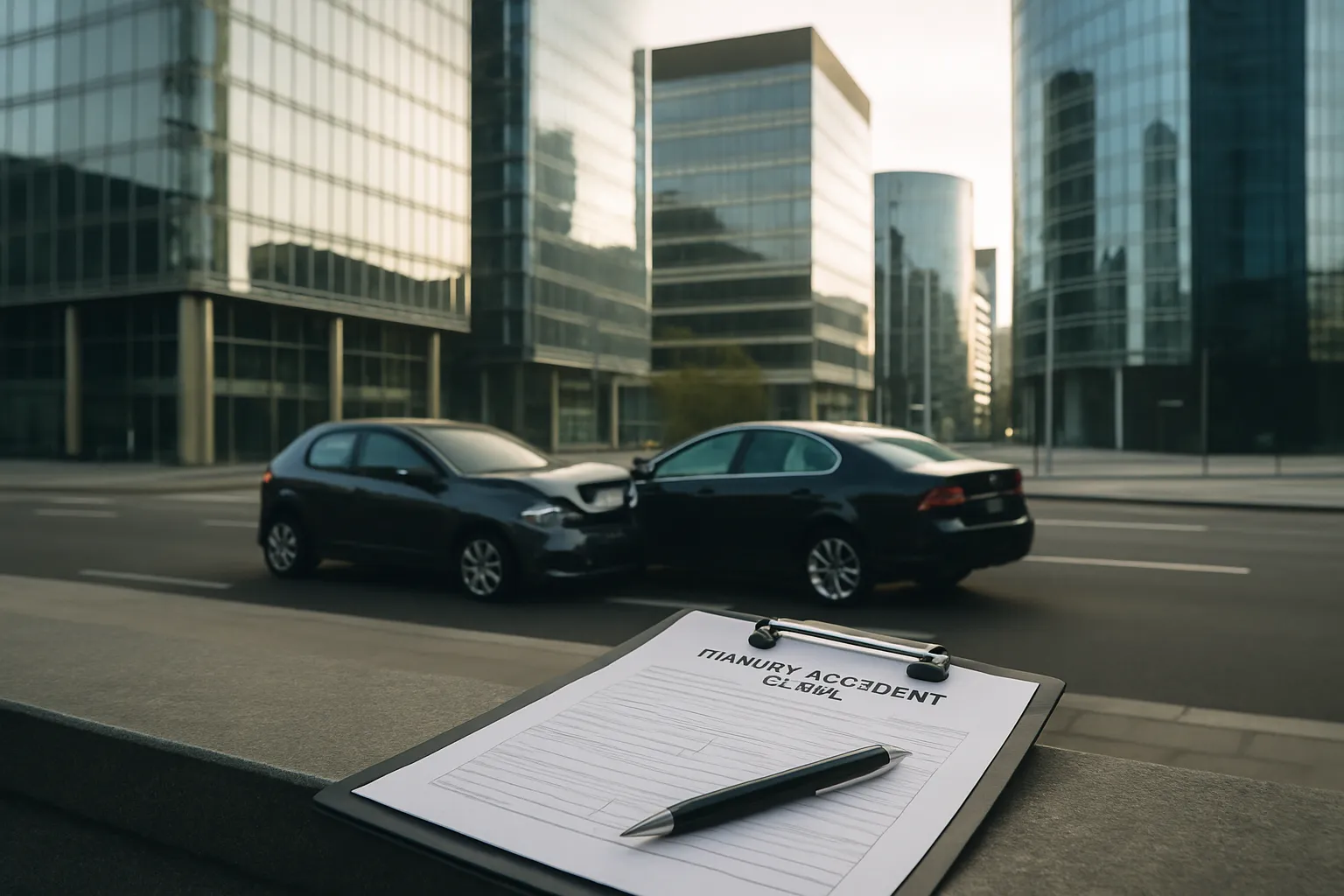
Secure the scene first: switch on hazard lights, place the warning triangle and move to safety. Exchange names, addresses, vehicle registration numbers and insurance details with every other driver involved. Complete the European Accident Statement (the standard amicable-settlement form) if all parties agree on the basic facts, and sign it. Take clear photographs of vehicle positions, damage, road signs, skid marks and the wider layout before vehicles are moved. Note the identities and contact details of any witnesses. This is the only moment the scene exists in its original state, capture it thoroughly.
Call the police where there are injuries, a fatality, a dispute over the facts, or where a party refuses to cooperate. When the police attend, they prepare an official report, the proces-verbaal (PV), recording the location, the parties, the vehicles, witness accounts and their own observations. The PV is a persuasive official document and a central piece of evidence, but it is not legally conclusive as to fault. Belgian courts assess the entire body of evidence and are free to reach a different conclusion from the impression left by the police report. Request the reference number of the PV at the scene; you will need it to obtain a copy later through the competent authority.
Treat the PV as the backbone of your file, not as the final word on liability.
Report the collision to your own insurer promptly, many policies require notification within a short, fixed period and impose consequences for late reporting. Provide the completed accident statement, the PV reference, photographs and a factual account. If you hold legal-expenses cover, activate it early: it can fund expert reports and legal representation. Where you carry own-damage cover, your insurer may advance repair costs and later recover them from the at-fault insurer through subrogation. Prompt notification protects your cover, triggers the insurer’s investigation, and starts the clock on any advance or interim payment you may be entitled to. Keep a dated record of every communication with the insurer.
Obtain medical assessment even if injuries seem minor, some conditions, such as whiplash or concussion, emerge over the following days. Attend a doctor or hospital promptly so that the injury is documented close in time to the collision, which strengthens the causal link. Keep every medical report, prescription, imaging result and hospital discharge note. Ask your doctor for a certificate of incapacity for work (attest) if you are unable to work; this underpins any claim for temporary incapacity and lost earnings. Consistent, contemporaneous medical documentation is the single most important evidence in a personal injury claim Belgium courts and insurers will scrutinise.
Assemble a complete evidence file: scene photographs and video, signed witness statements, repair estimates and invoices, medical records, and receipts for every out-of-pocket expense. Obtain a written repair estimate from a garage and, for significant damage, a technical assessment. Preserve damaged property where feasible until it has been inspected. Organise everything chronologically so the claim narrative is easy to follow. The more coherent and corroborated your file, the harder it is for an insurer to dispute or discount your car accident compensation Belgium claim.
Submit a formal, written claim to the insurer of the vehicle at fault. Set out the facts, the basis for liability, the categories of loss (bodily injury, property damage, lost earnings, expenses) and a quantified demand supported by your evidence. Reference the PV number and enclose copies of key documents. State clearly that you reserve your rights in respect of losses not yet quantified, for example, future medical treatment or ongoing incapacity. Send the claim by a method that provides proof of delivery and do so well before any prescription period could expire. A precise, well-documented claim frames the negotiation on your terms.
If the insurer denies liability or makes an inadequate offer, escalate. Send a formal demand letter (mise en demeure / ingebrekestelling) setting a deadline for a proper response. Consider mediation or a complaint to the Insurance Ombudsman (Ombudsman van de Verzekeringen / Ombudsman des Assurances) where insurer conduct is at issue. If these fail, litigation becomes the route to enforce your rights.
Where negotiation is exhausted, a claim is brought before the competent court, determined by the value of the claim and the language regime of the region. The at-fault insurer is typically joined to the proceedings so that any judgment can be enforced against a solvent party. The court may appoint an independent medical or technical expert to assess injury or reconstruct the collision. Litigation timelines vary considerably, from several months for straightforward matters to years for contested, high-value injury claims. Legal representation is strongly advisable at this stage.
| Step | Who | Typical duration / target timeline |
|---|---|---|
| 1. Secure scene & exchange details | All drivers / witnesses | Immediately, at the scene |
| 2. Call police / obtain police report | Victim / police | Same day (if injury or dispute); PV issued within days |
| 3. Seek medical attention | Victim / emergency services | As soon as possible (document injuries) |
| 4. Notify your insurer | Victim / policyholder | Promptly, or as the policy requires |
| 5. Collect evidence & estimates | Victim / repairer / witnesses | First few weeks |
| 6. Send formal claim to at-fault insurer | Victim / claims handler | Within weeks, before prescription runs |
| 7. Insurer response & negotiation | Insurer / claimant | Weeks to months; depends on complexity |
| 8. File court claim if unresolved | Claimant / lawyer | After failed negotiation; months to years |

A claim succeeds or fails on its documentation. Each document below plays a distinct evidential role, and the strength of the whole file depends on how completely and consistently these pieces fit together. Provide copies rather than originals to insurers, keep originals safe, and ensure every document is dated and legible. Photographs and correspondence should be preserved in their original digital form where possible, since metadata can corroborate timing.
| Document | Who provides it | Why it matters |
|---|---|---|
| Police report (proces-verbaal / PV) | Police | Primary official record of facts, parties and location; persuasive but not conclusive |
| Driver / vehicle details & insurance info | Parties involved | Identifies the liable insurer and the relevant policy |
| Photos and video of the scene | Claimant / witnesses | Visual proof of damage, vehicle positions and road signs |
| Medical reports & hospital records | Treating physicians / hospitals | Proof of injury, treatment and prognosis |
| Repair estimates & invoices | Garages / repairers | Proof of property damage and repair cost |
| Witness statements (signed) | Witnesses | Corroborates the claimant’s version of events |
| Claim form / insurer correspondence | Claimant / insurer | Establishes the paper trail of the claim and responses |
| Pay slips / proof of income | Claimant | Supports a claim for loss of earnings |
| Bank statements / receipts | Claimant | Proof of out-of-pocket expenses |
| Certificate of incapacity for work (attest) | Doctor / GP | Supports compensation for temporary incapacity |
Two practical tips. First, obtain the PV copy as early as the competent authority allows, because it anchors the factual narrative that every other document supports. Second, keep a running expense log with receipts attached; small out-of-pocket costs add up and are routinely under-claimed. A well-ordered document set signals to an insurer that the claim is serious and litigation-ready, which frequently improves the settlement offer.
Missing a prescription deadline is the most catastrophic and most avoidable error in any claim. Once a limitation period expires, the right to compensation is generally lost, however strong the underlying case. Because different rules apply to different components of a claim, you should treat the shortest applicable period as your working deadline and act well before it.
Belgian civil law distinguishes between the general prescription of contractual and non-contractual claims, the specific periods governing actions arising from an offence, and the rules applicable to claims against insurers. Personal injury and property damage arising from a road collision are typically pursued as non-contractual (tort) claims, which are subject to a limitation period that runs from the date the victim knew, or ought to have known, of the damage and the identity of the person responsible, subject to a longer absolute long-stop running from the event itself. Direct actions against the insurer, and claims connected to a criminal prosecution of the driver, may be governed by their own periods.
Because the precise period depends on the legal characterisation of your claim, obtaining the current statutory text and article numbers from the official legislation portal, or advice from a qualified lawyer, is essential.
Special protective rules apply to minors and legally incapacitated persons, for whom prescription may be suspended so that their rights are not lost while they are unable to act. This matters greatly in serious injury cases involving children.
To preserve your rights in practice:
Understanding the likely cost of pursuing a claim helps you weigh the insurer route against litigation. Many civil practitioners work under mixed fee arrangements, and legal-expenses insurance, where you hold it, can absorb much of the cost. Successful claimants can often recover part of their legal costs from the losing party through the procedural indemnity (rechtsplegingsvergoeding / indemnité de procédure), though this recovery is set by statutory scales rather than being a full indemnity.
The figures below are broad indications only; court fees, expert fees and lawyer fees vary considerably by court, case value and complexity, and are set by the applicable rules and by agreement with your lawyer. Confirm the current position before relying on any figure.
| Cost item | Who pays / indicative note | Notes |
|---|---|---|
| Court registry fee (rolrecht) | Claimant initially | Varies by court and claim value; potentially recoverable if you win |
| Expert / technical report | Claimant / court-allocated | Needed for complex injury or technical disputes; cost varies |
| Lawyer fees | By agreement (fixed, hourly or mixed) | Many civil lawyers use mixed fee models |
| Medical records retrieval | Claimant | Small administrative fees may apply |
| Vehicle repair excess | Policyholder (varies) | Depends on policy terms |
| Guarantee fund claim (uninsured) | Guarantee Fund, subject to criteria | Potential compensation via the Fonds commun de garantie belge / Belgisch Gemeenschappelijk Waarborgfonds |
Several developments are relevant to a traffic accident claim Belgium victims may bring. The ongoing digitalisation of police reporting is making electronic access to the proces-verbaal more streamlined in some districts, which can shorten the wait for a copy. Practitioner and judicial discussion continues on the evidentiary weight of the police report, reinforcing the settled position that the PV is persuasive but not binding on the court. Motor insurance supervision and consumer-protection practice also continue to evolve under the relevant supervisory authorities. Because reforms in this area take effect incrementally, confirm the current position against the official legislation and mobility sources before relying on any specific rule.
| Feature | Claim via insurer | Direct lawsuit against driver |
|---|---|---|
| Speed | Typically faster | Often slower (bound by the court timetable) |
| Costs to claimant | Usually lower upfront | Higher upfront legal costs |
| Recovery reliability | Insurer solvency generally strong | Depends on the defendant’s means |
| Evidence burden | Insurer investigates but may dispute | Court decides on the evidence; formal procedure |
| Subrogation risk | Insurer can pursue the wrongdoer later | Claimant sues directly; insurer may intervene |
The following outlines are for guidance only and do not constitute legal advice; adapt them to your circumstances and seek counsel before sending anything of legal significance.
Sample claim letter to the at-fault insurer, cover these points:
Sample reservation-of-rights wording: “I expressly reserve all my rights in respect of any further losses, including future medical treatment, ongoing incapacity for work and any consequences of the collision not yet capable of quantification.” Include this in your formal claim so that later-emerging losses are not treated as waived.
A well-run traffic accident claim Belgium victims and insurers pursue rests on three foundations: acting quickly to secure evidence, documenting everything with precision, and respecting the prescription deadlines that can otherwise extinguish an otherwise strong case. For most claimants the insurer route delivers a faster and more reliable recovery, but knowing when to escalate to a formal demand or to court, and how to preserve your rights while you decide, is what protects the full value of your claim. Where liability is disputed, injuries are serious, or the other driver is uninsured, professional advice is not a luxury but a safeguard.
If you are managing a traffic accident claim in Belgium, consider consulting an experienced civil and insurance lawyer to assess your position and protect your deadlines.
This article was produced by Global Law Experts. For specialist advice on this topic, contact Hakan Hüsnü Erzurumlu at Hakan H. Erzurumlu Advocaat, a member of the Global Law Experts network.