
Our Expert in Switzerland
No results available
VAT refund Switzerland claims have become materially harder to get right in 2026, and non‑established businesses that treat the process as a formality are increasingly seeing claims rejected or delayed. The Swiss Federal Tax Administration (FTA) has modernised its reporting environment and sharpened its scrutiny of cross‑border refund files, which means documentation that passed muster a few years ago may now trigger queries. This guide is written for CFOs, tax managers, non‑established suppliers and their advisers who need a clear, defensible route to reclaim Swiss VAT.
It sets out who qualifies, how to choose between registration and a refund, the procedural steps, the evidence the FTA expects, the deadlines that bind you, and how to prepare for an audit or appeal.
A VAT refund Switzerland application is designed for businesses established abroad that incur Swiss VAT but are not required to register for Swiss VAT. The mechanism sits within the Swiss VAT Act (Mehrwertsteuergesetz, MWSTG) and the FTA’s practice notes, and it allows a foreign taxable person to recover input VAT on qualifying Swiss expenditure, provided they do not carry on activities in Switzerland that would compel registration. The core logic mirrors international VAT principles endorsed by the OECD: VAT is a tax on domestic consumption, so businesses that are not the final consumer should not, in principle, bear it as a cost.
For context, the standard Swiss VAT rate is currently 8.1%, with a reduced rate of 2.6% for certain goods and a special rate of 3.8% for accommodation services. Always confirm the applicable rate against current FTA guidance before relying on any figure.
To qualify for a refund as a non‑established business, you generally need to meet several conditions. You must be a taxable person in your home jurisdiction, carrying on genuine business activity. You must not make taxable supplies in Switzerland that would require you to register (subject to the reverse‑charge rules that shift the tax to the Swiss recipient in many B2B situations). And your home country must, in principle, offer reciprocity, meaning Swiss businesses can obtain comparable relief in your jurisdiction. The FTA maintains guidance on which jurisdictions are recognised as offering reciprocity.
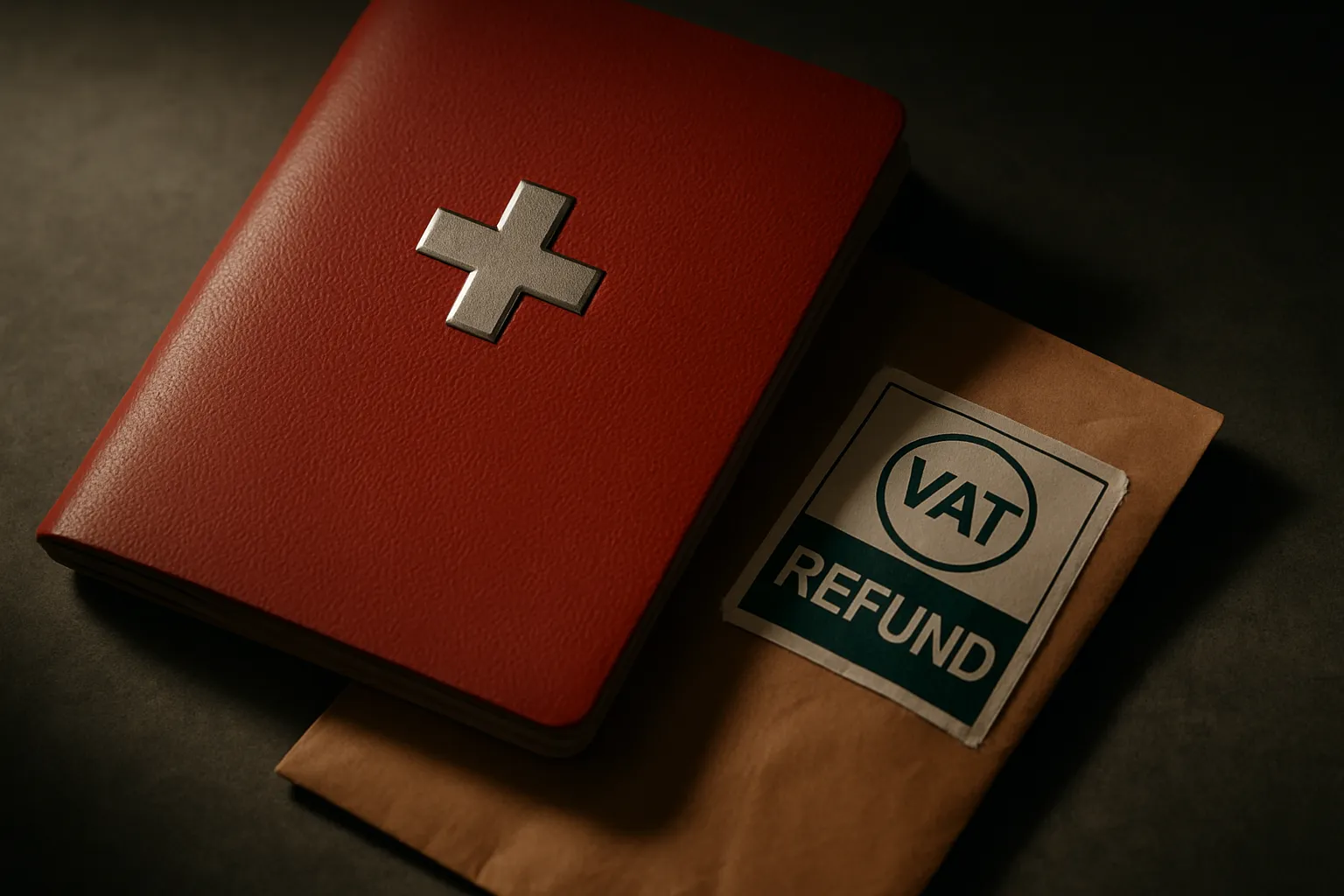
Do not confuse the business refund procedure with the tourist VAT refund scheme for goods exported in personal luggage. The tourist scheme is a retail export mechanism with its own minimum purchase threshold and export‑confirmation requirements. The business refund route discussed here is an administrative claim filed with the FTA for input VAT incurred in the course of trade. The two have entirely different forms, deadlines and evidence standards.
Common exclusions from a business refund include VAT on expenditure that is non‑deductible in nature, supplies used for exempt activities without credit, and claims from businesses in jurisdictions that do not offer reciprocity. Always confirm the current position against FTA guidance and the VAT Act on Fedlex before committing resources to a claim.
The first strategic decision is whether to reclaim Swiss VAT through the refund procedure or to register for Swiss VAT and recover input tax through periodic returns. This is not a matter of preference, it is driven by the nature and frequency of your Swiss activity. Register when your business makes recurring taxable supplies in Switzerland; use the refund route when you merely incur occasional Swiss input VAT on costs without making local taxable supplies.
Registration becomes mandatory once you carry on taxable business in Switzerland above the relevant turnover threshold (worldwide turnover from taxable supplies is relevant under the current rules), or where the reverse charge does not apply and you are the party liable to account for Swiss VAT on supplies made in the country. Registration turns you into a full Swiss taxable person: you charge and collect VAT, file periodic returns, and recover input tax through those returns rather than through a standalone refund application. Confirm the current registration threshold against FTA guidance, as it is fixed by law and subject to change.
The refund route is generally preferable where your Swiss footprint is limited to purchases, trade fair costs, marketing spend, hotel and travel expenses, professional fees or occasional imports, without any local taxable output. If you have no obligation to register and no recurring taxable supplies, the annual refund application is usually simpler and lower‑risk than maintaining a full Swiss registration.
| Factor | Register in Switzerland | Claim a refund |
|---|---|---|
| Typical trigger | Recurring taxable supplies in Switzerland; threshold exceeded; liable under Swiss VAT rules | Occasional Swiss input VAT on costs; no taxable supplies requiring registration |
| Pros | Continuous input‑tax recovery through returns; can issue Swiss VAT invoices; no reciprocity test | No ongoing compliance; single annual filing; lower administrative overhead |
| Cons | Periodic returns; ongoing compliance burden; fiscal representation usually required | Reciprocity requirement; strict evidence standards; one filing per period; slower cash recovery |
| Timing of recovery | Recovered each return period, faster cash cycle | Recovered once per year after claim processed, slower |
| Compliance burden | High, continuous | Moderate, concentrated at filing |
| Audit risk | Ongoing exposure across all returns | Concentrated on the annual claim file; heavily documentation‑driven |
Decision rule: Choose registration when your taxable turnover in Switzerland is recurring or exceeds the registration threshold, otherwise the refund route is usually preferable. Where the position is borderline, or where reverse‑charge treatment is uncertain, have a Swiss VAT adviser evaluate the facts before you file. The wrong pathway can mean rejected claims, penalties, or unnecessary compliance costs.
The FTA VAT refund procedure rewards preparation. Because the claim is largely assessed on the paper file you submit, the quality of that file determines the outcome. Follow the sequence below to build a claim that survives scrutiny.
Assemble original invoices (or compliant copies as the FTA specifies), import customs declarations for border VAT, contracts, proof of payment and a schedule listing each item with the Swiss VAT amount claimed. A well‑ordered claim schedule that ties each invoice to a supporting document is the single most effective way to reduce FTA queries.
Submit the claim using the FTA’s designated refund application form and the current submission channel. Follow the exact form instructions published by the FTA, because ongoing reporting modernisation has affected how supporting data is captured and transmitted. Use the current‑year form: an outdated version is a common reason files are returned unprocessed. Appointment of a Swiss fiscal representative is generally required for the refund procedure.
Amounts must be reported in the currency and format the FTA requires, and invoices must satisfy Swiss VAT invoicing rules, correct supplier details, a proper description of the supply, the VAT rate and amount, and the date. Where amounts are converted, apply the exchange‑rate convention accepted by the FTA and keep the calculation auditable.
Refund claims are subject to a statutory filing deadline set out in the VAT Act and its implementing ordinance on Fedlex. File within the prescribed window for the relevant period, late claims are, as a rule, forfeited. Because the precise cut‑off date is fixed by the ordinance and can be affected by administrative practice, confirm the current deadline against FTA guidance before you rely on it, and always aim to file well ahead of the limit.
Practitioner tip: Build your refund file continuously through the year rather than scrambling at the deadline. A running claim schedule, updated as invoices arrive, turns a stressful year‑end exercise into a review, and it is far easier to chase a missing customs declaration in real time than months later.
Documentation is where most VAT refund Switzerland claims succeed or fail. The FTA assesses the file on its face, so gaps, inconsistencies or non‑compliant invoices are the leading causes of rejection. Treat evidence as the core of the claim, not an afterthought.
For cross‑border VAT reclaim scenarios, you must evidence where and how the supply was consumed. For goods, this means transport and delivery documents. For services, it means contracts and, where relevant, evidence establishing the place of supply.
Where you are recovering import VAT, the Swiss customs import declaration is the central document. The records of the Swiss Federal Office for Customs and Border Security (FOCBS/BAZG) support the value and the VAT paid at the border, and the FTA expects the customs declaration to reconcile with the amount claimed. Keep freight documents, delivery notes and any customs valuation paperwork with the file.
Contracts substantiate the commercial substance behind the invoices, and proof of payment demonstrates that the cost was genuinely borne by your business. For higher‑value items or anything unusual, expect the FTA to want to see the money trail.
Digital and cross‑border services attract particular scrutiny because place‑of‑supply rules determine whether Swiss VAT was correctly charged in the first place. Where VAT should have been reverse‑charged, a refund of that VAT will not succeed, the correct route is a corrected invoice from the supplier. Keep a clear chain‑of‑supply narrative so the FTA can see why Swiss VAT was properly incurred.
Common FTA rejection triggers: non‑compliant invoices; VAT that should have been reverse‑charged; missing customs declarations for import VAT; costs outside the claim period; expenditure that is non‑deductible in nature; and mismatches between the claim schedule and the underlying documents.
A fiscal representative is a Swiss‑based intermediary who acts for a foreign business in its dealings with the FTA. For foreign businesses, appointment of a representative established in Switzerland is a standard requirement both for registration and, generally, for the refund procedure.
The fiscal representative liaises with the FTA, receives correspondence, and helps ensure filings meet Swiss standards. For registered foreign businesses, a Swiss representative is required. For refund claims, a foreign claimant typically must designate a representative in Switzerland to receive service; many businesses also rely on the representative to manage audit correspondence and to bridge language and procedural gaps.
Fees vary with complexity and volume, from modest fixed fees for a straightforward annual refund to higher engagements where audit defence is involved. Confirm liability allocation in writing, you remain the taxable person, but the representative’s diligence directly affects your exposure. For help identifying suitable advisers, see the Global Law Experts VAT lawyers, Switzerland directory.
Timing discipline protects the value of your VAT refund Switzerland claim. Miss the statutory window and the input tax is generally lost, regardless of merit.
Recent reporting changes have increased the emphasis on structured, machine‑readable data and consistent documentation, including expanded electronic filing through the FTA’s online portal. The practical effect is that files with clean schedules and reconciled evidence tend to move through faster, while incomplete files attract more queries. Build your timeline backwards from the deadline: allow weeks, not days, for gathering customs declarations and chasing compliant invoices.
Practitioner tip: Diarise the deadline the moment the claim period opens, and set an internal cut‑off at least a month earlier. That buffer is where you catch the missing invoice or the reverse‑charge error before it becomes a rejection.
Even a well‑prepared claim can be selected for review. Approaching an FTA audit as a documentation exercise, calmly and completely evidenced, is the most reliable way to preserve your refund.
Large claims, first‑time claimants, unusual cost profiles, and inconsistencies between the schedule and supporting documents are typical triggers. Keep the full evidence pack readily retrievable: invoices, customs declarations, contracts, payment proof and the reconciled claim schedule. The faster and more complete your response, the less momentum an audit gathers.
Common queries concern whether VAT was correctly charged rather than reverse‑charged, whether costs relate to your business, and whether import VAT reconciles with customs records. Prepare a concise cover note that walks the reviewer through each contested item with a direct reference to the supporting document. A clear, respectful, document‑led response resolves most queries without escalation.
If the FTA rejects the claim, you can challenge the decision through the objection and administrative appeal process, and thereafter before the Federal Administrative Court, with the possibility of a further appeal to the Federal Supreme Court on points of law. Appeals are subject to strict deadlines and formal requirements, so act promptly and take advice on the grounds before responding. Escalate to litigation where the amount justifies it and the legal position is defensible; resolve smaller or evidence‑based disputes at the administrative stage where possible.
Practitioner tip: When the first FTA query arrives, resist the urge to argue. Answer the specific question, attach the specific document, and reconcile the specific number. Most disputes escalate not because the claim was wrong, but because the response was vague.
Three short scenarios illustrate how the VAT refund Switzerland route works in practice.
Vignette 1, Non‑EU supplier reclaiming Swiss VAT on marketing spend. A non‑established business incurred Swiss VAT on trade‑fair, hotel and agency costs while promoting its products in Switzerland, without making any local taxable supplies. Because reciprocity was satisfied and the costs were business‑related, the annual refund route recovered the input tax. Key takeaway: keep compliant invoices and a running schedule from day one.
Vignette 2, Digital services and place of supply. A foreign provider was charged Swiss VAT on services that, on analysis, should have been reverse‑charged to the Swiss recipient. A refund of that VAT was not available; the correct fix was a corrected supplier invoice. Key takeaway: verify place‑of‑supply treatment before filing, because a refund cannot cure incorrectly charged VAT.
Vignette 3, Import VAT recovered via refund vs import declaration. A business importing goods for a short Swiss project paid import VAT at the border. With the customs import declaration reconciled to the claim, the import VAT was recovered through the refund procedure. Key takeaway: the customs declaration is the linchpin document for any import VAT recovery.
To move from intention to a filed, defensible VAT refund Switzerland claim, work through the following action list:
For related reading, see the Global Law Experts Swiss VAT Changes 2026 Checklist.
This article was produced by Global Law Experts. For specialist advice on this topic, contact Ivo Gut at Homberger VAT Ltd., a member of the Global Law Experts network.
posted 32 minutes ago

posted 54 minutes ago

posted 1 hour ago

posted 2 hours ago

posted 2 hours ago
posted 2 hours ago

posted 3 hours ago

posted 3 hours ago

posted 3 hours ago

posted 4 hours ago

posted 4 hours ago

posted 4 hours ago
No results available
Find the right Legal Expert for your business

Send welcome message