
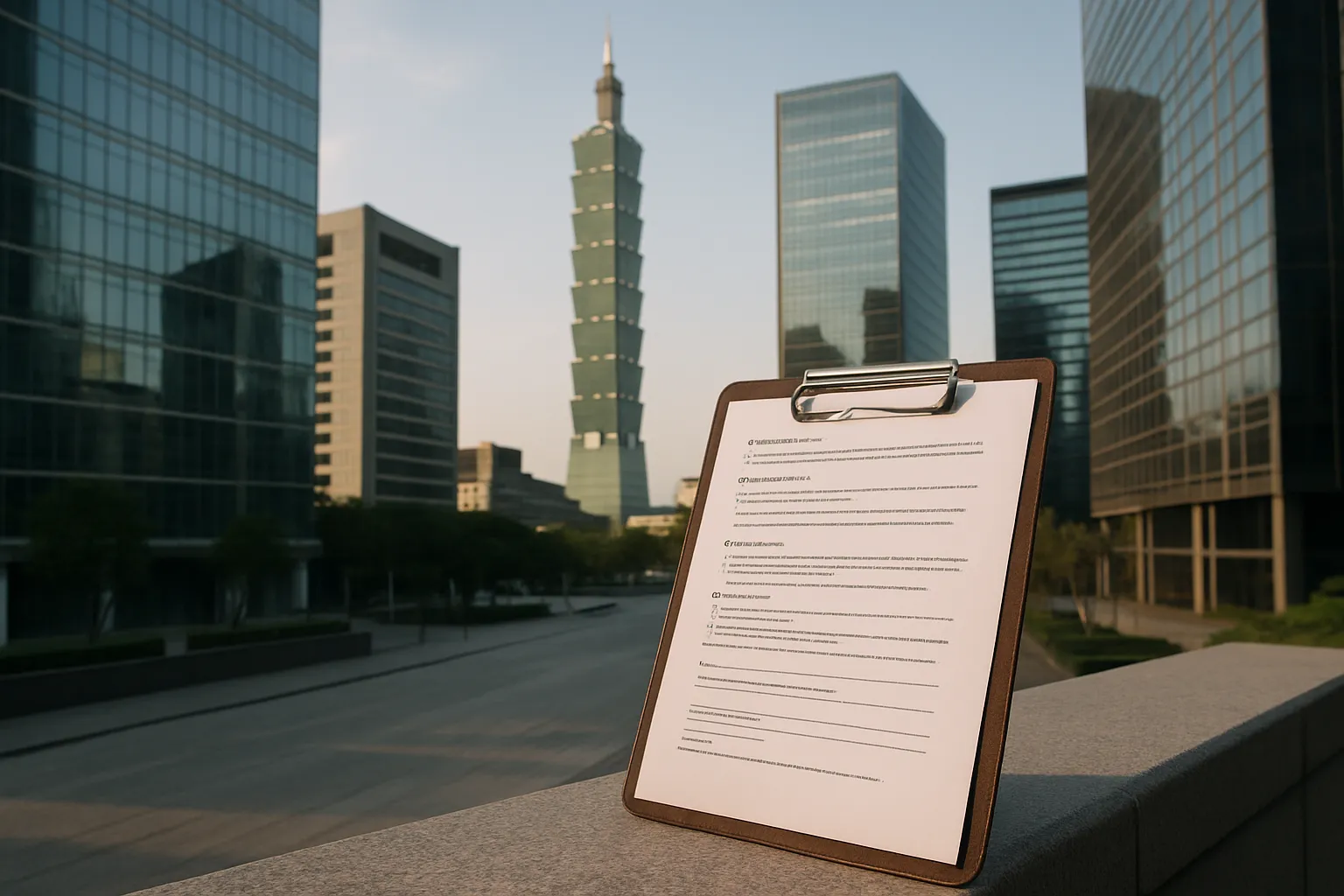

Securing a VASP registration Taiwan approval has become a defining compliance milestone for every business that touches virtual assets in the jurisdiction, following the passage of the Virtual Asset Service Act on 30 June 2026. What was once a light-touch anti-money-laundering self-registration model has now become a full taiwan crypto licence regime administered by the Financial Supervisory Commission (FSC). This guide explains, in practical and stepwise detail, how exchanges, custodians, stablecoin issuers, broker-dealers and fintechs can prepare, apply for and maintain a Taiwan VASP licence, and how legal and compliance teams should structure their readiness efforts.
On 30 June 2026, Taiwan’s Legislative Yuan passed the Virtual Asset Service Act, ending the era of AML self-registration and introducing a mandatory licensing framework overseen by the FSC. The Act consolidates supervision of virtual asset service providers under a single statutory regime, aligning Taiwan with international standards set by the Financial Action Task Force (FATF).
The implications are wide-ranging. Exchanges, hosted wallet providers, stablecoin issuers, custodians, broker-dealers and market-makers now face formal licensing prerequisites, minimum capital or net-asset floors, custody segregation duties, stablecoin reserve and trust obligations, and enhanced penalties for unlicensed activity. Providers that previously operated under AML self-registration cannot assume automatic grandfathering; they must review the transitional provisions of the Act and file for authorisation.
This guide is written for exchanges, fintech operators, stablecoin projects, custodians, and the legal and compliance teams supporting them, including foreign entrants weighing market access. Achieving VASP registration Taiwan approval is now the gateway to lawful operation, and understanding the FSC’s expectations early is the single most effective way to reduce cost, delay and enforcement risk.
The FSC processes applications through its designated channels for enterprises or persons providing virtual asset services, per the Financial Supervisory Commission guidance. A realistic end-to-end timeline for a well-prepared applicant runs from several months to roughly a year, depending on service scope, corporate complexity and the quality of submitted documentation. The nine steps below map the practical route to fsc vasp registration.
Begin with a structured gap analysis of your corporate structure, target service categories, governance and documentation. This readiness phase typically takes two to six weeks and determines whether your organisation can credibly evidence AML controls, capital adequacy and custody arrangements before you engage the regulator.
Map every service you intend to offer against the statutory definitions in the Virtual Asset Service Act, and identify missing policies, unsigned procedures or incomplete financials. A disciplined readiness assessment is the foundation of a successful VASP registration Taiwan application and is where a Step-by-step FSC VASP application checklist proves invaluable.
The Act defines distinct categories of virtual asset service, including exchange between virtual assets and fiat or between virtual assets, custody and safekeeping, transfer, brokerage, market-making and stablecoin issuance. Each category carries its own conditions and evidentiary burdens under the statute, so precise scoping is essential.
Over-scoping raises capital and audit obligations unnecessarily; under-scoping risks operating outside your authorisation and triggering enforcement. Determine your definitive scope by reference to the statutory definitions in the Laws and Regulations Database before drafting your application.
Assemble incorporation records, articles of association, the full shareholder structure, beneficial-ownership disclosures and board resolutions authorising the application. The FSC expects a transparent ownership chain and clear governance lines. Foreign-held groups should be ready to explain the ultimate controlling parties and demonstrate that domestic governance capacity exists to run the licensed business locally.
A robust AML/CFT program is central to vasp compliance taiwan and to the credibility of your application. This must cover customer due diligence and KYC, ongoing transaction monitoring, suspicious transaction reporting, the appointment of a qualified AML officer, staff training and independent testing.
The FSC benchmarks these controls against the FATF standards for virtual assets and VASPs, including the Travel Rule for originator and beneficiary information. Teams should align their manuals with the detailed procedures in a Taiwan AML & KYC playbook for VASPs to ensure coverage of thresholds, escalation paths and reporting frequency.
Demonstrate that you satisfy the applicable minimum capital or net-asset floor for your licensing category. Where you intend to issue stablecoins, prepare evidence of the mandated reserve and trust arrangements, including segregation of customer assets and a verifiable proof-of-reserve mechanism. Custody-focused applicants must evidence segregation of customer assets from proprietary assets and controls that establish provable custody of keys and holdings.
The FSC expects credible technical assurance. Prepare independent security audit reports, penetration-test summaries, custody architecture documentation, cold-storage and key-management policies, and business-continuity plans. Third-party audit reports carry significant weight and reduce the volume of supplemental questions the regulator raises during review.
File your completed application and supporting appendices in the FSC’s required format through its designated channel, together with the applicable fees. Follow the published submission format precisely: consistent pagination, a clear table of contents and a document index materially speed review. Confirm the current submission instructions on the FSC website and any notices issued by the Securities and Futures Bureau (SFB).
The FSC reviews the application and commonly issues supplemental requests for clarification or additional evidence. Review windows vary by scope and complexity, and responsiveness is decisive, organised, prompt and complete replies keep the file moving. The most frequent causes of delay are insufficient AML policies, inadequate proof of capital, and unresolved foreign-ownership or beneficial-owner questions.
On approval, the FSC issues your authorisation and registration details, which are recorded on the public register. Licensing is the beginning, not the end, of your obligations: periodic reporting, ongoing AML compliance, audit submissions and prompt notification of material changes all continue for the life of the licence. Sustained vasp compliance taiwan is what protects the licence you worked to obtain.
The table below summarises the principal activities involved in a VASP registration Taiwan project. Cost figures are indicative in New Taiwan dollars (NT$) and vary considerably with business scale, service scope and group complexity; treat them as planning ranges rather than fixed quotes.
| Activity | Typical requirement | Indicative cost range (NT$) | Indicative timeline |
|---|---|---|---|
| Application filing | Completed FSC-format application, appendices and fees | Filing fees plus counsel; scale-dependent | 2–4 weeks to compile |
| AML program development | KYC, monitoring, STR, AML officer, training, audit | Mid six-figure and up | 4–10 weeks |
| Capital / reserve evidence | Proof of capital floor; stablecoin reserve/trust proof | Category-dependent capital plus advisory | 2–6 weeks to evidence |
| Technical audit / security assessment | Independent security and custody audit reports | Six-figure, provider-dependent | 4–8 weeks |
| Local establishment / corporate formation | Local subsidiary or representative (if required) | Formation plus registered capital | 3–8 weeks |
Under the Virtual Asset Service Act, any enterprise or person providing a defined virtual asset service in or into Taiwan must be licensed by the FSC. Covered activities include exchange, custody, transfer, brokerage, market-making and stablecoin issuance. If your business model performs any of these functions for Taiwanese customers, you fall within scope and require authorisation before commencing operations.
Foreign entrants routinely ask whether a local entity or local director is required. The Act requires an authorised legal presence to conduct licensable activity in Taiwan, and in practice foreign providers will commonly need a local subsidiary or a designated domestic representative, together with demonstrable local governance capacity. The precise local-director and local-establishment conditions should be confirmed against current FSC guidance. For structuring choices, review foreign entry options for Taiwan VASPs.
The regulator assesses shareholders, directors, beneficial owners and the AML officer against fit-and-proper standards. Expect scrutiny of criminal history, financial soundness, relevant experience and integrity. The AML officer in particular must have the qualifications and authority to run an effective compliance function, a nominal appointment will not satisfy the FSC.
Applications may be refused for inadequate AML frameworks, insufficient capital, opaque ownership, unresolved fit-and-proper concerns or unreliable technical controls. Where a deficiency is curable, the practical path is to remediate promptly and resubmit the corrected materials. In comparable jurisdictions, the recurring gaps are unsigned policies, unevidenced proof of funds and weak transaction-monitoring rulesets, all avoidable with disciplined preparation.
Authorisation triggers a continuing set of obligations. Sustained vasp compliance taiwan demands active governance, not a one-time filing exercise, and the FSC supervises licensees against the standards below.
Licensees must operate risk-based customer due diligence with defined KYC thresholds, continuous transaction monitoring, and timely suspicious transaction reporting to the relevant authority. Programs should include periodic AML reporting, independent audit of the AML function, and implementation of the FATF Travel Rule for transfers. The FATF guidance on virtual assets and VASPs sets the international benchmark the FSC expects licensees to meet, and effective aml registration vasp taiwan readiness starts with mapping these controls to your customer risk profile.
The Act imposes minimum capital or net-asset requirements calibrated to licensing category. Licensees must maintain, and be able to evidence, adequate capital throughout the life of the licence, not merely at application. Solvency monitoring and prompt notification of material financial deterioration are part of ongoing supervision.
Where a licensee issues stablecoins, the stablecoin rules taiwan regime requires reserve backing held under trust or equivalent segregation, with permitted reserve assets and a verifiable proof-of-reserve process. Customer assets must be segregated from the issuer’s own assets, and periodic attestation or audit of reserves is expected. The distinctions between trust and escrow structures, permitted asset composition and audit cadence are explored in the stablecoin reserve and trust rules, Taiwan explainer.
Custodial licensees must segregate customer assets, maintain provable control of keys and holdings, and, where third-party custodians are used, evidence the custody arrangement and the controls that protect customer assets from loss or misuse. Cold-storage policies, key-management governance and reconciliation procedures are core evidence.
Expect periodic reporting to the FSC, external audit requirements, and disclosure of material events and changes in ownership, control or business scope. Maintaining a live compliance calendar and an evidence repository is the most reliable way to satisfy recurring reporting duties without last-minute pressure.
Practical evidence the FSC commonly requests includes AML manuals with version control, KYC sample files, transaction-monitoring rule documentation, STR logs, capital and reserve attestations, custody reconciliation records and independent audit reports.
A complete, well-organised document set is decisive for a smooth VASP registration Taiwan review. The checklist below reflects the categories of evidence the FSC and SFB expect for a virtual asset service application.
Foreign-language documents typically require certified translation into Chinese, and certain corporate documents may require notarisation or legalisation. Provide certified copies where originals cannot be lodged, and confirm the certification format against current FSC instructions before submission.
The recurring defects that stall applications are incomplete financial statements, unsigned or undated policies, and inadequate proof of funds. Resolve these before filing: reconcile financials to source records, ensure every policy is executed and version-controlled, and obtain independent confirmation of available capital and reserves.
When packaging the submission, organise appendices logically, paginate consistently and include a clear table of contents and cross-references. Establish a single point of contact to manage follow-up queries so supplemental requests are answered promptly and consistently.
Preparation commonly takes one to three months for a well-resourced applicant, followed by an FSC review that can run several additional months, especially where supplemental requests arise. Overall, plan for a multi-month project from readiness assessment to licence issuance, with the exact duration driven by scope and responsiveness.
Indicative costs span external counsel, independent technical and security audits, AML program build, and the capital or reserves you must hold. These are planning bands only and scale with the size and complexity of the business; a single-service applicant will budget very differently from a multi-service group issuing stablecoins.
Operating a virtual asset service without the required FSC approval exposes a business to administrative fines, criminal penalties under the amended anti-money-laundering framework, seizure of unlawful proceeds and injunctive enforcement that can halt operations. The Virtual Asset Service Act raised maximum penalties to strengthen deterrence, and industry observers expect the regulator to treat unlicensed activity as a supervisory priority. Structured remediation and appeal routes exist for licensees facing enforcement, see enforcement and penalties under the VASP Act.
Completing a VASP registration Taiwan application is achievable with disciplined preparation and an evidence-led approach. Start by reading the Virtual Asset Service Act and the FSC’s application guidance in full, then run a structured readiness assessment against every statutory requirement for your chosen licensing category. Identify gaps in governance, AML controls, capital and custody early, and remediate them before you engage the regulator.
From there, engage local counsel to confirm scoping and foreign-entry structure, build a FATF-aligned AML program, commission independent technical and security audits, and assemble verifiable proof of capital and, where relevant, stablecoin reserves. Package your submission in the FSC’s required format with a clear index and consistent pagination, and prepare a single point of contact to handle supplemental requests promptly.
The regulator’s forms and published requirements are the authoritative reference point, so always validate document lists and submission channels against the current FSC and SFB pages before filing. Approached methodically, VASP registration Taiwan becomes a manageable, well-defined project rather than a source of enforcement risk, and a properly maintained licence positions your business to operate with confidence under Taiwan’s new supervised regime.

posted 6 minutes ago

posted 28 minutes ago

posted 47 minutes ago

posted 2 hours ago

posted 2 hours ago

posted 3 hours ago

posted 3 hours ago

posted 3 hours ago

posted 4 hours ago

posted 4 hours ago

posted 5 hours ago

posted 5 hours ago
No results available
Find the right Legal Expert for your business

Send welcome message