
Our Expert in United Arab Emirates
No results available
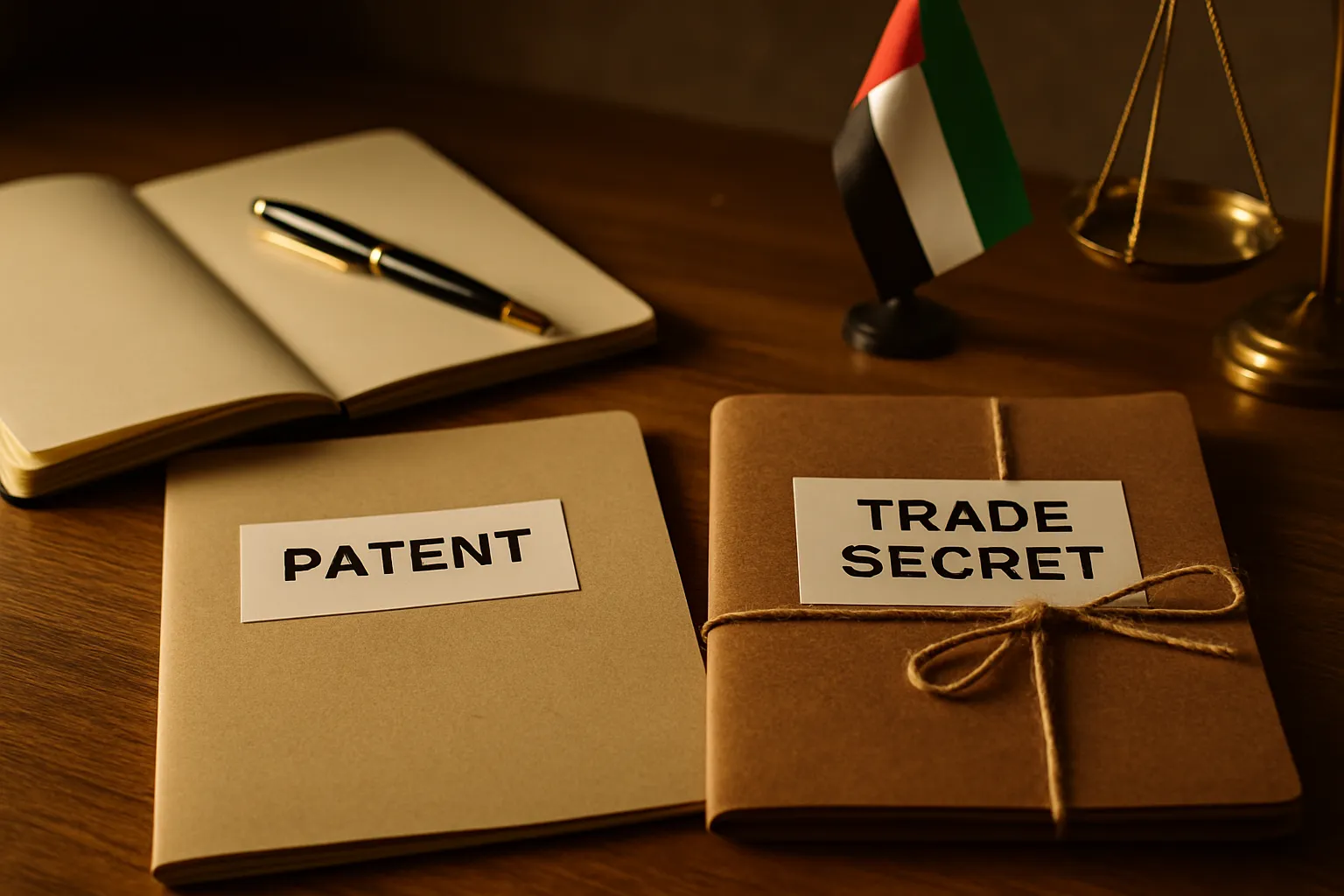
Patent vs trade secret UAE is the single most consequential intellectual property decision founders, in-house counsel and R&D managers will make in 2026, and this guide takes a clear position rather than hedging. The short answer: if you need enforceable exclusivity, plan to license or raise investment, and your invention is vulnerable to reverse engineering, file a patent and consider the UAE’s accelerated processing routes; if your edge is a genuinely secret process, formula or algorithm that can be locked down operationally, keep it confidential. Where accelerated examination is available, it can lower the time and opportunity cost of patenting, which shifts several borderline cases toward filing.
Use the decision framework and comparison table below for a 30-second route to a recommendation, then read the sections that apply to your path.
The patent vs trade secret UAE choice rests on two fundamentally different protection models. A patent is a registered, time-limited monopoly granted in exchange for public disclosure. A trade secret is an unregistered advantage that survives only as long as secrecy is maintained. Understanding the legal machinery behind each is the foundation for choosing correctly.
Patents in the UAE are registered rights obtained through a formal application to the Ministry of Economy, with the option to enter the national phase of an international (PCT) filing. The statutory framework, novelty and inventive-step requirements, and the standard 20-year term from the filing date are set out in the UAE’s federal legislation on the regulation and protection of industrial property rights, texts of which are available through WIPO Lex and the WIPO country profile. Trade secrets, by contrast, are not registered. They are protected through a combination of contractual obligations (NDAs and employment terms), civil actions for breach of confidence, and, in defined circumstances, criminal sanctions where misappropriation crosses into commercial fraud or theft of confidential business information.
The UAE Government’s official IP guidance describes this layered protection model, which depends entirely on the holder maintaining confidentiality.
Enforcement is distributed across several bodies, and knowing which door to knock on shapes both strategy and cost:
This multi-forum structure matters for the patent vs trade secret UAE decision because patents provide clearer statutory infringement remedies against a public register, whereas trade secret enforcement typically depends on the strength of your contracts and the availability of civil breach-of-confidence claims.
The table below is the centrepiece of this guide. It compares the two protection routes across every dimension that drives a real business decision, legal basis, disclosure, duration, cost, enforceability and suitability by technology.
| Dimension | Patent (UAE) | Trade Secret (UAE) |
|---|---|---|
| Legal basis / route | Registered right under UAE patent law (file at Ministry of Economy or national phase of PCT), requires application and disclosure | Unregistered contractual/statutory protection via confidentiality, employment law and civil/criminal statutes when misappropriated |
| Registration required | Yes, formal application, examination, grant | No registration, protection depends on secrecy and controls |
| Disclosure | Full public disclosure in the patent specification upon publication/grant | No public disclosure, remains confidential |
| Duration | Typically 20 years from filing (subject to renewal fees) | Potentially indefinite while the secret is maintained |
| Geographic scope | Territorial (UAE); international protection via PCT/foreign filings | Depends on where misappropriation occurs; enforceable via local courts |
| Enforcement route | Civil infringement actions, possible criminal remedies | Civil breach of confidence and breach of contract; criminal sanctions in certain cases |
| Remedies | Injunctions, damages, destruction/seizure of infringing goods | Injunctions, damages; criminal penalties in some cases |
| Public examination / prior art | Subject to prior-art search; novelty and inventive step required | No examination; independent development or reverse engineering can defeat the claim |
| Cost (approx.) | Official filing + prosecution + agent + translation fees; medium–high one-off with maintenance costs | Low–medium ongoing costs: compliance, security, monitoring, and litigation if breached |
| Timing (decision urgency) | File early to preserve novelty and priority; accelerated examination may shorten grant | No filing pressure, but controls must be implemented immediately |
| Suitability, software | Patentable where it delivers a technical solution; eligibility issues exist | Often suitable if protectable by secrecy and not easily reverse-engineered |
| Suitability, chemical/biotech | Often better protected by patent if the invention can be disclosed | Risky if the process is easily reverse-engineered; consider secrecy for know-how only |
| Employee risk | Needs clear assignment and invention clauses; filing must be controlled | High, requires NDAs, restrictive covenants and post-employment protections |
| Licensing / monetisation | Easier to license and monetise publicly | Possible but requires careful contractual structure to preserve secrecy |
| Public policy / compulsory licensing | Possible limitations (public interest, government use) | N/A, secrecy may avoid compulsory disclosure but loses statutory patent protections |
| Best for | Innovations needing exclusive market rights, where disclosure is acceptable and cross-border enforcement is desired | Processes, formulas and algorithms that can remain secret and where indefinite protection is strategically valuable |
Comparison table: patent vs trade secret protection in the UAE, 2026.
The differences above are not abstract, they translate directly into commercial outcomes. Here is how to read the table in practice:
Timing is the variable most often mishandled in the patent vs trade secret UAE decision. Patents reward the diligent: novelty is destroyed by prior public disclosure, so the moment to decide is before you publish, pitch or demo. Where accelerated examination options exist, they add a second timing dimension, potentially moving from filing to grant faster than the standard route, which can be decisive for time-sensitive products.
A conventional UAE patent moves through three broad stages: filing the application (with a full specification and claims), formal and substantive examination against prior art for novelty and inventive step, and grant followed by publication. Pendency under the standard route can extend over a period of years depending on the complexity of the invention and any office actions raised during prosecution. The Ministry of Economy administers each stage, and applicants entering via the PCT national phase must observe the relevant deadlines to preserve their priority date. The practical lesson is simple: file first, publish later.
Where available, accelerated patent processing is the development that can make this a live decision rather than a theoretical one. Accelerated or fast-track routes are designed to compress examination and shorten time-to-grant for eligible applications, which is especially valuable for start-ups and R&D-driven businesses racing competitors to market. Availability, eligibility criteria, official timelines and any additional fees change over time, so confirm current parameters directly with the Ministry of Economy before relying on them. The strategic effect is clear: when grant is faster, the case for patenting a time-sensitive innovation strengthens against keeping it secret.
Total patent cost comprises official filing and prosecution fees, professional agent fees, and translation costs where the specification must be filed in Arabic. These combine into a medium-to-high one-off outlay, followed by periodic renewal (maintenance) fees to keep the patent in force across its 20-year term. Because figures vary with the technology’s complexity, number of claims, and translation volume, and official fees are set by the Ministry of Economy and revised from time to time, obtain a written estimate from counsel and confirm current fees with the Ministry before committing. Trade secrets avoid these registration costs but carry their own continuing spend on security, monitoring and, if breached, litigation.
Choosing the trade secret path is a positive strategic decision, not a fallback. It is the right call when disclosure would hand competitors your advantage and the asset can be genuinely locked down. But trade secret protection UAE only holds if you treat secrecy as an operational discipline.
Not every innovation suits secrecy. Assess by category:
Trade secret protection UAE stands or falls on the controls you implement. A court will typically only protect information you have visibly treated as confidential. Put these in place before disclosure to anyone:
The three great threats to a trade secret are a departing employee, a competitor’s reverse engineering, and inadvertent disclosure through public filings or marketing. Employee mobility is a common cause of loss, which is why post-employment confidentiality and well-drafted restrictive covenants are essential. If reverse engineering is realistic, secrecy provides no defence, a competitor who independently develops or lawfully dismantles your product generally owes you nothing. Where these risks are high, the patent vs trade secret UAE analysis tilts firmly toward patenting.
Enforceability is where the two routes diverge most sharply, and it should weigh heavily in your decision. Patents give you a registered right that is comparatively straightforward to assert; trade secrets require you to prove both the existence of a protected secret and its wrongful acquisition or use.
For patents, civil infringement actions can secure injunctions to stop the infringing activity, damages, and orders for destruction or seizure of infringing goods. For trade secrets, the civil route runs through breach of confidence and breach of contract, seeking injunctions and damages. The critical difference: a patent holder proves infringement against a public register, whereas a trade secret claimant must first establish that the information was secret, valuable and subject to reasonable protection measures, which is why documented controls are decisive evidence.
Criminal remedies are available for patent infringement in defined circumstances and, in specific cases, for trade secret misappropriation where conduct amounts to commercial fraud or the theft of confidential business information. Criminal routes can carry penalties and confiscation of infringing materials, but their availability for trade secrets is more fact-dependent than for registered patents. The practical takeaway: do not assume a criminal remedy will rescue a poorly protected trade secret, build your contractual foundation first.
UAE Customs offers an enforcement layer against infringing and counterfeit goods at the border, most directly for trademarked and copyrighted products. This mechanism is largely unavailable for trade secrets, because there is no registered right for customs officials to check against. For businesses facing counterfeiting or grey-market imports, border enforcement is a meaningful part of an overall IP protection strategy.
Here is the crisp, position-taking framework. Map your situation to the bullets below.
Choose a patent when:
Choose a trade secret when:
Once you have decided, execute methodically. The checklists below cover both paths.
Both patents and trade secrets are territorial in effect, which shapes any international strategy. A UAE patent protects you only in the UAE; to secure rights abroad you must file in each target jurisdiction or use the PCT route to preserve the option of national-phase entry across many countries from a single international application, a key consideration for businesses eyeing the wider GCC and global markets. Trade secret protection likewise depends on where misappropriation occurs and on the enforcement tools available there. On monetisation, patents are generally easier to license because the right is registered and definable, whereas licensing a trade secret demands carefully drafted contracts that preserve confidentiality while permitting use.
When choosing between jurisdictions for filing, weigh enforcement strength, examination quality and cost, but for UAE-based operations with UAE and regional markets in view, the local route combined with strategic foreign filings is the pragmatic default.
Brief specialist IP counsel before you disclose, publish or demo anything, and before any deadline that could compromise novelty. Come prepared with a clear description of the invention, records of who created it, details of any prior disclosures, your commercial timeline, and your monetisation goals (sale, licence or in-house use). Early advice is decisive: the patent vs trade secret UAE decision is far cheaper to get right at the outset than to correct after a public disclosure has destroyed patentability or a weak contract has undermined a trade secret. Where speed to market matters, ask counsel to assess accelerated processing eligibility at the first meeting.
The patent vs trade secret UAE decision comes down to a clear test: patent when you need enforceable, transferable exclusivity and can accept disclosure; keep it secret when your advantage is genuinely confidential, hard to reverse-engineer, and worth protecting for as long as secrecy holds. Where faster patent processing is available, it can tilt borderline cases toward filing by cutting time-to-grant, so revisit any default preference for secrecy. Use the comparison table and decision framework above to reach a defensible position, implement the relevant checklist without delay, and take specialist advice before any public disclosure. Getting the patent vs trade secret UAE choice right at the outset protects both your invention and its commercial value.
This article was produced by Global Law Experts. For specialist advice on this topic, contact Ziad Hassouneh at Emirates Intellectual Property Services, a member of the Global Law Experts network.

posted 11 minutes ago

posted 32 minutes ago
posted 51 minutes ago

posted 1 hour ago

posted 2 hours ago

posted 2 hours ago
posted 2 hours ago

posted 3 hours ago

posted 3 hours ago

posted 3 hours ago

posted 3 hours ago

posted 4 hours ago
No results available
Find the right Legal Expert for your business

Send welcome message