
Our Expert in USA
No results available
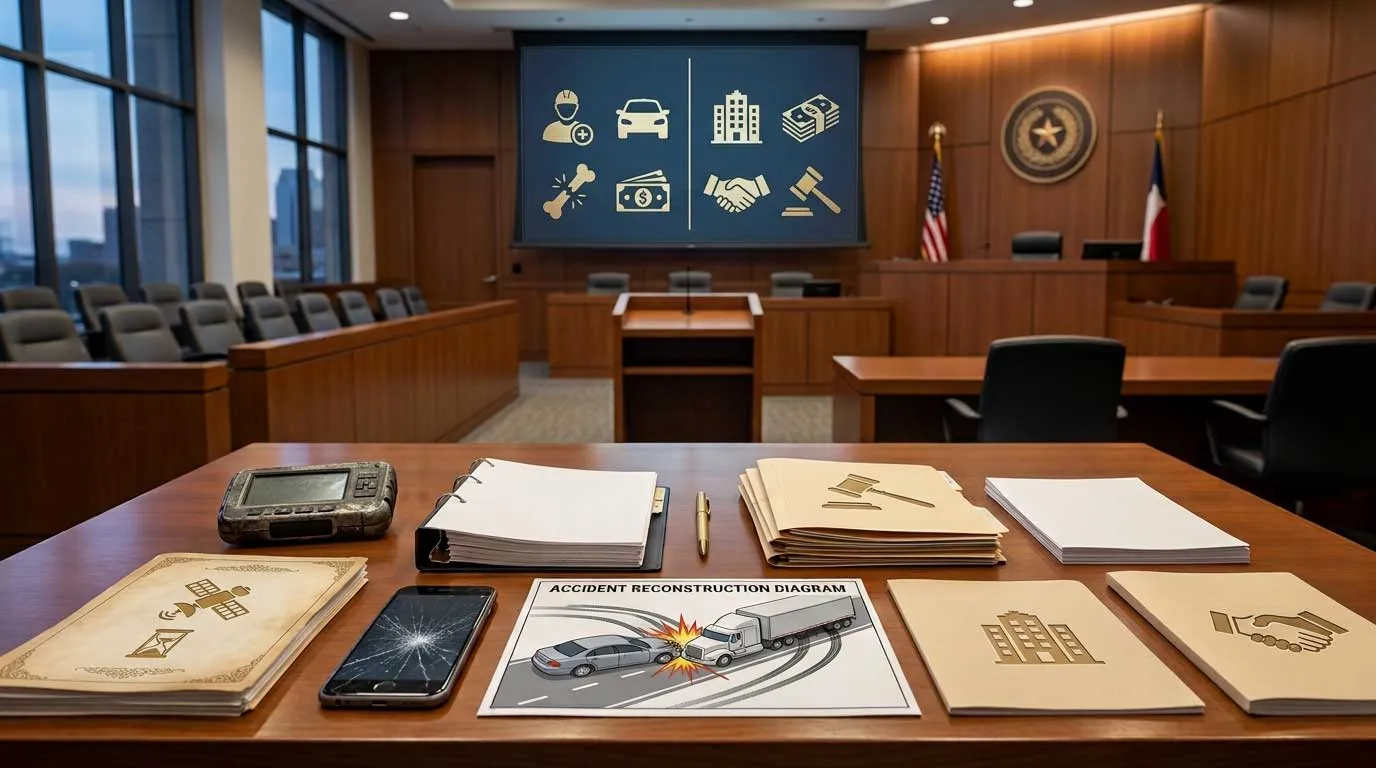
Texas HB 19 trucking lawsuits have reshaped how commercial-vehicle crash cases are tried, litigated and valued across the state, and by 2026 the statute sits at the center of nearly every serious 18-wheeler claim. HB 19 was enacted in 2021 by the 87th Texas Legislature and applies to actions filed on or after September 1, 2021. If you were seriously injured by a commercial truck, or you are counsel evaluating a referral, understanding this law is important, it can affect what evidence a jury sees, when they see it, and how corporate fault is presented.
This guide explains the mechanics of HB 19, its effect on corporate-fault evidence, the bifurcation structure it created, and the discovery and trial strategies plaintiffs use to preserve and present their cases. It is written for injured Texans, referring attorneys and plaintiff firms who need a practical, jurisdiction-specific roadmap rather than a national overview.
What you will learn:
House Bill 19 was enacted by the 87th Texas Legislature in 2021 and is codified primarily in Chapter 72, Subchapter B of the Texas Civil Practice and Remedies Code. It changes how certain lawsuits arising out of commercial-motor-vehicle accidents are structured and tried. The bill’s text, legislative analyses and enactment history are available through the Texas Legislature’s official bill records. At a high level, the statute responds to concerns from the commercial transportation industry about the way employer or corporate fault was presented to juries in cases where a company employee was driving. The practical result can reorganize the trial itself and restrict when certain categories of corporate-conduct evidence may be admitted.
Before HB 19, plaintiffs in a typical Texas commercial vehicle accident could present the driver’s negligence and the trucking company’s corporate failures, hiring practices, training gaps, safety-policy violations, together, in a single unified narrative before one jury. HB 19 changes that default in defined circumstances. It provides a mechanism to separate the question of the driver’s conduct and compensatory damages from the question of the employer’s independent corporate fault and any exemplary (punitive) damages, and it limits the admissibility of certain corporate-negligence evidence in a case where the employer has stipulated that its employee was acting within the scope of employment.
HB 19 applies to civil actions involving commercial motor vehicles where a plaintiff seeks to hold an employer liable for the acts of an employee driver. That includes the classic 18-wheeler accident lawsuit in Texas, a tractor-trailer, tanker, or other heavy commercial vehicle operated by a company driver. The statute is most consequential where the plaintiff alleges both that the driver was negligent and that the motor carrier was independently negligent through hiring, training, supervision, entrustment or safety-management failures. Understanding whether a particular claim falls within the statute’s scope is the first analytical step in any Texas HB 19 trucking lawsuit.
The legislative purpose behind HB 19 was to address what proponents characterized as inflated verdicts driven by evidence of corporate conduct that, they argued, was not causally tied to the crash. Whether one agrees with that framing, the operative effect is procedural: the statute channels certain corporate-fault evidence into a defined phase and imposes conditions on its admissibility. As Texas courts continue to interpret the statute, plaintiff counsel should track opinions available through the Texas Judicial Branch to understand how trial courts are applying bifurcation triggers and evidentiary limits in practice.
A significant shift for plaintiffs in Texas HB 19 trucking lawsuits concerns the admissibility of certain corporate-conduct evidence. Historically, evidence that a carrier ignored its own safety policies, cut corners on driver vetting, or maintained a poor safety record was often admitted early. Under HB 19, where the employer stipulates that its employee was acting in the course and scope of employment, certain evidence directed at the employer’s independent negligence may be restricted during the initial liability-and-compensatory phase unless specific statutory conditions are satisfied. The evidence does not necessarily disappear, but its timing, framing and admissibility conditions can change materially.
This does not mean corporate accountability is off the table. It means plaintiff counsel must be surgical: preserve everything, plead precisely, and be ready to demonstrate the causal link between corporate conduct and the crash so that the evidence survives any statutory gate.
Certain categories of evidence recur in every serious commercial vehicle accident case. Their treatment under HB 19 requires careful handling:
A critical distinction is between evidence that bears on the crash mechanics and the driver’s conduct, often admissible in the first phase, and evidence that speaks purely to corporate culpability, which HB 19 may channel into a later phase. Skilled framing of the same document under both theories is often the difference between admission and exclusion.
Plaintiffs preserve admissibility by building the causal bridge early. Expert testimony from an accident reconstructionist or a carrier-safety expert can tie a specific corporate failure, say, dispatching a fatigued driver in violation of hours-of-service limits, to the mechanics of the collision. Where corporate evidence also proves the driver’s negligence (for example, ELD data showing the driver had exceeded lawful driving hours), counsel should argue for its admission in the first phase on that independent ground. Anticipate limiting motions and motions in limine, and prepare offers of proof to preserve the record for appeal when a court excludes evidence you believe is admissible.
Bifurcation is a structural feature of HB 19. On motion by a defendant, the trial may be divided into phases. The first phase generally addresses the driver’s negligence, causation and compensatory damages. Depending on the findings and the statutory predicate, a second phase may address the employer’s independent corporate liability and any exemplary damages. Understanding how bifurcation under Texas HB 19 operates is essential to structuring proof, sequencing witnesses and preserving the emotional and factual force of a case.
The consequence for plaintiffs can be significant. The compelling narrative of a reckless corporation cutting corners, the story that historically framed the entire case, may, under bifurcation, wait until a later phase. In the first phase, the jury focuses on the driver and the harm. This can flatten the emotional arc of the plaintiff’s presentation if counsel is not deliberate about building a first-phase story that stands on its own.
Because compensatory damages are decided in the first phase, plaintiffs must fully develop pain-and-suffering, medical, and life-impact evidence without leaning on corporate villainy. The human story of the injury, the surgeries, the lost independence, the family impact, has to carry weight on its own. Demonstratives, treating-physician testimony, day-in-the-life evidence and lay witnesses become even more important. The corporate-fault narrative, when it comes in a later phase, then reinforces the exemplary-damages case rather than the compensatory one. Plaintiff strategy under HB 19 often requires two complete, self-supporting stories rather than one blended one.
Bifurcation is resolved through pretrial motion practice, so timing and record preservation are decisive. Counsel should anticipate the defense motion to bifurcate and prepare their position on scope, what evidence belongs in each phase, well before trial. Where the court excludes evidence from the first phase, make a clear offer of proof to preserve the issue. Where jury instructions channel or limit consideration of certain evidence, object on the record and submit proposed alternative instructions. A clean record on bifurcation rulings and evidentiary exclusions is often the foundation of any post-trial or appellate challenge, and Texas appellate opinions accessible through the Texas Judicial Branch increasingly turn on how these issues were preserved below.
A common and urgent question in Texas HB 19 trucking lawsuits is whether the statute’s evidentiary limits also shrink discovery. The short answer is that discovery and admissibility are distinct. HB 19 principally governs what a jury sees and when, it does not eliminate a plaintiff’s right to discover relevant corporate records. Evidence that is discoverable may still be inadmissible in the first phase; evidence that is inadmissible may still be fully discoverable. Plaintiff counsel should therefore pursue a comprehensive discovery plan while planning separately for the admissibility fight.
The urgency is real. ELD data, dashcam footage, and telematics records are frequently overwritten on short retention cycles. Physical evidence, the tractor, trailer, brakes and tires, can be repaired, sold or scrapped. The window to lock down this evidence often opens and closes within days of the crash, long before suit is filed.
Preservation begins with a prompt, specific spoliation letter to the carrier, the driver, any broker or shipper, and any maintenance vendor. The letter should identify the evidence with precision, ELD and hours-of-service logs, dashcam and event-data-recorder (“black box”) data, dispatch and messaging records, driver qualification files, maintenance and inspection records, and demand that routine deletion or repair cease immediately. Where a defendant destroys evidence after receiving notice, Texas courts may impose remedies for spoliation, which can include an adverse-inference instruction in appropriate circumstances under governing Texas Supreme Court precedent. Document every preservation demand and the defendant’s response; that paper trail supports a later spoliation motion.
Counsel should also consult the discovery rules in the Texas Rules of Civil Procedure and guidance published by the State Bar of Texas when structuring these demands.
A thorough truck crash discovery plan in Texas typically requests documents grouped under headings such as:
Priority deposition targets include the driver, the safety director, the dispatcher, the maintenance manager and any corporate representative designated on safety and hiring practices. Sequencing these depositions to build causal links before the admissibility fight strengthens the plaintiff’s position.
Communications with brokers and shippers can reveal dispatch pressure, unrealistic delivery windows and knowledge of a carrier’s poor safety record. Plaintiffs may subpoena these third parties for load tenders, rate confirmations, carrier-selection records and email traffic. Expect objections on relevance, burden and confidentiality; negotiate protective orders and clawback agreements to keep discovery moving while protecting genuinely sensitive commercial information. Broker and shipper records frequently support independent negligent-selection theories that survive alongside the claims against the carrier.
Proving corporate fault in Texas HB 19 trucking lawsuits demands disciplined pleading and a well-sequenced evidence plan. Negligent entrustment in Texas trucking cases generally requires showing that the owner entrusted the vehicle to a driver it knew or should have known was unlicensed, incompetent or reckless, that the driver was negligent, and that the driver’s negligence proximately caused the harm. Related theories, negligent hiring, negligent training, negligent supervision and negligent retention, target distinct corporate decisions. Vicarious liability under respondeat superior remains available where the driver acted within the scope of employment. Under HB 19, the pleading and proof of these independent corporate theories must be handled with care to satisfy the statute’s conditions for reaching the corporate phase.
The strategic principle is to plead each theory precisely, support each with specific record evidence, and connect each to causation. Vague, boilerplate corporate-negligence allegations are more vulnerable under the statute; specific, evidence-backed allegations are more likely to reach the jury.
Expert testimony often determines whether corporate-fault evidence reaches the jury. An accident reconstructionist establishes how the crash happened and what a competent driver or properly maintained vehicle would have done differently. A carrier-safety expert explains the applicable FMCSA standards, how the carrier’s conduct may have departed from them, and how that departure connects to the crash. Where the carrier’s hiring or training failures allowed an unfit driver behind the wheel, expert testimony can bridge the corporate decision and the collision. Prepare experts for challenges to their qualifications and methodology under Texas Rule of Evidence 702 and the governing Texas reliability standards, and ensure their opinions rest on the discoverable record, driver files, ELD data, maintenance logs and safety audits.
Because bifurcation can separate the driver’s conduct from corporate fault, plaintiff counsel should be prepared to craft two coherent narratives. In the first phase, the story centers on the crash, the driver’s choices and the human cost of the injuries. In the corporate phase, the narrative shifts to the pattern of decisions that put a dangerous driver or vehicle on the road. A first-phase narrative might read: The evidence will show that a heavily loaded tractor-trailer, driven beyond the lawful hours of service, struck the plaintiff’s stopped vehicle without braking, and that the driver’s fatigue was a direct cause of catastrophic, permanent injuries.
The corporate-phase narrative then builds on the driver’s proven fault to show the carrier’s role in creating the danger. Demonstratives, timelines, ELD visualizations and reconstruction animations, reinforce each phase’s distinct message.
Effective trial presentation under HB 19 depends on sequencing and clarity. Order witnesses to build causation before liability: reconstruction and mechanical experts early, treating physicians and damages witnesses to anchor the compensatory case, and corporate representatives reserved for the corporate phase where corporate fault is at issue. Use demonstratives to make technical evidence accessible, an animation synchronizing ELD hours-of-service data with the crash timeline can turn a spreadsheet into a persuasive story.
On cross-examination, hold defense witnesses to the carrier’s own written standards and to FMCSA requirements, using their admissions to establish the standard of care and its breach. Anticipate reliability challenges by grounding every expert opinion in the record and in recognized methodology. For jury instructions, submit proposed language that accurately states the applicable standards for each phase and object on the record where the court’s instructions improperly limit the jury’s consideration of admissible evidence. Where the Texas Pattern Jury Charges apply, adapt them to the phased structure the statute requires, and preserve any disputes for appellate review.
| Issue | Pre-HB 19 practice | Post-HB 19 (HB 19 effect) | Plaintiff tactic |
|---|---|---|---|
| Trial structure | Single unified trial; driver and corporate fault heard together | Bifurcation available on defense motion; corporate fault and exemplary damages may be separated | Build two self-supporting narratives; sequence witnesses per phase |
| Corporate-policy evidence | Often admitted early alongside driver negligence | May be restricted in first phase where employer stipulates scope; channeled to corporate phase | Tie corporate conduct to causation; argue dual relevance to driver’s conduct |
| Discovery scope | Broad access to corporate records | Discovery remains broad; admissibility, not discoverability, is what is limited | Pursue full discovery; plan admissibility fight separately |
| Punitive/exemplary damages proof | Presented with the main case | Reserved for a later phase after threshold findings | Develop gross-negligence evidence for the second phase; preserve record |
| Timeline impact | Shorter, consolidated trial | Potentially longer, phased proceedings; more pretrial motion practice | Front-load preservation and pretrial briefing; anticipate bifurcation motion |
In Texas HB 19 trucking lawsuits, the first days after a crash are decisive. The following checklist helps plaintiff counsel and injured clients preserve evidence and position the case before critical records disappear.
Days 0–7:
Days 7–30:
Days 30–90:
A spoliation letter should, at minimum, identify the specific evidence, demand immediate suspension of routine deletion or repair, warn of the consequences of destruction, and request written confirmation of preservation.
Note: Texas generally imposes a two-year statute of limitations for personal-injury claims under Section 16.003 of the Texas Civil Practice and Remedies Code, though exceptions and tolling rules can apply. Confirm the applicable deadline with a Texas-licensed attorney as early as possible.
Texas HB 19 trucking lawsuits reward preparation, precision and early action. The statute did not close the courthouse door on corporate accountability, but it changed the sequence, the timing and the evidentiary conditions under which plaintiffs may prove it in certain cases. Success now often depends on locking down ELD data, black-box downloads, driver files and maintenance records before they vanish; pleading corporate theories with specificity; building expert testimony that bridges corporate conduct and causation; and preparing coherent trial narratives for a potentially bifurcated structure. Injured Texans and referring counsel who move quickly and strategically can still hold negligent carriers accountable.
If you are facing a commercial-truck injury claim, consult a Texas-licensed personal injury attorney experienced in these matters to preserve your evidence and protect your right to full compensation.
This article was produced by Global Law Experts. For specialist advice on this topic, contact Tony Buzbee at THE BUZBEE LAW FIRM, a member of the Global Law Experts network.

posted 12 minutes ago

posted 32 minutes ago

posted 49 minutes ago

posted 1 hour ago

posted 2 hours ago

posted 2 hours ago

posted 2 hours ago

posted 3 hours ago

posted 3 hours ago

posted 4 hours ago

posted 4 hours ago

posted 4 hours ago
No results available
Find the right Legal Expert for your business

Send welcome message