
Author
No results available
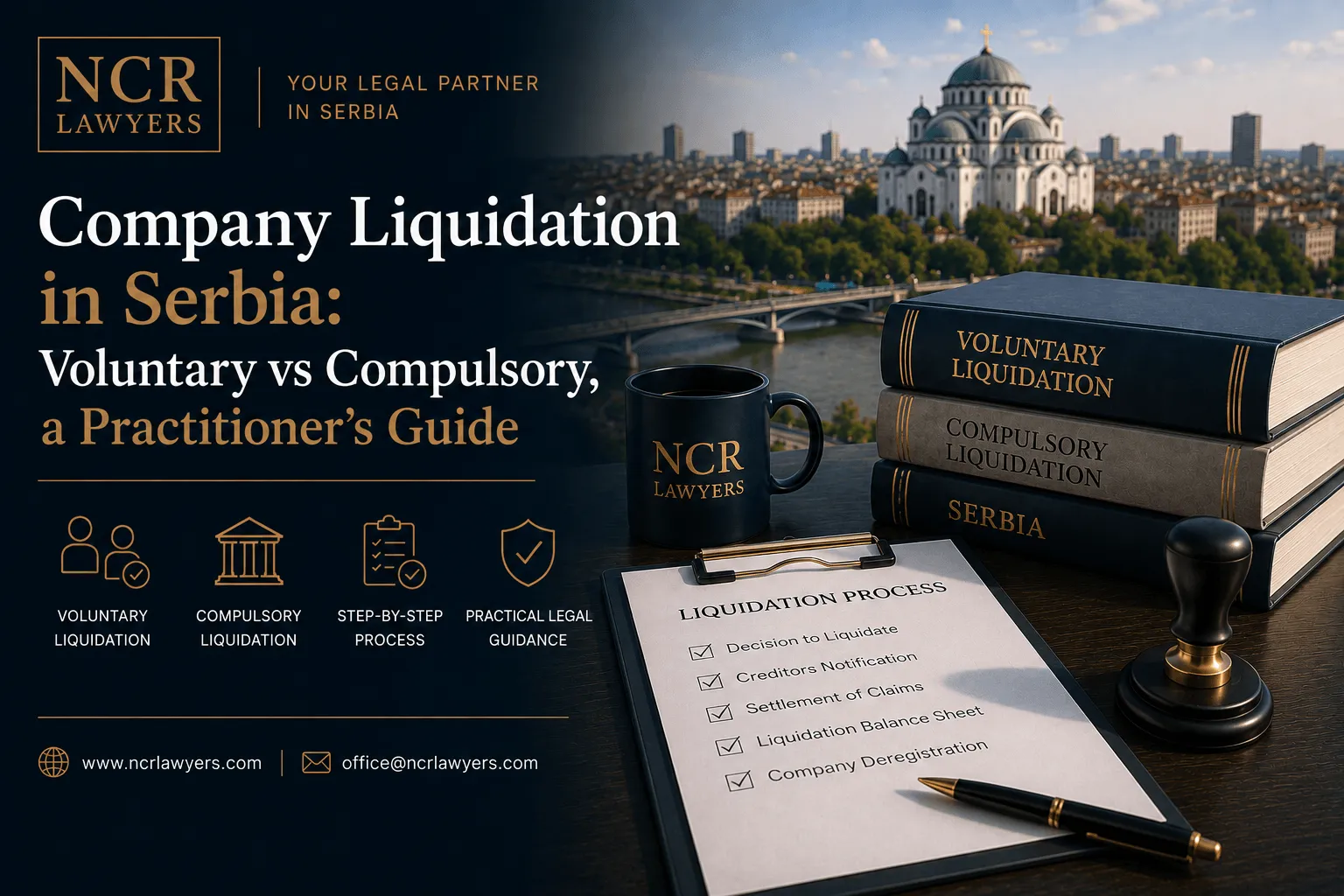
Company liquidation Serbia voluntary vs compulsory is one of the most consequential decisions a company’s shareholders, directors or creditors can face, and getting the process right is important, particularly as Serbia continues to refine its corporate and insolvency framework. This guide explains the legal framework, practical steps, timelines, costs and key risks for winding up a company in Serbia, with an attorney-ready checklist and links to authoritative sources. It is written for in-house counsel, chief financial officers, company directors, law firms and foreign investors who need a clear, comparative and practice-focused resource.
Throughout, we distinguish between the two principal routes, a shareholder-driven voluntary wind-up and a court-ordered insolvency (bankruptcy) procedure, and set out how each affects control, creditors and personal liability.
Before comparing company liquidation serbia voluntary vs compulsory in detail, it helps to separate three concepts that are frequently confused. Liquidation is the formal winding up of a company’s affairs, realising assets, settling liabilities and distributing any surplus, after which the entity is removed from the register. Dissolution is the broader legal event that ends the company’s existence; liquidation is the process that typically precedes it. Bankruptcy (insolvency) is a distinct, creditor-focused procedure that applies where a company cannot meet its obligations and requires collective, court-supervised treatment of creditor claims.
The regime governing company liquidation serbia voluntary vs compulsory is built on the interaction of Serbia’s principal companies legislation, its bankruptcy legislation and the registration rules administered by the Business Registers Agency (Agencija za privredne registre, or APR). The Companies Act (Zakon o privrednim društvima) sets out how solvent voluntary liquidations are commenced, the appointment and powers of the liquidator, and the sequence for settling claims and deregistering the entity. The Law on Bankruptcy governs the insolvency route where the company cannot satisfy its liabilities, providing for court petitions, appointment of a bankruptcy administrator and collective treatment of creditors.
Two institutional anchors matter in practice. The Business Registers Agency (APR) is the central registry: it processes the entry of a liquidation, records the appointed liquidator, publishes the mandatory public notice inviting creditors and effects the final deregistration once the process concludes. The Ministry of Justice of the Republic of Serbia provides the framework for the courts that supervise insolvency proceedings. Bankruptcy proceedings themselves are administered by the competent commercial courts, and bankruptcy administrators are supervised by the Bankruptcy Supervision Agency (Agencija za licenciranje stečajnih upravnika).
Solvent, shareholder-led wind-ups are governed principally by the Companies Act and registered through the APR, while court-ordered and insolvency-driven procedures fall under the Law on Bankruptcy and are administered by the competent commercial courts. Where a company is a regulated entity, for example, a bank or insurer, the National Bank of Serbia may impose additional requirements or supervisory steps before a wind-up can proceed (specific insolvency regimes apply to financial institutions). For the authoritative text of each statute, practitioners should consult the Official Gazette (Službeni glasnik) publication, and confirm the current article numbering, which is subject to legislative amendment.
Voluntary liquidation Serbia is the route chosen where a company is solvent and its owners have decided to bring the business to an orderly close, for example, because the venture has served its purpose, a group is being restructured, or a subsidiary is no longer needed. Because the company controls the process, a well-managed voluntary wind-up is generally faster, cheaper and less disruptive than the compulsory alternative. The essence of company liquidation serbia voluntary vs compulsory is precisely this trade-off between control and cost on one side, and court compulsion on the other.
The process begins with a decision of the company’s owners. In practice the key steps at the outset are:
The liquidator becomes the company’s legal representative for the duration of the process. Their core responsibilities include preparing an opening liquidation balance sheet, taking custody of and realising the company’s assets, collecting receivables, settling verified creditor claims, and preparing the closing accounts. The liquidator must act diligently and in the interests of creditors as well as shareholders, and they carry personal responsibility for the proper conduct of the wind-up. A liquidator who mismanages assets or disregards creditor priorities can face liability, which is one reason careful selection of the office-holder matters.
Creditor protection is central to any lawful voluntary wind-up. Following registration of the liquidation and publication of the public notice, creditors are invited to lodge their claims within the prescribed statutory period. The liquidator reviews each claim, admits or disputes it, and cannot proceed to distribute surplus assets to shareholders until creditor claims have been addressed. Where the liquidator concludes that the company’s assets are insufficient to meet its liabilities in full, the voluntary route generally cannot continue and the matter must be redirected into the bankruptcy procedure, the practical bridge between the voluntary and compulsory tracks.
Once all admitted claims have been settled, the liquidator prepares the final liquidation balance sheet and a report on the conduct of the wind-up, and proposes a distribution of any remaining assets to shareholders. The shareholders adopt the closing documents, after which the liquidator files for deregistration with the APR. Deregistration removes the company from the register and ends its legal existence. The company must also settle its tax position and comply with applicable tax requirements before final strike-off, and records must be retained for the statutory retention period after closure.
Compulsory liquidation Serbia arises where the winding up is not a matter of shareholder choice but is imposed by a court or triggered by a statutory default. This is the more adversarial half of the company liquidation serbia voluntary vs compulsory comparison: control moves away from the company’s owners and directors to a court and a court-appointed office-holder, and the process is driven by the protection of creditors and the public interest rather than by commercial convenience.
The grounds that can lead to a compulsory or court-ordered wind-up include:
The bankruptcy route typically runs as follows. A petition is filed with the competent commercial court, supported by evidence of the grounds relied upon. The court examines the petition and, if satisfied, opens proceedings and appoints a bankruptcy administrator to take control of the company. Creditors are invited to register their claims, and a creditors’ assembly and creditors’ committee are formed. The administrator then realises assets and reports to the court, which supervises the process and adjudicates disputed claims. The company’s affairs are wound up under court oversight, and only once the process concludes is the entity removed from the register.
The defining feature of the compulsory route is court supervision. Unlike a voluntary wind-up, where the liquidator answers to the shareholders, in a court-ordered process the bankruptcy administrator acts under the authority and supervision of the court, and key decisions, including the treatment of claims and the realisation of significant assets, are subject to judicial oversight and, in many cases, to the involvement of the creditors’ bodies. Interested parties, including creditors and the company, generally retain rights of appeal against decisions of the court in accordance with procedural law, which adds safeguards but also lengthens the timetable relative to a smooth voluntary liquidation.
Duration is one of the sharpest points of difference between the two routes. A straightforward voluntary wind-up of a solvent company with few creditors and easily realisable assets can be completed comparatively quickly, whereas a contested bankruptcy procedure, with disputed claims, complex asset pools and appeals, can run considerably longer.
| Scenario | Typical duration | Main variables |
|---|---|---|
| Simple solvent voluntary wind-up | Several months | Number of creditors, ease of asset realisation, tax matters |
| Standard voluntary liquidation | Approximately 6–18 months | Claim volume, asset complexity, creditor disputes |
| Compulsory / bankruptcy procedure | Longer and less predictable | Court schedule, contested claims, appeals, asset complexity |
These are practical estimates only. The actual timeline for any company liquidation serbia voluntary vs compulsory case depends on the specific facts, the volume and nature of creditor claims, the ease of asset realisation, and, for the compulsory route, the court’s schedule and the extent of any disputes. Practitioners should build contingency into any indicative timetable given to stakeholders.
The cost of winding up a Serbian company is made up of several components, and the balance between them differs markedly between the voluntary and compulsory routes. In broad terms the categories are:
As a general rule the voluntary route is more cost-efficient because it avoids court fees and the extended professional engagement that contested proceedings require. Any figure quoted to a client should carry a clear currency reference (RSD, with a EUR equivalent for foreign stakeholders), the date of the estimate, and an express caveat that costs vary with the size and complexity of the estate and are subject to the tariffs currently in force. Costs in a bankruptcy procedure are generally met from the company’s assets, which reduces the pool available to creditors.
Creditor treatment is the heart of any wind-up. In both routes, creditors must actively lodge their claims within the applicable window following the public notice; a creditor who fails to come forward risks losing the opportunity to participate in a distribution.
A creditor submits a claim setting out the amount owed and the basis for it, supported by documentary evidence. The liquidator or bankruptcy administrator reviews each submission and either admits the claim, admits it in part, or disputes it. Disputed claims in a court-supervised bankruptcy are resolved under the supervision of the court, with rights of challenge for interested parties.
Available assets are distributed according to a statutory order of priority rather than on a first-come basis. In broad terms, secured creditors look first to the value of their security; certain preferential claims recognised by the Law on Bankruptcy, such as the costs of the proceedings and specified employee entitlements, are dealt with ahead of general creditors; and ordinary unsecured creditors rank in the subsequent statutory ranks. Shareholders receive any surplus only after all admitted creditor claims have been satisfied. Because the priority order determines who recovers what, understanding where a claim sits in the waterfall is essential for any creditor assessing its likely recovery, and the exact ranking should be confirmed against the current statutory text.
The directors’ liability dimension is where the stakes are highest, and it is a critical part of the company liquidation serbia voluntary vs compulsory analysis. Once insolvency becomes imminent, the focus of directors’ duties shifts: directors must have regard to the interests of creditors and must not take steps that prejudice the creditor body as a whole.
Where directors breach these duties, personal liability can follow, and in serious cases, conduct such as fraudulent asset stripping can carry criminal exposure under the Criminal Code. The practical lesson is that directors who suspect the company is or is about to become insolvent should take specialist advice early, document their decisions carefully, and avoid any transaction that could be characterised as a preference or a transfer at an undervalue.
Foreign investors frequently ask whether an overseas company can be wound up through the Serbian system. The answer depends on structure. Where a foreign parent operates in Serbia through a registered local subsidiary or a registered branch, that Serbian entity or establishment can be liquidated under Serbian law and, where appropriate, subjected to bankruptcy proceedings before the Serbian courts. The foreign parent itself is a separate matter governed by its own home jurisdiction.
Recognition of foreign insolvency proceedings in Serbia, and the coordination of parallel proceedings across borders, is a more specialised area. Serbia is not an EU member state, so the EU’s insolvency instruments do not apply automatically; instead, cross-border recognition turns on Serbian domestic rules and applicable international frameworks. The UNCITRAL model instruments provide the leading international template for cross-border insolvency cooperation and recognition, and the European Commission’s Serbia enlargement information offers useful context on the direction of regulatory alignment. Any cross-border wind-up involving Serbian and foreign entities should be planned with specialist advice from the outset.
The following checklist condenses the practical milestones for both tracks and can be adapted into an internal working document:
| Feature | Voluntary liquidation | Compulsory liquidation / bankruptcy |
|---|---|---|
| Who initiates | Shareholders / the company | Creditors, public authority, or the company where insolvent |
| Legal basis | Companies Act, registered via the APR | Law on Bankruptcy and court order |
| Decision-maker / control | Shareholders and their appointed liquidator | Court and court-appointed bankruptcy administrator |
| Typical timeline | Faster; often around 6–18 months | Longer and less predictable |
| Court involvement | Minimal in a solvent wind-up | Central; process runs under court supervision |
| Creditor influence | Claims lodged and settled by the liquidator | Collective creditor process with a creditors’ assembly and committee |
| Cost range | Generally lower (no court fees) | Generally higher (court and extended professional costs) |
| Director control | Retained until liquidator takes over | Lost to the court-appointed administrator |
| Typical outcome | Orderly solvent wind-up and strike-off | Court-supervised realisation and deregistration |
Choosing the right liquidator materially affects the speed, cost and lawfulness of a wind-up. In a voluntary liquidation the shareholders select and appoint the liquidator; in a bankruptcy procedure the administrator is appointed in accordance with the Law on Bankruptcy from among licensed bankruptcy administrators. When selecting a liquidator for a voluntary process, consider:
Because the liquidator assumes the company’s representative powers and carries personal responsibility for the conduct of the wind-up, appointment should never be treated as a formality.
The wind-up does not end when the assets are distributed. The liquidator must finalise the closing accounts, settle the company’s tax obligations, and file for deregistration with the APR so that the company is formally removed from the register. After strike-off, the company’s books and records must be preserved for the statutory retention period, and a custodian should be identified to hold them. Proper closure protects former directors and shareholders from later challenges and ensures that any residual queries from tax authorities or creditors can be answered from a complete record.
Serbia’s corporate and insolvency framework has been the subject of periodic amendment, and reforms can have practical consequences for anyone considering a wind-up. Changes to registration, reporting and compliance obligations can alter both the triggers for compulsory action, where non-compliance is the gateway, and the mechanics of a voluntary process. Companies planning a wind-up should confirm the current requirements before filing, because procedural details and forms may have been updated. For a fuller treatment of recent reforms and their broader impact, see our overview of Serbia’s corporate law changes at Serbia: Corporate law changes, overview. The general trend towards tighter compliance discipline makes early planning of any wind-up more valuable.
Certain signals should prompt urgent legal advice before any step is taken:
Understanding company liquidation serbia voluntary vs compulsory is essential for any director, shareholder, creditor or foreign investor facing the end of a Serbian company’s life cycle. The voluntary route offers control, speed and lower cost for solvent businesses, while the compulsory (bankruptcy) route protects creditors and the public interest through court supervision where insolvency makes a shareholder-led wind-up impossible. As Serbia’s corporate framework continues to evolve, early planning, careful compliance and specialist advice are more valuable than ever, particularly where director liability, creditor priority or cross-border elements are in play. For entity-specific guidance on any aspect of a Serbian wind-up, seek qualified corporate counsel before taking any procedural step.
This article was produced by Global Law Experts. For specialist advice on this topic, contact Nemanja Curcic at NCR lawyers, a member of the Global Law Experts network.
posted 13 minutes ago

posted 35 minutes ago

posted 57 minutes ago

posted 58 minutes ago

posted 1 hour ago

posted 2 hours ago

posted 2 hours ago

posted 2 hours ago

posted 2 hours ago
posted 3 hours ago

posted 3 hours ago
posted 3 hours ago
No results available
Find the right Legal Expert for your business

Send welcome message