
Our Expert in Morocco
No results available
Royal arbitration Morocco has become a widely searched phrase in 2026, driven by a nationwide lawyers’ strike over the reform of the legal profession and by media reports that practitioners might “request royal arbitration” to break the deadlock. The term sounds authoritative, but it is frequently misunderstood, conflated with the King’s constitutional role, with formal commercial arbitration, and with political mediation. This article sets out, in plain legal English, what royal arbitration in Morocco actually means, what its constitutional and statutory basis is (and is not), and when, if ever, it can resolve a dispute. Full statutory analysis, a side-by-side comparison with commercial arbitration under Law n°95-17, and practical guidance for in-house counsel follow below.
Who this article is for: In-house counsel, company leaders, journalists and arbitration practitioners who want a clear, authoritative answer to whether “royal arbitration” is a genuine legal route in Morocco, what underpins it, and where its limits lie, especially in the wake of the 2026 lawyers’ strike and the disruption it has caused to ordinary court proceedings.
Here is the headline: royal arbitration Morocco is not, in the strict sense, a codified private dispute-resolution procedure that companies can invoke like commercial arbitration. Moroccan statutory law regulates arbitration through Law n°95-17, and that framework, not any “royal” process, governs how private commercial disputes are arbitrated and enforced.
The phrase “royal arbitration” instead describes a political or symbolic appeal to the Crown to mediate or intervene in a matter of high national significance. It draws on the King’s constitutional standing as arbiter between institutions rather than on any statute that creates an arbitral tribunal appointed by the palace. For a private company facing a commercial dispute, a supply contract, a shareholder disagreement, a construction claim, the realistic route remains arbitration under Law n°95-17 or litigation before the ordinary courts.
The practical takeaway for practitioners is straightforward: do not treat calls for royal arbitration as a substitute for a proper dispute-resolution strategy. Where court access is disrupted, the effective alternatives are institutional or ad hoc arbitration, emergency arbitration and foreign interim relief, mechanisms with a firm legal basis and predictable enforcement.
To understand what is meant by royal arbitration Morocco, it helps to separate two distinct ideas that the phrase tends to merge.
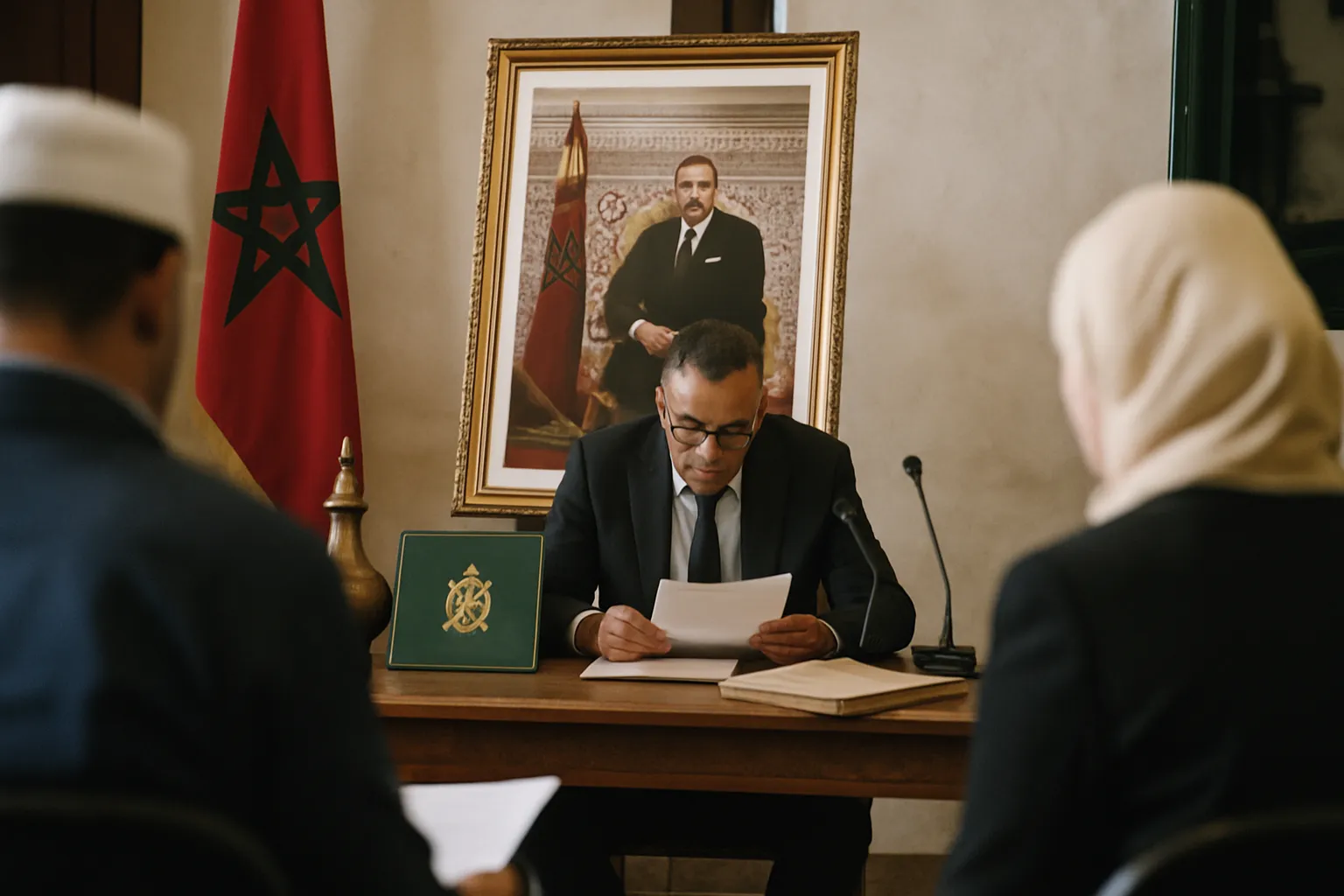
The first idea is the King’s constitutional role. Under the Moroccan Constitution of 2011, the monarch occupies a position above the ordinary institutions of state. Article 42 describes the King as the Head of State and, among other functions, as arbiter between the institutions of the state. This is a high-level, structural function, the King as guarantor of the continuity of the state and mediator between constitutional bodies, rather than a mechanism through which a private claimant obtains a binding decision on a contractual claim.
The second idea is the colloquial use of “royal arbitration” (sometimes rendered as “king arbitration Morocco”) to describe a public appeal to the Crown to resolve a national impasse. This is the sense in which the 2026 lawyers’ strike commentary uses the term: professionals asking the palace to step in and mediate a conflict between the profession and the government over legislative reform. Such appeals are political acts, not the filing of an arbitration request under a procedural code.
Historically, the Moroccan Crown has intervened in matters of national importance through royal instruments, Dahirs and royal directives, and through informal mediation. But these interventions operate in the constitutional and political sphere. They are not the same as an arbitral award rendered by a tribunal constituted under an arbitration agreement, and they should not be confused with one. When people ask “what is royal arbitration Morocco,” the most accurate answer is that it is a political or constitutional concept of royal mediation, not a private legal procedure with defined rules, timelines and enforcement pathways.
The legal basis for royal arbitration Morocco is best analysed across three layers: the Constitution, royal instruments (Dahirs and decrees), and the statutory arbitration framework.
The Moroccan Constitution defines the King’s prerogatives, including his role as a guarantor of the state’s institutions and as an arbiter among them. This constitutional function is real and significant, but it is institutional in character. It empowers the monarch to safeguard constitutional order and to mediate between the branches and organs of the state, it does not create a docket to which a private business can submit a commercial claim and expect a legally enforceable award. The King’s arbitral role, in constitutional theory, is about the equilibrium of the state, not about resolving individual disputes over money or contract.
The Crown acts through Dahirs (royal decrees), which are published in the Bulletin Officiel and administered through the Secrétariat Général du Gouvernement. Dahirs promulgate laws, ratify treaties and give effect to certain royal decisions. Importantly, arbitration legislation itself, the statutory framework that governs commercial arbitration, is promulgated by Dahir, which shows how royal instruments and the arbitration system actually intersect: the Crown formally enacts the arbitration law, but the arbitration is then conducted by tribunals under that law, not by the palace. There is no general statutory instrument creating a standing “royal arbitration” procedure open to private litigants.
The short answer is no. Moroccan law does not contain a formally named, freestanding “royal arbitration” procedure that parties can trigger. Arbitration as a legal mechanism is governed by Law n°95-17 on arbitration and conventional mediation. A royal decision, communiqué or mediated settlement does not, of itself, produce an arbitral award in the technical sense, that is, an award susceptible to recognition and enforcement through the arbitration provisions applied by the Moroccan courts. This distinction matters enormously for enforceability, which we examine in the comparison section below.
Because royal arbitration is a political and constitutional concept rather than a codified procedure, there is no application form, registry or filing route for private parties. Requests directed to the Crown are, in practice, appeals made publicly or through official and political channels in matters touching the national interest. For a private commercial actor, there is no realistic mechanism to compel or obtain royal arbitration of a business dispute. Any attempt to characterise a commercial disagreement as suitable for the Crown’s intervention is, legally speaking, a category error, and any client suggesting it should be gently redirected toward the arbitration and litigation routes that carry enforceable outcomes.
Where the Crown has historically resolved or defused conflicts of national significance, it has done so through constitutional and political means, royal directives, appointments, and mediation between institutions, rather than by issuing arbitral awards. These interventions are documented through royal instruments published in the Bulletin Officiel, but they belong to the constitutional order. They do not generate a body of arbitration jurisprudence and they are not enforced as arbitral awards under Law n°95-17.
The clearest way to grasp the distinction is to place royal arbitration Morocco side by side with commercial arbitration under Law n°95-17, the statute that actually governs how private disputes are arbitrated and enforced.
Law n°95-17 provides a modern arbitration framework broadly consistent with international norms reflected in the UNCITRAL Model Law on International Commercial Arbitration. It rests on party autonomy, the freedom of parties to agree to arbitrate, to choose their arbitrators, seat and rules, and it sets out the conditions for arbitrability, the conduct of proceedings, and the recognition and enforcement of awards by the Moroccan courts. This is the machinery that gives a commercial award its binding force and its enforceability, both domestically and internationally.
| Feature | Royal arbitration (practical / political) | Law n°95-17 commercial arbitration |
|---|---|---|
| Legal basis | Constitutional and political concept of royal mediation; no dedicated statutory procedure | Codified statute (Law n°95-17), promulgated by Dahir; broadly consistent with UNCITRAL principles |
| Initiation (who and how) | Public or political appeal to the Crown in matters of national significance; no filing route for private parties | Arbitration agreement or clause between parties; request filed with tribunal or arbitral institution |
| Binding force | Not a private arbitral award; outcomes are political/constitutional, not technically arbitral | Award is binding on the parties and susceptible to enforcement |
| Enforceability in Moroccan courts | No enforcement as an arbitral award; a mediated settlement may be enforceable only as a contract | Enforceable through recognition and exequatur procedures applied by the courts |
| Typical use-cases | National-interest impasses; institutional conflicts; symbolic mediation | Commercial, construction, corporate, investment and cross-border disputes |
| Transparency / accountability | Political and discretionary; no procedural rules or reasoned award | Procedural rules, reasoned awards, defined grounds for challenge and refusal |
| Remedies & provisional measures | None as a matter of arbitral procedure | Interim and provisional measures available, subject to the conditions in the applicable rules |
The enforcement point deserves emphasis because it is where the difference between royal arbitration and commercial arbitration becomes decisive. A Law n°95-17 award can be recognised and enforced through the courts, and, for foreign awards, through the recognition regime Morocco applies to international awards. Morocco is a party to the 1958 New York Convention on the Recognition and Enforcement of Foreign Arbitral Awards, which supports the cross-border enforcement of arbitral awards. A politically mediated outcome, by contrast, has no arbitral status.
If it is reduced to a written settlement, it may bind the parties as a contract, but it does not carry the enforcement advantages of an arbitral award, and it cannot be exported for enforcement abroad as an award can. For a company weighing how to secure a decision it can actually collect on, this is the pivotal consideration.
Disputes involving the Moroccan state or state-owned entities raise their own issues, consent to arbitrate, the arbitrability of public-law matters, and questions of immunity from jurisdiction and execution. These are real complications, but they are resolved within the arbitration framework and through carefully drafted consent, not through an appeal to the Crown. Where a counterparty is a sovereign or a state-owned enterprise, the right response is a robust arbitration clause and a considered enforcement strategy, addressed further in the practical guidance below.
The 2026 lawyers’ strike is the immediate reason royal arbitration Morocco is trending. Prolonged industrial action by the profession, in protest at legislative reform of the legal profession, has disrupted the ordinary functioning of the courts, producing adjournments, backlogs and delays in enforcement. In that climate, the suggestion that the King might arbitrate the underlying conflict has understandably captured attention.
It is important to read that suggestion accurately. The call for royal arbitration in the strike context is a political appeal to resolve a national dispute between the profession and the state. It is not a route that individual companies can borrow to resolve their own commercial claims. The strike does not create a new legal mechanism; it simply reduces access to the usual one, the courts, and thereby increases the value of alternatives that do not depend on ordinary court availability.
For businesses, the practical consequences of the disruption are concrete: hearings are postponed, enforcement steps that require court involvement slow down, and the timing of provisional relief becomes uncertain. The realistic response is to lean on dispute-resolution options that are less exposed to court congestion. Arbitration under Law n°95-17, institutional arbitration, emergency arbitration and foreign interim relief all offer paths that can keep a dispute moving even when the local courts are under strain. Our guide to Emergency Arbitration, Morocco (practical alternatives) examines how urgent relief can be obtained without waiting for a fully constituted tribunal.
In short, the 2026 strike changes the operational landscape but not the legal one. Royal arbitration does not become a private remedy because the courts are disrupted; instead, the disruption makes disciplined use of arbitral tools more important than ever.
The following steps translate the analysis above into a workable playbook when court access is uncertain or when a counterparty raises royal arbitration.
Foreign-seated arbitration and cross-border interim relief become attractive when the counterparty holds assets outside Morocco, when neutrality is a priority, or when domestic court disruption threatens the timing of urgent measures. In cross-border matters, consider a foreign seat with access to emergency arbitrators, and coordinate provisional measures across the relevant jurisdictions so that protection is not delayed by local congestion.
For contracts with the Moroccan state or state-owned entities, a considered arbitration clause is essential. A workable starting point is to provide expressly for institutional arbitration, a defined seat, express consent to arbitrate, and a waiver of objections to jurisdiction, while taking specialist advice on immunity from execution. The principle is the same across all counterparties: build enforceability into the clause rather than hoping to improvise a remedy once a dispute has erupted.
Checklist when a counterpart suggests royal arbitration:
Moroccan courts apply the arbitration framework to arbitral awards and apply contract and civil-procedure rules to settlements. The doctrinal position is coherent: an arbitral award, rendered under a valid arbitration agreement and consistent with Law n°95-17, is recognised and enforced through the procedures the courts apply to awards, subject to the defined grounds for refusal. A politically mediated or extrajudicial outcome does not enter that pathway. If such an outcome is captured in a signed settlement, it is treated as a contract and enforced as one, a materially weaker position than holding an award. This is why the distinction between royal arbitration and Law n°95-17 arbitration is not academic: it determines which enforcement machinery is available to you.
The bottom line on royal arbitration Morocco is clear. It is a constitutional and political concept, an appeal to the Crown to mediate matters of national significance, not a private dispute-resolution procedure with rules, timelines and enforceable awards. For commercial disputes, the operative framework is Law n°95-17, which delivers binding, enforceable outcomes and access to interim and emergency relief. The 2026 lawyers’ strike has made the phrase newsworthy, but it has not turned royal arbitration into a remedy that businesses can invoke. What the strike does underline is the importance of arbitration clauses, emergency and provisional measures, and a considered enforcement strategy.
If a dispute is looming, or a counterparty is proposing royal arbitration, the right next step is to consult qualified Moroccan arbitration counsel to secure a route that actually binds and enforces.
This article is general information, not legal advice. For advice on a specific dispute, consult a qualified Moroccan arbitration lawyer.
This article was produced by Global Law Experts. For specialist advice on this topic, contact Azzedine Kettani at Kettani Law Firm, a member of the Global Law Experts network.

posted 17 minutes ago

posted 36 minutes ago

posted 55 minutes ago

posted 2 hours ago

posted 2 hours ago

posted 2 hours ago

posted 2 hours ago

posted 2 hours ago
posted 3 hours ago

posted 3 hours ago

posted 3 hours ago

posted 3 hours ago
No results available
Find the right Legal Expert for your business

Send welcome message