
Author
No results available
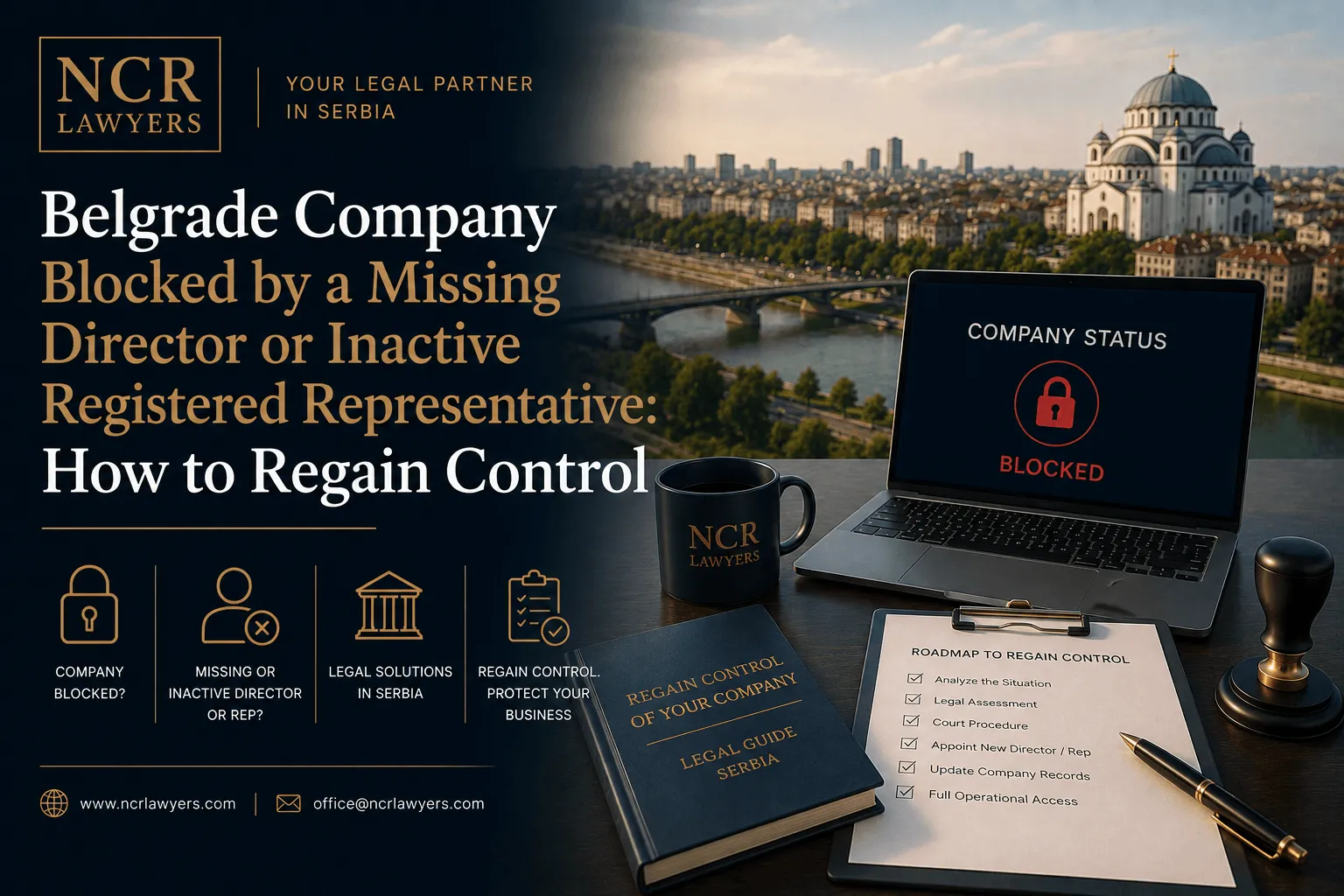
When a Belgrade company is blocked because a director is missing or a registered representative has become inactive, every day of operational paralysis costs money, damages commercial relationships and exposes the company to regulatory risk. At NCR lawyers, I regularly advise shareholders, co-founders and in-house teams who discover, often without warning, that their company cannot sign contracts, authorise bank payments or file statutory returns because the person registered at the Serbian Business Registers Agency (APR) as the legal representative is unreachable, has resigned without notice or has simply abandoned their role.
This guide sets out the exact steps I recommend in practice: what to do in the first 72 hours, how to navigate the APR, when to seek emergency court relief, and how to manage the compliance risks that follow.
Speed matters. The longer a Belgrade company remains blocked by a missing director or inactive representative, the greater the risk of missed tax filings, defaulted contracts and frozen bank accounts. Below is the eight-step emergency checklist I walk clients through on the first call.
The APR’s public search function allows anyone to verify a company’s registered director and legal representative in real time. Enter the company’s registration number (matični broj) at the APR website to pull the current registration extract. For blocked bank account Serbia checks, the PKS Partner portal provides data on whether a company’s accounts have been blocked due to enforced collection, unpaid taxes or court orders. Checking both portals within the first few hours gives you a clear picture of the company’s operational and financial status.
What NOT to do in the first 72 hours:
The Serbian Business Registers Agency (APR) is the authoritative source for a company’s registered director and legal representative. Under the Companies Act, only the person entered on the APR register has the legal power to represent the company vis-à-vis third parties, banks and government bodies. If the wrong person is listed, or if no active director appears, the company is effectively frozen.
To change a legal representative in Serbia and register a new director with the APR, you will generally need to prepare and submit the following:
The APR generally processes registration of changes within five working days of receiving a complete and properly authorised application. If the application is deficient, the APR will issue a request for correction, which extends the timeline. Registration fees for changes to director or representative data are modest, typically in the range of a few thousand Serbian dinars, but errors and resubmissions add cost and, more critically, time. In my experience, the most common cause of delay is not the APR itself but incomplete documentation on the applicant’s side: missing notarisations, unsigned consents or improperly convened shareholder meetings.
When your Belgrade company is blocked because a director is missing, the path to restoring operational capacity depends on the company’s legal form, its constitutional documents and the specific circumstances of the director’s absence. The Companies Act provides the legal framework, but the articles of association often contain critical procedural details that override or supplement the statutory defaults.
To remove a director by shareholder resolution in Serbia, the following procedure applies under the Companies Act and the company’s founding documents:
If the company has only one director and that director is the missing person, the company faces a uniquely difficult situation. There is no other officer who can sign on the company’s behalf, authorise bank transactions or represent the company before regulators. In this scenario, shareholders must act without delay: convene a shareholders’ meeting (even an extraordinary one), appoint a new director, and file the change with the APR. If the missing director was also the sole shareholder, the situation escalates into a potential succession or insolvency issue, and court intervention may be necessary.
A notarised power of attorney granted by a director before their disappearance or incapacity may provide a temporary bridge. However, this tool has significant limitations. First, the power of attorney is only valid if the director who granted it was authorised at the time and has not subsequently died or been declared incapacitated, events that typically extinguish a power of attorney. Second, Serbian banks have their own internal policies on accepting powers of attorney for banking transactions; many will require the representative registered at the APR to appear in person or provide fresh authorisation. In practice, I find that a power of attorney buys days, not weeks, and it is never a substitute for resolving the underlying registry problem.
When internal corporate mechanisms fail, because shareholders cannot agree, the missing director is obstructing the process, or the company faces imminent harm, Serbian courts offer several forms of emergency relief. These remedies are available through the Commercial Court in Belgrade (Privredni sud u Beogradu) for companies domiciled in its jurisdiction. An emergency injunction in Serbia can be sought in the following forms:
| Remedy | Typical trigger / when used | Typical time to relief (estimate) |
|---|---|---|
| Court injunction to permit specific acts (e.g., sign contracts) | No available director or refusal to act; immediate risk of financial loss or contract default | 3–14 days (depends on court urgency assessment) |
| Provisional appointment / court-appointed manager | Deadlock, fraud, or prolonged absence resulting in demonstrable harm to the company | 1–4 weeks |
| Mareva-type freezing order (prevent asset dissipation) | Credible risk that company assets will be removed, dissipated or concealed | 1–7 days (emergency ex parte application possible) |
To obtain any of these remedies, the applicant (typically a shareholder or the company itself through authorised persons) must demonstrate urgency, the likelihood of success on the merits and that the harm would be irreparable or difficult to remedy through damages alone. Courts will examine the evidence supporting the claim that the company is blocked and that immediate intervention is necessary. For guidance on the general principles behind urgent interdict and interim relief requirements, including the tests courts apply, I recommend reviewing the procedural standards that apply across jurisdictions. Similarly, where there is a risk of asset dissipation by an absent director, the principles governing Mareva-type freezing orders are directly relevant.
Under the Companies Act, the director (or directors collectively, if there is a board) holds the power to manage the company and represent it externally. Shareholders do not, by default, have the right to represent the company or sign on its behalf, their role is to appoint and remove directors, approve fundamental decisions and exercise oversight. This distinction matters because shareholders sometimes attempt to act in the director’s place during a crisis, only to find that banks, counterparties and the APR refuse to recognise their authority. The proper route is always: shareholder decision to appoint a new director, followed by APR registration, followed by operational resumption.
Dealing with banks when a Belgrade company is blocked by a missing director requires a structured approach. Banks in Serbia are bound by their own regulatory obligations, including Know Your Customer (KYC) and anti-money-laundering (AML) rules, which means they will not simply accept informal assurances that “someone else is now in charge.” Here is the checklist I provide to clients for bank engagement when resolving a blocked bank account in Serbia:
In my experience, most Serbian banks will not accept a power of attorney as a permanent substitute for a registered director. However, some banks will accept a notarised power of attorney for specific, limited transactions, particularly where the company can demonstrate that the APR registration process is underway and will be completed imminently. The key is to communicate proactively, in writing, and to provide the bank with a clear timeline for resolving the registry issue. Do not assume the bank will be flexible: get their requirements in writing before submitting documents.
Resolving an operational blockage is only part of the challenge. Companies and incoming directors must also manage the legal risks that arise from the period of paralysis and from the departing director’s conduct.
Director disqualification in Serbia can occur where a director has been convicted of certain economic offences, has breached fiduciary duties, or has been found personally liable for company debts through court proceedings. The Companies Act imposes duties of care, loyalty and avoiding conflicts of interest on all directors. An absent director who has abandoned the company without proper resignation may be in breach of these duties, which could expose them to personal liability claims from the company or its creditors.
For new appointees, the risks are different but real:
Understanding the requirements to remove a director under the Companies Act is essential not just for unblocking the company, but for ensuring that the removal itself does not create grounds for the departing director to bring a claim. Proper notice, procedural fairness and compliance with the articles of association are non-negotiable. For a comparative perspective on how other jurisdictions handle this process, see this guide on how to remove a director from a company.
Preparation is the single biggest factor in how quickly a blocked Belgrade company regains operational capacity. Before filing anything, assemble the following:
If the company is ultimately unrecoverable, for example, if all shareholders and directors have abandoned it, the terminal option is to wind down the company through formal dissolution or liquidation proceedings.
The following table summarises the escalation sequence I recommend to clients whose Belgrade company is blocked by a missing director or inactive representative:
| Timeframe | Action | Objective |
|---|---|---|
| Immediate (Day 1) | Check APR register, contact banks, attempt to reach director, secure records and tokens | Establish the facts and prevent further deterioration |
| Days 1–3 | Review articles of association, identify power of attorney options, engage legal counsel | Determine the fastest viable route to appoint a replacement |
| Days 3–7 | Convene extraordinary shareholders’ meeting, adopt resolution to remove and replace director | Produce the corporate decision that authorises APR filing |
| Days 7–14 | File change with APR, submit new documents to banks, update specimen signatures | Restore registered representation and banking authority |
| Weeks 2–4 | If internal remedies fail: apply to Commercial Court for interim measures or provisional appointment | Obtain court-ordered relief to unblock operations |
| Ongoing | Conduct compliance audit, remediate missed filings, review governance documents to prevent recurrence | Stabilise the company and close exposure gaps |
A Belgrade company blocked by a missing director or inactive registered representative is not an unusual scenario, in my practice, I see it arise from partnership breakdowns, expatriate founders relocating, directors passing away without succession plans, and even deliberate obstruction during shareholder disputes. What separates the companies that recover quickly from those that suffer lasting damage is the speed and precision of the response. Act within the first 72 hours, follow the APR process methodically, and do not hesitate to escalate to court if internal mechanisms are insufficient.
Equally important is the post-crisis step: update your articles of association to include deputy director provisions, deadlock-breaking mechanisms and mandatory succession protocols so that the company is never again paralysed by a single point of governance failure.
For specialist advice on this topic, contact Nemanja Curcic at NCR lawyers.

posted 13 minutes ago

posted 35 minutes ago

posted 56 minutes ago

posted 58 minutes ago

posted 1 hour ago

posted 2 hours ago

posted 2 hours ago

posted 2 hours ago

posted 2 hours ago

posted 3 hours ago

posted 3 hours ago

posted 3 hours ago
No results available
Find the right Legal Expert for your business

Send welcome message