
Author
No results available
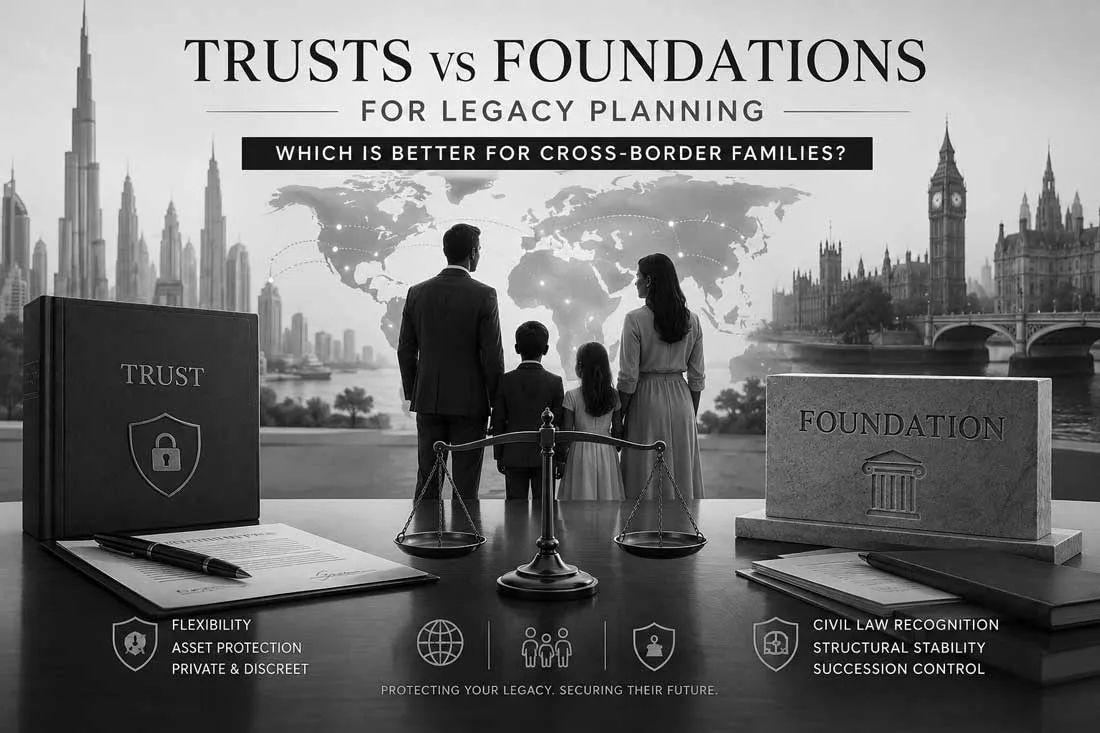
For families with assets and members spread across multiple countries, choosing the right succession vehicle- a trust or a foundation- can significantly affect how smoothly wealth transfers between generations, how well it’s protected from disputes and creditors, and how efficiently it’s taxed along the way. Both structures achieve similar broad goals, but they work quite differently, and the right choice depends on your family’s specific circumstances and where your assets and beneficiaries are actually based.
Knightsbridge Group’s legal team structures both trusts and foundations for cross-border families, and we start every engagement by understanding the family’s actual goals and jurisdictional footprint before recommending either vehicle. As a fully licensed legal and corporate advisory firm with offices in Dubai, London, and Istanbul, here’s how the two compare.
A trust is a legal relationship, not a separate legal entity, in which a settlor transfers assets to trustees, who hold and manage those assets for the benefit of named beneficiaries, according to terms set out in the trust deed. Trusts originate from common law systems and are widely used and well understood across jurisdictions including the UK, US, and many Commonwealth countries.
Trusts offer significant flexibility in how and when beneficiaries receive assets, including the ability to stagger distributions across a beneficiary’s lifetime or attach conditions to distributions, and the trustee’s fiduciary duty provides a strong legal framework for beneficiary protection. However, because a trust is a relationship rather than a distinct legal entity, its recognition and tax treatment can vary considerably across civil law jurisdictions that don’t have an equivalent concept in their own legal systems, which can create complications for families with significant ties to civil law countries.
A foundation, such as a DIFC Foundation, is a standalone legal entity in its own right, similar in structure to a company but without shareholders, that holds assets in its own name for purposes and beneficiaries defined in its charter. Because a foundation is a distinct legal entity rather than a relationship, it is generally more readily recognised and understood across both common law and civil law jurisdictions, an important advantage for families with connections to countries, including much of Continental Europe, the Middle East, and parts of Asia, where the trust concept isn’t native to the local legal system.
Foundations are governed by a council (analogous to a board of directors), which can include the founder during their lifetime, professional advisors, and family members, offering a governance structure many founders find more intuitive and involved than the trustee relationship in a traditional trust.
Legal recognition across jurisdictions. Foundations, as standalone entities, tend to face fewer recognition challenges in civil law countries compared to trusts, which can encounter difficulty being recognised or taxed predictably outside common law systems.
Founder involvement. Foundations generally allow the founder a more direct, ongoing governance role through the foundation council, while a trust structure traditionally separates the settlor from ongoing control once assets are transferred to trustees, though modern trust structures can be designed with greater settlor involvement where appropriate.
Familiarity for beneficiaries and advisors. Families with strong ties to common law jurisdictions, the UK, US, or Commonwealth countries, often find trusts more familiar and better understood by their existing advisors and beneficiaries. Families based primarily in civil law or Middle Eastern jurisdictions often find foundations a more natural fit, both legally and culturally.
Regulatory environment. A DIFC Foundation operates within a well-regulated, internationally recognised framework in Dubai, offering a strong, transparent alternative to offshore trust jurisdictions that have faced increasing international scrutiny in recent years.
There’s no universally correct answer; the right choice depends on where your beneficiaries live, which legal systems your assets and family are most connected to, and how much ongoing involvement you want in governance during your lifetime. Many cross-border families with ties spanning both common law and civil law jurisdictions ultimately find that a foundation offers the more predictable, widely recognised solution, while families deeply rooted in common law systems may find a well-structured trust continues to serve them well.
Choosing between a trust and a foundation, and structuring it correctly for your family’s specific cross-border footprint, is a decision worth getting right the first time. Knightsbridge Group’s legal team will assess your family’s circumstances, jurisdictional ties, and long-term goals, and design and administer the structure best suited to protecting your legacy. Contact our advisors to discuss the right succession planning structure for your family.
Stay informed with the latest legal developments at Global Law Experts News.

posted 18 minutes ago

posted 2 hours ago

posted 2 hours ago

posted 2 hours ago

posted 3 hours ago

posted 3 hours ago

posted 4 hours ago

posted 4 hours ago

posted 4 hours ago

posted 4 hours ago

posted 5 hours ago

posted 5 hours ago
No results available
Find the right Legal Expert for your business

Send welcome message