
Author
No results available
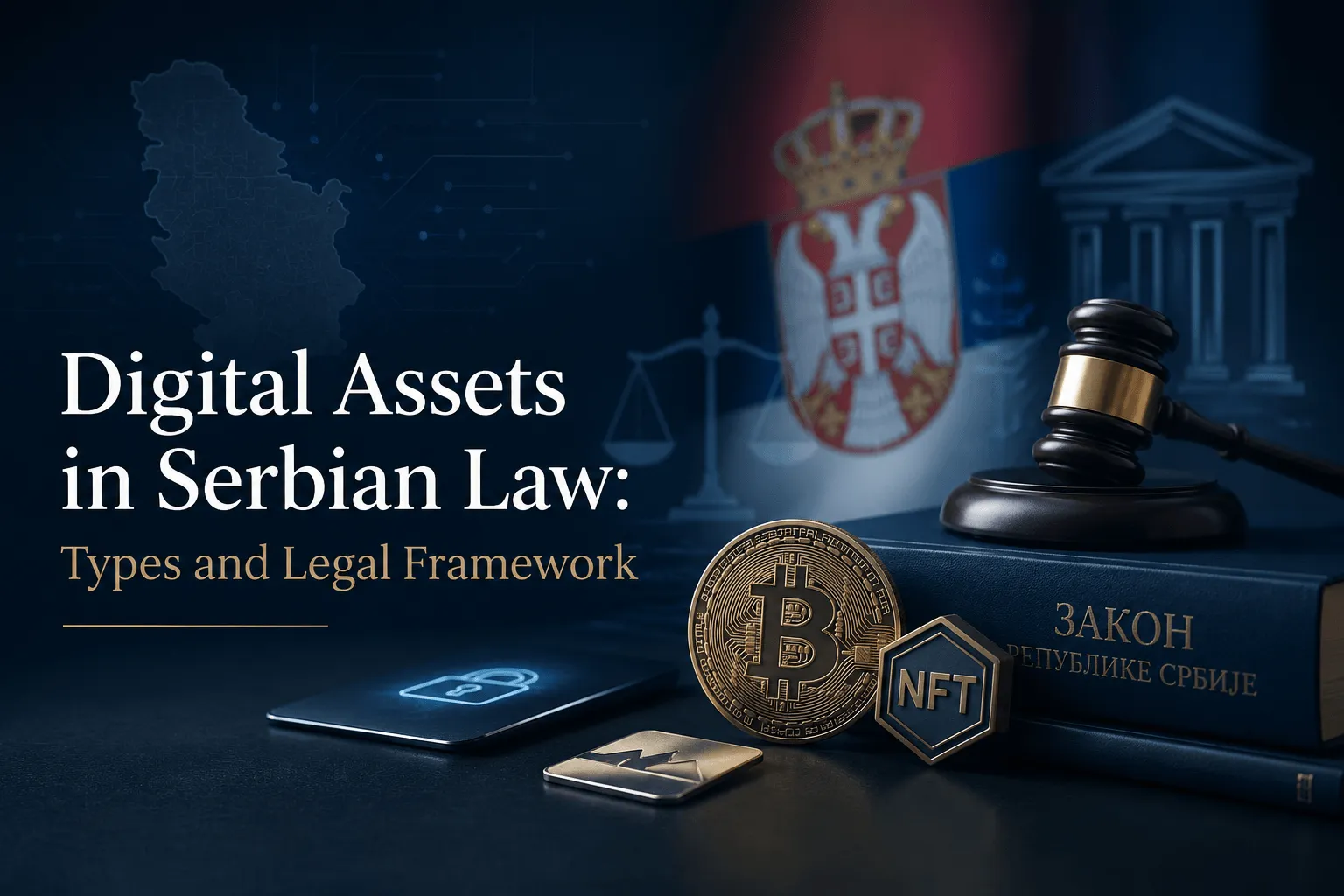
Serbia’s Law on Digital Assets (Official Gazette of the RS, No. 153/2020) established one of Europe’s earliest comprehensive frameworks for regulating digital assets, and it remains the cornerstone statute that every corporate counsel, fintech founder and compliance officer must navigate when operating in this market. Published on 21 December 2020 and fully applicable from 30 June 2021, the law draws a fundamental distinction between two categories, virtual currencies and digital tokens, and the classification decision a company makes at the outset determines the entire downstream chain of licensing, AML/KYC, tax and disclosure obligations.
At NCR lawyers, we regularly advise corporate clients on structuring digital-asset projects within this framework, and in my experience the single most consequential compliance question is getting that initial classification right. This guide walks through every layer of the framework: the types of digital assets Serbian law recognises, the regulatory obligations attached to each, and the practical steps corporate issuers and service providers should take to stay compliant.
The Law on Digital Assets (the “LDA”) governs three broad areas: the issuance of digital assets and secondary trading, the provision of services related to digital assets, and the rights and obligations of issuers, service providers and users. It explicitly states that virtual currencies are not legal tender in the Republic of Serbia, a point that still generates confusion among international clients entering the market.
Before any commercial activity begins, the first compliance decision is binary: is the asset a virtual currency or a digital token? Virtual currencies function as a medium of exchange but are not issued by a central bank or public authority. Digital tokens, by contrast, represent property rights, service rights or other entitlements recorded in a digital ledger. Each classification carries distinct regulatory consequences, from the type of licence required and the regulator with supervisory authority, through to the AML programme that must be in place and the tax treatment of transactions.
In my practice I have seen projects delayed by months because founders assumed that all crypto-related products fell into a single regulatory bucket. The reality under the LDA is more nuanced, and a well-reasoned legal opinion at the outset can save both time and significant cost.
The LDA applies to any person or entity that issues digital assets, provides services related to digital assets, or trades digital assets within or from the territory of the Republic of Serbia. The law’s scope is broad: it covers issuance, secondary trading, custody, brokerage, exchange services and the administration of digital-asset platforms. It also addresses the right of pledge and fiduciary transfer of digital assets as security, a detail of particular importance for corporate treasury and lending arrangements.
Understanding the statute starts with its definitions. The table below maps the core statutory terms to their practical meaning for corporate users:
| Statutory Term | Practical Meaning |
|---|---|
| Digital asset | The umbrella category covering both virtual currencies and digital tokens, any digital record of value that can be digitally purchased, sold, exchanged or transferred, and used for investment or payment purposes. |
| Virtual currency | A type of digital asset not issued by a central bank or public authority, not pegged to legal tender, and accepted by natural or legal persons as a medium of exchange. Bitcoin and Ether are the most common examples. |
| Digital token | A digital asset representing one or more property rights, including rights to profit, ownership interests or access to services. Tokens are recorded in a distributed ledger or similar technology. |
| Digital asset service provider (VASP) | Any entity providing exchange, custody, brokerage, platform-operation or advisory services related to digital assets. |
The regulatory split is significant: virtual currencies fall primarily under the supervisory authority of the National Bank of Serbia (NBS), while digital tokens, particularly those with investment characteristics, may also engage the Serbian Securities Commission (SEC). This dual-regulator model demands that every issuer and crypto licensing and compliance decision is mapped against the specific asset type.
The LDA’s two-category framework is the backbone of Serbia’s digital-assets regulation. Every compliance obligation flows from the classification, so corporate counsel must be able to identify the distinguishing features of each type and spot the edge cases, stablecoins, NFTs and hybrid tokens, that do not fit neatly into either box.
Virtual currencies are defined negatively: they are digital assets that are not issued by a central bank or other public authority and are not necessarily pegged to a fiat currency. They function as a medium of exchange but carry no legal-tender status. Serbia does not prohibit the use of virtual currencies in transactions between willing parties, but no person can be compelled to accept them.
Digital tokens, on the other hand, are digital records of rights. The law treats them as representations of property rights, profit-sharing interests or rights to access a product or service. This makes the token sub-classification critical, an investment token that confers dividend or profit rights triggers securities-like obligations, while a utility token that merely grants platform access may face lighter requirements.
Where a digital token confers ownership, profit-sharing or dividend-equivalent rights, it is functionally similar to a security. The Serbian SEC has indicated that such tokens attract oversight analogous to that applied to securities, including potential prospectus or white-paper requirements and conduct-of-business rules for intermediaries. For companies considering a security token offering (STO), this means engaging with the SEC early and preparing disclosure documentation that mirrors capital-markets standards.
Utility tokens, those granting access to a service or platform without conferring economic ownership, are subject to lighter regulatory requirements, though consumer-protection and contractual rules still apply. Non-fungible tokens (NFTs) sit in a category of their own: each NFT is unique, and Serbian law does not carve out a bespoke NFT regime. In practice, I advise clients that an NFT’s legal treatment depends on the rights it encodes, an NFT conferring a profit share is functionally an investment token; an NFT representing a digital artwork is closer to a utility or collectible asset.
Stablecoins, tokens pegged to a fiat currency or basket of assets, are also assessed by reference to the underlying rights they confer. A stablecoin functioning purely as a means of payment may be treated as a virtual currency, while one backed by reserves and conferring a redemption right may be classified as a digital token with additional obligations. The classification depends on the specific design.
| Token Type | Legal Definition / Feature | Primary Compliance Triggers |
|---|---|---|
| Virtual currency | Not issued by a public authority; medium of exchange but not legal tender | AML/KYC for exchanges; anti-fraud rules; VASP registration with NBS |
| Investment token | Token conferring ownership or economic rights (dividend, profit-share) | Securities-like rules; white-paper / prospectus; SEC oversight |
| Utility / payment token | Grants access to a service or platform | Consumer protection; contractual terms; lighter regulatory treatment |
| NFT (non-fungible token) | Unique token representing a specific asset or right | IP and ownership-transfer rules; tax treatment varies; marketplace compliance |
The LDA casts a wide net over market participants. Any entity that issues digital assets, operates a trading platform, provides custody, acts as a broker or dealer, or offers advisory services related to digital assets must comply with registration or licensing requirements. The obligations differ depending on whether the entity deals in virtual currencies (overseen primarily by the NBS) or digital tokens (where the SEC may also have jurisdiction).
A virtual-asset service provider (VASP) under the LDA includes any person providing one or more of the following services: exchange between digital assets and fiat currency; exchange between different digital assets; transfer of digital assets; custody and administration of digital assets; and services related to the offer or sale of digital assets. Any company intending to provide such services must obtain a licence or register with the competent authority before commencing operations.
Prohibited practices include pledging or creating a fiduciary transfer over a client’s digital assets without the client’s express written consent, charging undisclosed fees, and misrepresenting the nature or risks of a digital asset. Violations can result in enforcement action, fines and licence revocation.
Operators of digital-asset trading platforms bear obligations around order-book transparency, trade reporting and fair-access rules. Platform operators must ensure that their systems are resilient and that trading is orderly. In my experience, this is an area where Serbian regulators have been increasingly active, I have seen compliance queries from the NBS directed at platform operators regarding the adequacy of their order-matching procedures and conflict-of-interest controls.
For clients exploring initial coin offerings (ICOs) or token sales structured from Serbia, the issuance provisions of the LDA require the preparation of a white paper containing prescribed disclosures, and, for investment tokens, potential engagement with the SEC’s registration process.
Serbia’s AML framework applies to digital-asset service providers alongside banks and other obligated entities. The Law on the Prevention of Money Laundering and the Financing of Terrorism interacts directly with the LDA, imposing customer-due-diligence and record-keeping obligations on every VASP operating in the country.
VASPs must implement a risk-based customer-due-diligence programme. In practice this means:
VASPs are required to report suspicious transactions to the Administration for the Prevention of Money Laundering (APML). Record-keeping obligations require that transaction data and customer-identification documents be retained for a minimum period prescribed by law. Non-compliance carries criminal and administrative penalties.
The travel-rule principle, requiring that originator and beneficiary information accompany digital-asset transfers, is increasingly relevant as Serbia aligns its framework with FATF recommendations. From what I am seeing in practice, regulators expect VASPs to have systems capable of transmitting and receiving originator data on cross-border transfers, even where the specific secondary legislation is still being refined.
For corporate entities, the treatment of digital assets on the balance sheet, the tax consequences of issuance and trading, and the rules on custody and pledging are central concerns. The LDA permits digital assets to be the subject of a right of pledge and fiduciary transfer, which opens the door to secured-lending structures, but only with proper client consent and documentation.
On the tax side, the key considerations fall into three areas:
| Activity | Tax Treatment | Notes |
|---|---|---|
| Corporate trading of digital assets (capital gains) | Subject to corporate income tax on realised gains | Gains measured as difference between disposal and acquisition cost |
| Issuance of tokens (primary market) | Proceeds may be treated as income or capital depending on token structure | Investment tokens may attract securities-like tax treatment |
| Accepting digital assets as payment for goods/services | VAT applies to the underlying supply; digital-asset payment is valued at market price | Determine fair market value at the time of transaction |
| Mining / staking rewards | Potentially income-taxable when received | Classification depends on whether activity is carried on as a business |
Example 1: A Serbian company sells 10,000 utility tokens to fund platform development. The proceeds are booked as income and subject to corporate income tax. VAT treatment depends on whether the token sale is classified as a supply of services.
Example 2: A company accepts Bitcoin as payment for consulting services. The transaction is subject to VAT on the consulting service, with the Bitcoin valued at its market price on the date of receipt. Any subsequent gain or loss on the Bitcoin holding is a separate taxable event.
In my view, the following seven-step checklist captures the essential compliance workflow for any company planning to issue or adopt digital assets in Serbia:
The LDA applies to digital-asset services provided within Serbia, but the borderless nature of blockchain technology creates inevitable cross-border questions. Serbian regulators may assert jurisdiction where services are directed at Serbian residents, even if the provider is incorporated abroad. In my advice to clients considering cross-border token offerings, I emphasise the importance of geo-fencing, clear jurisdictional disclaimers and sanctions screening.
Enforcement risk is real. The NBS and SEC have the power to impose fines, revoke licences and refer matters for criminal prosecution. Companies using tokens for crowdfunding or payment must ensure that their activities do not constitute unlicensed deposit-taking, unlicensed provision of payment services or, for investment tokens, unregistered public offerings of securities. For businesses comparing crypto licensing requirements across European jurisdictions, Serbia’s enforcement posture is increasingly aligned with EU standards, though it has not yet adopted the EU’s Markets in Crypto-Assets Regulation (MiCA).
The following table summarises the critical milestones in Serbia’s digital-assets regulatory timeline:
| Date | Event | Practical Effect |
|---|---|---|
| 21 December 2020 | Publication in Official Gazette No. 153/2020 | Law on Digital Assets enacted and published |
| 30 June 2021 | Law became applicable | All compliance obligations enforceable; unlicensed activity became sanctionable |
| 2021–2025 | Secondary guidance and regulator notices | NBS, SEC and MFIN issued implementation clarifications and licensing procedures |
The treatment of digital assets under Serbian law turns on a single foundational decision: whether the asset is a virtual currency or a digital token, and, if a token, what rights it confers. Every licensing, AML, tax and disclosure obligation flows from that classification. For corporate issuers, VASPs and investors, the practical imperative is to classify early, document thoroughly and engage with the relevant regulator before launch. Serbia’s framework is maturing, and businesses that invest in compliance now will be best positioned as the regulatory environment continues to develop.
For specialist advice on this topic, contact Nemanja Curcic at NCR lawyers.

posted 8 minutes ago

posted 40 minutes ago

posted 44 minutes ago

posted 1 hour ago
posted 1 hour ago

posted 2 hours ago

posted 2 hours ago

posted 2 hours ago

posted 3 hours ago

posted 3 hours ago

posted 3 hours ago

posted 3 hours ago
No results available
Find the right Legal Expert for your business

Send welcome message