
Author
No results available
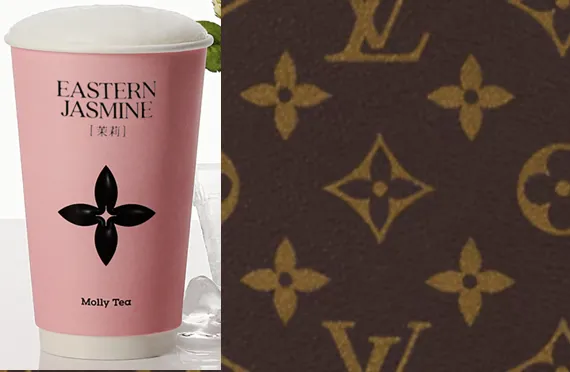
The backlash after Molly Tea was ordered to pay Louis Vuitton approximately US $1.5 million has dominated legal and commercial discourse across China and beyond. A court in Suzhou ruled that the popular bubble‑tea chain’s four‑petal floral logo infringed Louis Vuitton’s registered trademarks, ordering Molly Tea to pay 10.3 million yuan in damages, immediately cease using the contested design, and issue a public apology. The decision has sparked fierce debate, from intellectual property lawyers dissecting the similarity standard to small‑business owners questioning whether common geometric shapes can truly be monopolised. The case offers critical lessons for every brand operating in China, and the commercial ripple effects for franchisees, designers, and trademark holders are only beginning to unfold.
Understanding the full arc of the Molly Tea lawsuit requires context about both parties. Molly Tea (茉莉奶白, Mòlì Nǎibái) grew rapidly from a single Guangdong storefront into a nationwide bubble‑tea phenomenon, expanding to hundreds of outlets across mainland China and franchised locations in the United States, including stores in New York. Its brand identity centred on a distinctive four‑petal flower motif used across packaging, store signage, and cups, a design that would ultimately draw legal scrutiny.
Molly Tea positioned itself as a premium jasmine‑milk‑tea brand targeting younger consumers. Its franchise model fuelled rapid growth, and by the time litigation commenced, the chain had established a significant physical and social‑media presence both domestically and overseas. Reports indicate the brand had authorised at least five franchise locations in the US market, though several of those relationships subsequently became the subject of separate commercial disputes.
Louis Vuitton, the French luxury house, holds a substantial portfolio of registered trademarks in China through the China National Intellectual Property Administration (CNIPA). Among these registrations are multiple graphic marks depicting four‑petal floral motifs, the iconic Monogram Flower design that has been central to the Louis Vuitton visual identity for more than a century. Louis Vuitton asserted several of these registrations in its complaint, arguing that Molly Tea’s logo was confusingly similar to its protected designs.
| Date / Period | Event | Legal Significance |
|---|---|---|
| Pre‑2024 | Molly Tea adopts and scales a four‑petal floral logo across stores and packaging nationwide | Establishes the accused mark’s commercial use and geographic reach, relevant to damages calculation |
| 2024–2025 | Louis Vuitton files trademark infringement proceedings at the Suzhou court; cease‑and‑desist demands precede formal litigation | Engages China’s Trademark Law (PRC), Articles 57 and 63 provide the statutory basis for the claim |
| Mid‑2026 | Suzhou court issues first‑instance judgment: 10.3 million yuan in damages, injunction on logo use, public apology ordered | Sets a notable damages benchmark for trademark enforcement in China’s F&B sector; appeal window opens under PRC Civil Procedure Law |
| July 2026 | Ruling goes viral; social debate erupts; franchise disputes surface in US market (Molly Tea Flushing locations) | Demonstrates reputational and commercial knock‑on effects of IP litigation; raises cross‑border franchise risk questions |
The Suzhou court’s first‑instance judgment is significant both for its legal reasoning and for the scale of relief granted. We at IPO Pang Shenjun have followed this case closely because it sits at the intersection of trademark enforcement in China, franchise operations, and brand design, three areas where our commercial clients regularly require guidance.
Under Article 57 of the Trademark Law of the People’s Republic of China, using a mark that is identical or similar to a registered trademark on the same or similar goods, where such use is likely to cause confusion, constitutes infringement. The Supreme People’s Court has elaborated on this test through judicial interpretations, directing lower courts to consider overall visual impression, the degree of distinctiveness of the prior mark, the goods or services involved, and the attention level of the relevant consumer group.
In practice, the Suzhou court would have conducted a side‑by‑side comparison of the Molly Tea logo and Louis Vuitton’s registered floral monogram marks, assessing whether an average consumer exercising ordinary attention could confuse the source of the goods. The court evidently concluded that the similarity was sufficient, factoring in the high distinctiveness that Louis Vuitton’s Monogram Flower has acquired through decades of worldwide use and recognition.
Louis Vuitton’s legal strategy relied on graphic mark registrations (as opposed to word marks or composite marks) filed with CNIPA. The four‑petal flower motif, which forms part of Louis Vuitton’s broader Monogram pattern, is registered independently as a standalone device mark across multiple Nice Classification classes. By asserting the graphic registrations rather than the full Monogram pattern, Louis Vuitton narrowed the comparison to the specific floral element, maximising the visual overlap with Molly Tea’s logo and strengthening the likelihood‑of‑confusion argument.
This approach reflects a well‑established brand‑enforcement tactic: luxury houses routinely register individual design elements in addition to composite logos, precisely so that each element can be enforced independently. CNIPA’s database shows that Louis Vuitton maintains an extensive register of such device marks in China, giving the company a layered enforcement toolkit.
The court ordered three primary remedies. First, Molly Tea was directed to immediately cease all use of the infringing logo on products, packaging, signage, and promotional materials. Second, the court awarded damages of 10.3 million yuan (approximately US $1.5 million). Third, Molly Tea was ordered to publish a public apology, a remedy that, while less common in Western jurisdictions, is specifically contemplated under Chinese trademark and unfair competition law.
Article 63 of the PRC Trademark Law governs the calculation of damages for trademark infringement in China. Courts may determine compensation based on the actual losses suffered by the rights holder, the profits earned by the infringer, or a reasonable multiple of trademark licence royalties. Where none of these figures can be precisely established, the court may award statutory damages of up to five million yuan per infringement, though the 10.3 million yuan award here suggests the court assessed actual profits or losses rather than relying solely on the statutory cap. This is consistent with the Supreme People’s Court’s guidance encouraging more robust damages awards to deter IP infringement.
Louis Vuitton’s decision to litigate rather than settle reflects a deliberate global enforcement posture. Luxury brands operating in China understand that failing to police trademark rights can weaken distinctiveness over time and, in the worst case, jeopardise the enforceability of registrations. The World Intellectual Property Organization (WIPO) has noted in its country reports that China’s IP enforcement regime has matured significantly over the past decade, with courts increasingly willing to grant meaningful injunctive relief and substantial damages to well‑prepared rights holders.
Louis Vuitton’s case likely rested on several pillars: the early registration dates of its floral device marks with CNIPA, evidence of the marks’ well‑known status under Article 13 of the Trademark Law, documentation of consumer confusion or dilution risk, and proof of Molly Tea’s commercial scale (hundreds of outlets using the mark). In my experience advising brand owners, the strength of these evidentiary submissions is often what separates a successful damages claim from a nominal award.
The broader message to the market is unmistakable: luxury conglomerates will deploy significant legal resources to protect even individual design motifs, and China’s courts will support those efforts when the evidence is compelling.
In trademark infringement proceedings, defendants in China typically raise several categories of defence. Molly Tea could argue that its logo was the product of independent creative design, that the four‑petal shape is a common geometric element incapable of monopolisation, or that the overall commercial impression, considering colour, typography, and trade dress, differs sufficiently from Louis Vuitton’s marks to negate consumer confusion. Defendants may also argue prior use, laches, or that the plaintiff’s mark lacks distinctiveness in the relevant goods category.
While the Suzhou court ultimately rejected these arguments at first instance, the availability of appeal means the legal debate is far from over. Under the PRC Civil Procedure Law, Molly Tea has the right to file an appeal to the higher court within fifteen days of receiving the written judgment.
Public reaction to the backlash after Molly Tea was ordered to pay has been sharply divided. Many consumers and small‑business commentators have expressed sympathy for Molly Tea, arguing that simple floral shapes should not be treated as the exclusive property of any single company. Social media hashtags related to the case have attracted hundreds of millions of views, with vocal critics suggesting the ruling disproportionately favours global luxury brands over domestic enterprises.
From a legal perspective, however, Chinese trademark law does not require a mark to be complex or novel, it requires distinctiveness, meaning the capacity to identify the source of goods or services. Louis Vuitton’s four‑petal flower, through extensive and long‑standing use, has acquired a very high degree of acquired distinctiveness. The public debate, while understandable, conflates aesthetic simplicity with legal non‑protectability, two very different concepts in trademark enforcement in China.
China’s trademark regime, administered by CNIPA and enforced through both administrative channels (the State Administration for Market Regulation, or SAMR) and the courts, offers rights holders a dual‑track enforcement system. Judicial enforcement through the People’s Courts, as in the Molly Tea case, provides the ability to obtain injunctions, damages, and destruction orders. Administrative enforcement through SAMR and its local counterparts can deliver faster relief, including seizure of infringing goods and administrative penalties, though it does not result in damages awards.
Articles 56 through 63 of the Trademark Law define the scope of exclusive rights, the acts that constitute infringement, and the remedial framework. The Supreme People’s Court has issued multiple judicial interpretations clarifying how lower courts should assess similarity, confusion, and damages, creating a body of interpretive guidance that has grown increasingly sophisticated.
In recent years, Chinese courts have moved decisively toward higher damages for trademark infringement. The 2019 amendment to the Trademark Law raised the statutory damages ceiling to five million yuan per infringement and introduced punitive damages of up to five times actual losses for wilful infringement. The Molly Tea award of 10.3 million yuan, while substantial, fits within this upward trend and signals that courts will not hesitate to impose economically meaningful penalties where infringement is widespread and commercially significant.
| Entity | Relief Typically Available in China | Key Practical Notes |
|---|---|---|
| Registered trademark owner (well‑known brand) | Injunctions, damages (including punitive), publicity remedies, destruction/seizure of infringing goods | Courts are sympathetic to well‑documented evidence of similarity and dilution; comprehensive policing budgets strengthen enforcement posture |
| Domestic SME with unregistered mark | Limited damages; possible corrective measures under unfair competition law | Register early with CNIPA; an unregistered mark relies on unfair competition arguments, which carry a heavier evidentiary burden |
| Franchisee or local operator | Contractual remedies against franchisor; limited independent right to use marks if the franchise agreement terminates | Franchise agreements must include clear IP indemnification, termination transition plans, and rebranding obligations |
The commercial consequences of this ruling extend well beyond the 10.3 million yuan damages figure. Molly Tea faces an immediate obligation to remove the infringing logo from every customer‑facing touchpoint, store signage, packaging, cups, uniforms, mobile applications, and social media profiles. For a chain operating at this scale, a forced rebrand can easily cost millions of yuan in direct expenses alone, not including lost brand equity and consumer goodwill built over years of marketing investment.
Franchise relationships are another pressure point. Reports indicate that Molly Tea has ended authorisation for several US stores, including locations in Flushing, New York, amid separate commercial disputes. The intersection of a Chinese court’s injunction and active US franchise disagreements creates a complex cross‑border compliance challenge. Franchisees who invested capital based on the Molly Tea brand and logo may now face contractual claims, rebranding obligations they did not anticipate, and uncertainty about the viability of their investment.
For Louis Vuitton, the victory reinforces the deterrent value of litigation and sends a clear signal to other potential infringers. The ruling has the possibility of accelerating enforcement activity by other luxury conglomerates holding device mark registrations in China, particularly against fast‑growing consumer brands in the food and beverage sector.
Whether you are a brand owner developing a new logo or a franchisee evaluating a partnership, the Molly Tea ruling underscores the need for proactive trademark risk management. The following steps are recommended:
The backlash after Molly Tea was ordered to pay Louis Vuitton is a defining moment for trademark enforcement in China in 2026. The ruling affirms that Chinese courts will award meaningful damages to protect registered device marks, even when the accused design appears to many as a simple geometric shape. For brand owners, the lesson is clear: invest in early trademark registration, rigorous clearance, and proactive policing. For franchisees and SMEs, the case is a stark reminder that IP due diligence is not optional, it is a commercial survival skill.
Last updated: July 21, 2026.
Need Legal Advice?
For specialist advice on this topic, contact Peter Pang at IPO Pang Shenjun Law Firm.

posted 5 minutes ago

posted 24 minutes ago

posted 27 minutes ago

posted 27 minutes ago

posted 27 minutes ago

posted 43 minutes ago

posted 2 hours ago

posted 2 hours ago

posted 2 hours ago

posted 2 hours ago

posted 2 hours ago

posted 2 hours ago
No results available
Find the right Legal Expert for your business

Send welcome message