
Author
No results available
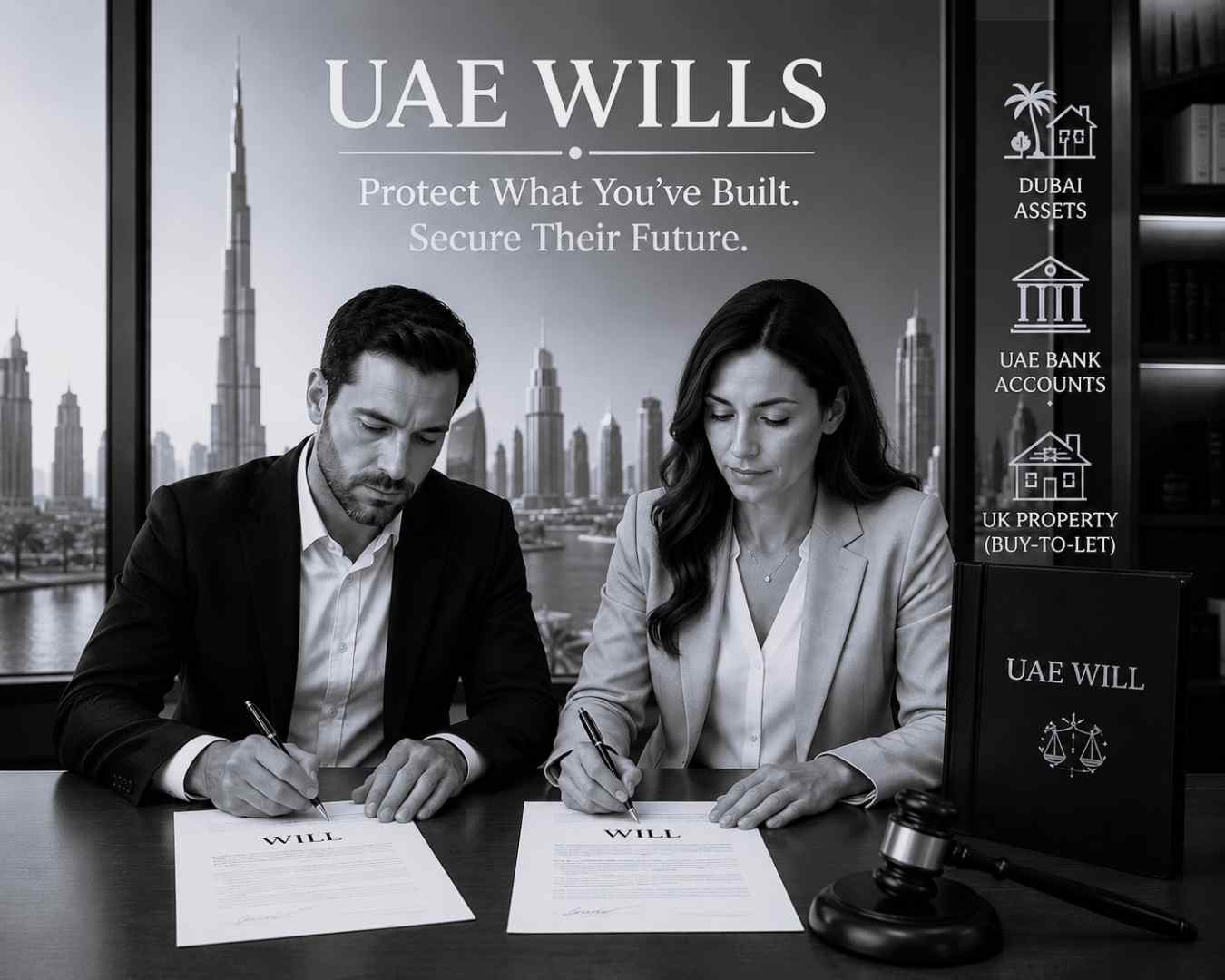
John and Sarah moved to Dubai from London in 2015. He runs a consultancy through a Dubai free zone company; she works for a regional bank. They own an apartment on the Palm, have savings in UAE bank accounts, and still hold a buy-to-let property in Surrey. They have been meaning to sort out their wills for years.
They are not unusual. They are, in fact, representative of hundreds of thousands of British expats who have built their lives and their wealth in the UAE. In the last eighteen months, three separate pieces of legislation – one in the UAE, one in the UK, and one in Dubai – have quietly but fundamentally changed the legal landscape that governs what happens to everything they have built, if either of them dies.
None of it made front-page news; most expats in Dubai are entirely unaware that any of it happened. The consequences of remaining unaware are serious.
On 1 January 2026, Federal Decree-Law No. 51 of 2024 and the Personal Status Law No. 41 of 2024 came into force. These laws represent the most significant overhaul of UAE succession rules for expatriates in a generation.
The headline change is stark: if a foreign resident dies in the UAE without a valid will and without identifiable legal heirs, their UAE-based assets – bank accounts, real estate, business shares – will no longer sit in legal limbo through years of court proceedings. Instead, they will be converted into a charitable endowment, a Waqf, and transferred to approved foundations for public interest purposes. For the family back home who expected to inherit, this is not a theoretical risk. It is the legal default.
The same laws also cement a new standard for intestate estates where heirs do exist, but no will has been registered: the surviving spouse receives 50 percent of the estate, and the remainder is divided equally among children regardless of gender. For many families, this may sound reasonable, but it is the law’s outcome, not the family’s wishes, that governs.
If John and Sarah had three children and John had always intended to leave the Palm apartment specifically to his eldest, that intention counts for nothing without a registered will.
The UAE has made genuine, commendable progress in making succession clearer and fairer for expatriates. Clarity about what the law does when you have not planned is not, however, the same as protection. The new framework makes a registered will more important than ever, not less.
For British expats in Dubai, the second change carries the largest financial consequences, and it has attracted the least attention in the UAE.
From 6 April 2025, the United Kingdom replaced its long-standing domicile-based inheritance tax system with a residence-based one. For decades, British nationals who had lived abroad for long enough and acquired a domicile outside the UK could hold assets anywhere in the world without those assets being subject to UK inheritance tax at 40 percent. It was one of the primary legal reasons many high-net-worth British nationals chose to build their wealth in the UAE rather than retain it in the UK.
That protection has gone. Under the new rules, what matters is not domicile but residency history. If you have been a UK tax resident for ten or more of the previous twenty tax years, you are a Long-Term Resident for UK inheritance tax purposes. On your death, your entire worldwide estate – your Dubai apartment, your UAE bank accounts, your investment portfolio, your overseas company interests – is potentially subject to UK inheritance tax at 40 percent.
For John and Sarah, who moved to Dubai from the UK in 2015, this means they are not yet Long-Term Residents. They will be, though, if they remain here and have UK residency years behind them. Anyone who moved to Dubai from the UK before 2015 may already have crossed the threshold.
There is a further complication. The new rules include an inheritance tax “tail” – a sliding scale period after you leave the UK during which your worldwide estate remains exposed. If you lived in the UK for 20 years and relocated to Dubai five years ago, you may remain liable for UK inheritance tax on your global assets for up to ten years after your departure.
The UK-UAE double tax treaty covers income tax and capital gains tax. It does not cover inheritance tax, and there is no treaty relief available. The estate plans that many British expats in Dubai built on the foundations of their non-domiciled status – excluded property trusts, offshore structures designed around the old domicile rules – need to be reviewed urgently, because the assumptions on which they were built no longer hold.
The third change is less dramatic but practically important for anyone who has already done the right thing and registered a DIFC Will.
In March 2025, His Highness Sheikh Mohammed bin Rashid Al Maktoum issued Dubai Law No. 2 of 2025, which consolidates and modernises the entire legislative framework governing the DIFC Courts. The DIFC Wills Service – the mechanism through which non-Muslim expatriates register wills covering Dubai assets – operates under the jurisdiction of the DIFC Courts. The reform streamlines and strengthens that judicial framework, which is broadly positive news.
Anyone holding an existing DIFC Will should confirm with their adviser that their arrangements remain optimally structured under the updated framework, particularly where the will interacts with offshore structures, international assets, or trust arrangements that may be affected by the UK rule changes described above.
The intersection of these three changes creates a set of risks that no single adviser, will, or structure can address in isolation. It requires a coordinated approach across UAE law, UK tax law, and estate planning.
For UAE residents who do not yet have a registered will, the position is urgent. The new UAE succession law has removed the ambiguity about what happens to unplanned estates, and the answer is not reassuring. A DIFC Will for Dubai assets, supplemented by an Abu Dhabi Judicial Department Will for Abu Dhabi assets where relevant, should be the first step.
For British nationals in the UAE, the UK inheritance tax position needs to be assessed now, individually, based on actual residency history. This is not a generic exercise. The ten-year count is specific to each person; the tail period varies, and the implications for existing structures depend on when and how they were set up. Some people will discover they are already Long-Term Residents. Others will find they are approaching the threshold. Either way, the planning options available before the threshold is crossed are significantly more flexible than those available after it.
And for anyone who structured their affairs around the old UK non-dom rules – excluded property trusts, offshore holding companies, arrangements designed to sit outside the UK tax net based on domicile – those structures should be reviewed immediately. The legal foundations have changed. The structure may still work, or it may not. The only way to know is to look.
John and Sarah on the Palm are a composite, but they represent a real and widespread situation. The three legal changes described in this article are not hypothetical future risks. They are the current law. The families who act on them now will protect what they have built. Those who do not will leave their outcomes to legislation that was not written with their specific wishes in mind.

posted 30 minutes ago

posted 31 minutes ago

posted 51 minutes ago

posted 1 hour ago

posted 1 hour ago

posted 2 hours ago

posted 2 hours ago

posted 2 hours ago
posted 3 hours ago

posted 3 hours ago
posted 3 hours ago

posted 4 hours ago
No results available
Find the right Legal Expert for your business

Send welcome message