
Author
No results available
Introduction
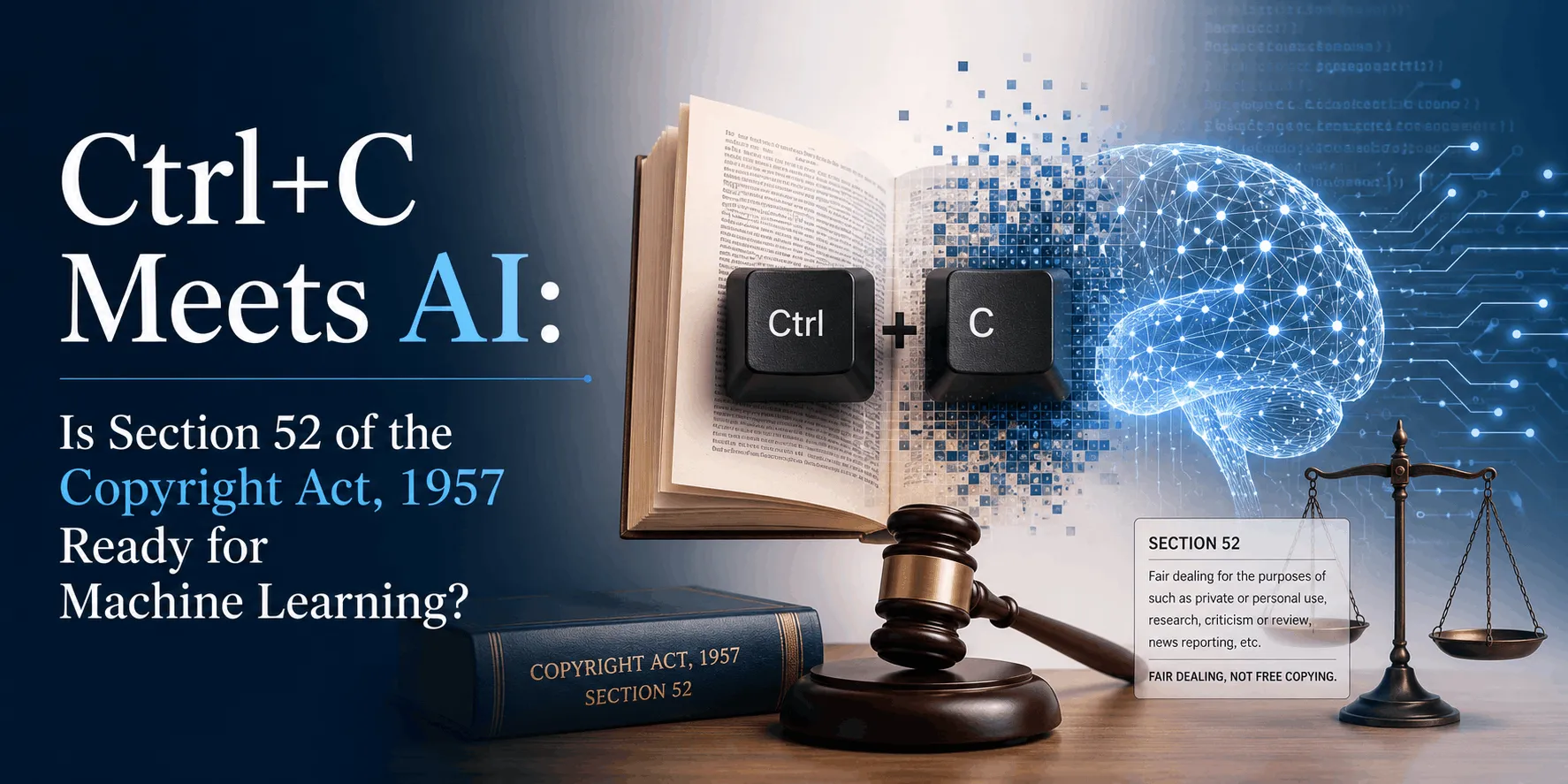
Generative AI is a type of AI that generates content such as images, videos, texts, code, etc by analysing and learning the patterns of the existing data. While technology promises significant innovation across industries, it also raises profound legal questions such as what role does Copyright Law play with respect to Gen AI? Since, AI is using pre-existing data to generate fresh content, does it not constitute copyright infringement? Therefore, how does the existing copyright law in India, especially the exceptions under Section 52 of the Copyright Act, 1957 (“the Act”), apply to generative AI systems? This article examines the current copyright regime in India, the scope and limitations of Section 52, and why existing statutory exceptions may be inadequate to address the challenges posed by generative AI. The analysis will be done in relation to the working paper by the Department for Promotion of Industry and Internal Trade (DPIIT) on the intersection of Generative Artificial Intelligence and Copyright.
Overview of Indian Copyright Law and Section 52
The Indian Copyright Act, 1957 grants exclusive rights to authors over their works, including the rights to reproduce, adapt, distribute the work to the public. These exclusive rights are outlined in Section 14, and unauthorized exercise of these rights constitutes infringement under Section 51 of the Act. Infringement triggers both civil and criminal remedies for the rights holder.
On the contrary, Section 52 provides statutory exceptions to copyright infringement and is referred to as “fair dealing” doctrine in India and as “fair use” in other jurisdictions. The provision enumerates limited purposes for which copyrighted material may be used without the author’s authorization. These include: i) Private or personal use, including research; ii) Criticism or review of works; and iii) Reporting of current events, including lectures delivered in public. The exception also includes incidental storage of the same in electronic form and for the purposes mentioned above would not constitute infringement.
Generative AI: Use of Copyrighted Works in Training
Gen AI models inherently use “work” without the explicit consent of the copyright holders. The ongoing debate discusses whether using copyrighted works to train machine learning models constitutes infringement and whether it requires justification through Section 52.[1] Under the Indian Copyright Act, 1957, using copyrighted works to train a large language model is not copyright infringement. As per Section 14 of the Act, the reproduction rights and adaptation rights do not inherently extend to use of work that is fundamentally different from the original work. Training comes under one such use. This is what the Courts have laid down in several case laws and the same cases simply have to be applied to the AI context. For instance, in the cases of Eastern Book Company v. D.B. Modak[2], University of Oxford v. Rameshwari Photocopy Service,[3] the court held that work reproduced for educational and research purposes is allowed and would not amount to infringement. On the other hand, as per the statute ‘storing or reproduction of work’ constitutes infringement. As per that logic, training AI models is infringement.
Most stakeholders assume that the doctrine of ‘fair dealing’ is sufficient to defend the cases of data mining. On the contrary, the doctrine has been stretched and used out of proportion in several cases, deeming it invaluable in certain cases.[4] Recently, the Department for Promotion of Industry and Internal Trade (DPIIT) formed a committee to examine the intersection of Generative Artificial Intelligence and Copyright.[5] The aim of this working paper was to protect copyright of human-created work without hindering technological advancements. The Committee explored various models such as Voluntary Licensing, Extended Collective Licensing, Statutory Licensing and Text and Data Mining Exception and the conclusion after analysing all these regulatory methods was that if used in a traditional sense then all these options have suitability challenges. This working paper is a built off The Subcommittee Report of 2024. In this report, two legal issues were highlighted: first, the use of copyrighted material as input for AI training; and second, the copyrightability of works generated by AI models.
Generative AI and copyright share a deeply reciprocal relationship. On one hand, using copyrighted works without authorisation can undervalue human artistry and eventually discourage future creation. On the other, overly strict regulations could stifle technological progress and deprive society of the benefits of AI innovation. Thus, achieving a middle ground is essential to ensure both creative and technological ecosystems can thrive.
In an ongoing case i.e., ANI Media Pvt. Ltd. v. Open AI Inc.,[6] ANI sued Open AI for copyright infringement, alleging that the latter used its content to train their models, without ANI’s consent. This might be the first major judicial decision in terms of copyright infringement in Generative AI works.
The DPIIT Committee evaluated various regulatory approaches for using copyrighted data in AI training and found that traditional copyright frameworks are inadequate[7]:i) Text and Data Mining (TDM) exception– This method is common in other jurisdictions but is not present in India. The Committee argues that a blanket TDM exception would weaken copyright protection by removing compensation and control for creators. An opt-out model is also seen as impractical due to the burden on rights holders, reliance on transparency from AI developers, risks of incomplete datasets, and enforcement challenges. Further, the opt-out method would put smaller stakeholders at a disadvantage. ii) Voluntary licensing- This method is rejected as unfeasible because of the massive scale of data required. Negotiating individual licenses with numerous rights holders would be nearly impossible, create barriers for startups, and lead to gaps in datasets if some rights holders refuse participation, ultimately reducing AI quality. iii) Collective Licensing (CL) and Extended Collective Licensing (ECL)– These are considered more efficient, as they centralize negotiations through collective management organizations and reduce transaction costs. However, a purely voluntary system still poses risks, particularly the possibility of collective bodies demanding excessive fees or withholding licenses, which could hinder innovation and competition.iv) Statutory Licensing– The Committee ultimately supported this as the most effective solution. This model ensures AI developers have reliable access to data while guaranteeing compensation for creators. It removes negotiation barriers and prevents holdouts. However, because traditional statutory licensing may be too complex for large-scale AI use, the Committee proposes a modernized “hybrid model” to address these limitations. The new ‘Hybrid’ Model[8]
The Committee proposed a hybrid model as a balanced solution. It recommended a mandatory blanket license that allows AI developers to use all legally accessed copyrighted works for training AI systems. In return, copyright owners would receive statutory royalties, but they would not have the option to refuse the use of their works for AI training.
A central, government-designated non-profit body, formed by rights holders, would manage this system. It would collect payments from AI developers and distribute royalties through its members, which include copyright societies and collective management organizations (one for each type of work). Both members and non-members can receive royalties, as long as they register for their work. Royalty rates would be set by a government-appointed committee, and a fixed percentage of revenue from AI systems would be shared with rights holders. Overall, this model aims to make it easy for AI developers to access large amounts of data through a single system, while ensuring creators are fairly paid and reducing complexity and costs.
Conclusion
As per a study by Goldman Sachs, Generative AI could raise Global GDP by 7%. “Despite significant uncertainty around the potential for generative AI, its ability to generate content that is indistinguishable from human-created output and to break down communication barriers between humans and machines reflects a major advancement with potentially large macroeconomic effects,”[9] Goldman Sachs economists Joseph Briggs and Devesh Kodnani write in a report.
From an Indian statute point of view, generative AI poses complex challenges to the existing copyright regime. Section 52 of the Copyright Act, 1957 provides limited and narrowly defined exceptions that are unlikely to facilitate broad, commercial use of copyrighted materials for AI training. The closed nature of the fair dealing exceptions and the conservative judicial approach in India mean that reliance on Section 52 for generative AI activities faces significant legal uncertainty. Consequently, without legislative reform or clear judicial interpretation, AI developers in India must be cautious about using copyrighted works without authorisation. Meanwhile, policymakers face the task of evolving copyright law to accommodate technological advancements while preserving the economic rights of creators. The coming years are likely to see significant developments in how Indian copyright law responds to generative AI, potentially making India a site of influential jurisprudence and policy innovation in this space.

posted 5 minutes ago

posted 5 minutes ago

posted 9 minutes ago

posted 12 minutes ago

posted 13 minutes ago

posted 16 minutes ago

posted 21 minutes ago
posted 23 minutes ago

posted 28 minutes ago
posted 29 minutes ago

posted 29 minutes ago

posted 31 minutes ago
No results available
Find the right Legal Expert for your business

Send welcome message