
Author
No results available
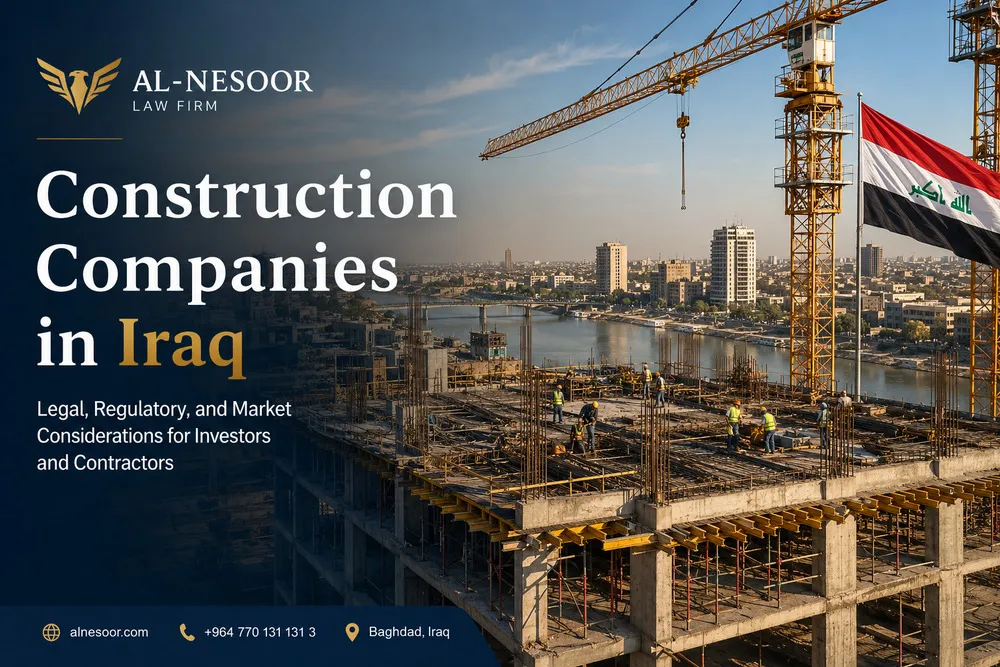
The construction sector in Iraq continues to attract significant local and international interest, particularly in infrastructure, housing, energy, logistics, healthcare, and mixed-use developments. As government spending gradually returns to major infrastructure projects and private investment increases in key cities such as Baghdad, Basra, and Erbil, construction companies operating in Iraq are facing both major opportunities and complex legal and operational challenges.
For foreign contractors, EPC companies, engineering consultants, and developers, understanding Iraq’s legal and regulatory environment is often just as important as technical capability or project financing.
At Al‑Nesoor Law Firm, we regularly advise construction companies, foreign investors, subcontractors, and project owners on establishing operations, managing contractual risks, and navigating regulatory procedures in Iraq.
Construction activity in Iraq is currently concentrated in several major sectors:
Many projects are funded through government budgets, foreign investment, international development programs, or public-private partnerships.
Foreign construction companies entering Iraq typically operate through:
The appropriate structure depends on the project type, ownership requirements, tax exposure, licensing needs, and operational strategy.
One of the first legal considerations for international contractors is whether they must formally register in Iraq before beginning operations.
In many cases, foreign construction companies are required to complete registration procedures with the Iraqi Registrar of Companies and obtain sector-specific approvals before signing or executing contracts.
This process may include:
Companies involved in public tenders or government contracts may also face additional compliance requirements and prequalification procedures.
For companies evaluating market entry, our guide on foreign companies registration in Iraq explains the practical registration process and documentation requirements.
Construction projects in Iraq are commonly governed by:
In practice, many disputes arise not from the main contract itself, but from unclear scopes of work, delayed approvals, payment issues, variation orders, and weak dispute resolution clauses.
Construction companies operating in Iraq should pay particular attention to:
Poorly drafted technical scopes frequently create disputes over project deliverables, timelines, and additional compensation.
Payment delays remain a major operational concern in Iraq, particularly on large projects involving multiple government approvals.
Force majeure events, permit delays, customs issues, and security restrictions can significantly affect project schedules.
International contractors often prefer arbitration clauses with enforceable dispute mechanisms rather than relying exclusively on local court litigation.
Government contracts represent a significant portion of Iraq’s construction market. However, public procurement procedures can be highly regulated and documentation-heavy.
Construction companies bidding on public projects should carefully review:
Recent updates to government contracting procedures have also increased compliance expectations for contractors participating in public tenders.
Construction activities in Iraq can trigger multiple tax and regulatory obligations, including:
Foreign contractors sometimes underestimate the importance of early tax structuring, particularly where projects involve long-term on-site operations or multiple subcontractors.
Construction companies should also ensure that contractual structures align with operational realities to reduce future disputes with tax authorities or project owners.
Although Iraq offers substantial market opportunities, companies should realistically assess operational risks.
Common challenges include:
Despite these challenges, many international companies continue to operate successfully in Iraq with the right legal, commercial, and local support structure.
Legal support for construction companies in Iraq often extends beyond simple contract drafting.
In practice, legal advisors may assist with:
At Al‑Nesoor Law Firm, we work with local and international construction companies operating across Iraq, helping clients manage both legal risk and practical business challenges associated with project execution.
You can also explore our broader services related to company formation services in Iraq and foreign investment advisory support.
Iraq’s construction sector continues to present substantial long-term opportunities across infrastructure, housing, energy, and commercial development. However, success in the Iraqi market requires more than technical expertise or financing capacity.
Construction companies operating in Iraq must carefully manage legal structuring, licensing, contractual protections, regulatory compliance, and operational risk from the earliest stages of a project.
With proper planning and experienced local legal support, foreign and domestic contractors can position themselves more effectively for sustainable operations and long-term project success in Iraq.
Author: Furat Kuba
Managing Director & Partner
Al‑Nesoor Law Firm

posted 22 minutes ago

posted 45 minutes ago

posted 1 hour ago

posted 2 hours ago

posted 2 hours ago

posted 2 hours ago

posted 2 hours ago

posted 2 hours ago

posted 2 hours ago

posted 2 hours ago

posted 2 hours ago
posted 2 hours ago
No results available
Find the right Legal Expert for your business
Sign up for the latest legal briefings and news within Global Law Experts’ community, as well as a whole host of features, editorial and conference updates direct to your email inbox.
Naturally you can unsubscribe at any time.
Global Law Experts is dedicated to providing exceptional legal services to clients around the world. With a vast network of highly skilled and experienced lawyers, we are committed to delivering innovative and tailored solutions to meet the diverse needs of our clients in various jurisdictions.
Global Law Experts is dedicated to providing exceptional legal services to clients around the world. With a vast network of highly skilled and experienced lawyers, we are committed to delivering innovative and tailored solutions to meet the diverse needs of our clients in various jurisdictions.

Send welcome message