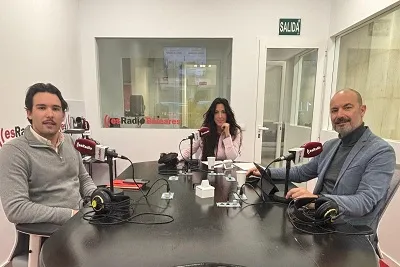
On February 25, during the program Motores Económicos, a key issue for today’s business landscape was addressed: strategic alliances. Representatives from the hotel sector took part in the discussion, and from the fields of professional firms and technological innovation, Germán Pérez, CEO of ETL Confialia, and Didac Pérez, founder of Nuria Labs, participated.
The starting point was clear: “We live in a time that calls for collective responses.” In an environment where business challenges are becoming increasingly complex—regulatory, technological and competitive—the logic of “everyone looking after their own interests” loses effectiveness. The conversation focused on how to structure alliances that generate real, sustained and orderly growth.
The context: growing through networks (also in the hotel sector)
As a sector-specific example, the alliance between Sumun Hotel Group and R2 Hotels, part of the Shalland Gisen group, was analyzed.
Beyond the figures—46 hotels and a forecast to exceed 50 before 2028—the reflection was strategic. The hotel management noted that in this type of operation “synergies are not only doubled, but sometimes exponential.”
This concept can be applied to any sector: sharing operational knowledge, best practices and market vision does not simply add capabilities; it multiplies them.
The alliance as a natural evolution for entrepreneurs
From the perspective of the professional firm, Germán Pérez was direct: “It is very difficult to move forward more quickly if you do not join forces with other entrepreneurs.”
He added an important clarification: “A partnership or strategic alliance goes beyond a commercial agreement; it is not all about money.”
Here a central idea emerges: an alliance is not merely a financial decision. It is a strategic and cultural decision.
Germán used a clear analogy: “It is like a relationship. First, you need to get to know each other.” Before signing, compatibility must be verified: service vision, business values and approach to team management.
In this regard, he explicitly referred to his long-standing professional relationship with Arnau Moranta, Managing Partner of ILIA ETL GLOBAL: “The friendship and professional relationship with Arnau Moranta has spanned many years. We both know what we can ask of each other and that we are compatible.”
Compatibility is not improvised. It is built.
Legal structure: organizing without blocking
One of the most practical aspects of the discussion was the explanation of how to properly structure an alliance.
Germán highlighted the cuentas en participación agreement as a particularly useful formula when two established entrepreneurs want to collaborate without necessarily creating a new company from the outset. It is a flexible tool that allows partners to define contributions, distribute results and anticipate future scenarios.
He also issued a warning about commonly misused structures, such as the community of assets for economic activities: “A community of assets is not designed to carry out economic activity.”
He offered an interesting reflection on the founding stage: “Starting by discussing how to dismantle what is being created can be the beginning of the end.”
Protecting assets is essential, but the structure should organize the project, not suffocate it from the start.
Capital and work are not the same
Another highly relevant aspect was the distinction between capital and labor within a company. “You can split capital evenly. But it is practically impossible to split the work evenly.”
This statement touches on a critical issue in many early-stage alliances. Capital can be divided into exact percentages. Effort, client acquisition, team management or the contribution of know-how are rarely symmetrical.
If the remuneration of capital and the remuneration of work are not properly separated, conflict is likely.
Technology as an extension of the alliance model
Didac Pérez’s contribution added a complementary dimension: technology.
Nurialabs, a laboratory specialized in artificial intelligence, was recognized by La Razón for its innovative capacity. Beyond the award, however, its role within the professional ecosystem is strategic.
Didac summarized his project as: “An alliance between two friends who have tried a couple of times.”
He added: “When there is that much trust, it can be an advantage.”
But alongside trust, method: “From the outset, it is important to clearly define roles and put in writing what is going to happen.”
The tool Gescon, developed by Nurialabs, addresses a specific need: organizing internal knowledge. Germán explained it from a practical standpoint: “We have an inflow of 60 people in our day-to-day operations. Without a very well-organized environment, it is impossible to stay aligned.”
Here, the alliance is not only corporate; it is operational. Technology becomes strategic infrastructure to absorb growth without losing efficiency.
Independence within the network
A distinguishing element that stood out was management independence. “We can turn to the central office for help in making decisions, or we can operate independently.”
The network provides support, brand and structure, while the firm maintains operational autonomy; that combination reduces the risk of internal friction and strengthens direct accountability for results.
It is not integration by absorption. It is strategic coordination.
The program conveyed a clear message: strategic alliances are not a trend or a temporary solution, but a structural response to an increasingly complex environment.
From the hotel sector to professional firms and technological innovation, the pattern is consistent: compatibility must come before the contract; structure before improvisation; method alongside trust; and technology acts as an essential lever for scaling with solidity.
At ILIA ETL GLOBAL, we share this vision. Growing through networks does not mean diluting identity, but strengthening it within a structure that enables the organization to take on greater challenges with stronger solvency and better organization.
Because the issue is not simply about partnering.
It is about doing it properly.