
Our Expert in Spain
No results available
Last updated: 5 May 2026
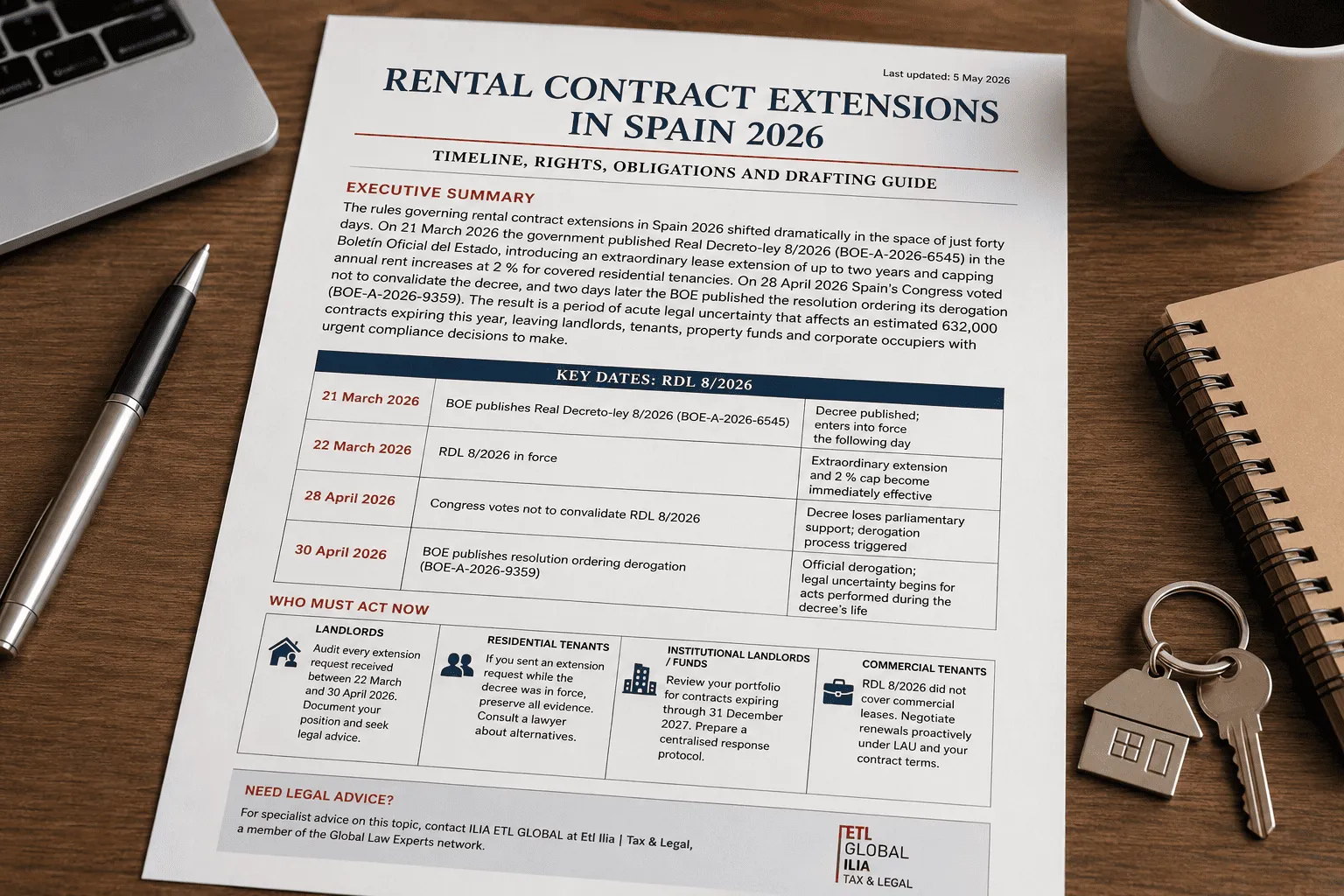
The rules governing rental contract extensions in Spain 2026 shifted dramatically in the space of just forty days. On 21 March 2026 the government published Real Decreto‑ley 8/2026 (BOE‑A‑2026‑6545) in the Boletín Oficial del Estado, introducing an extraordinary lease extension of up to two years and capping annual rent increases at 2 % for covered residential tenancies. On 28 April 2026 Spain’s Congress voted not to convalidate the decree, and two days later the BOE published the resolution ordering its derogation (BOE‑A‑2026‑9359). The result is a period of acute legal uncertainty that affects an estimated 632,000 contracts expiring this year, leaving landlords, tenants, property funds and corporate occupiers with urgent compliance decisions to make.
Between 22 March 2026 (the day RDL 8/2026 entered into force) and 30 April 2026 (the date the derogation resolution appeared in the BOE), tenants could request extraordinary extensions and landlords were bound by the 2 % rent‑increase cap. Actions taken during that window, burofax notifications, accepted extensions, capped rent reviews, now sit in a legal grey zone. Industry observers expect litigation, and early indications suggest that courts may reach divergent conclusions on whether those acts survive the decree’s derogation.
Your immediate next step depends on your role:
Real Decreto‑ley 8/2026, published in the BOE on 21 March 2026 under reference BOE‑A‑2026‑6545, was enacted under the government’s emergency legislative power (Article 86 of the Spanish Constitution). It entered into force on 22 March 2026 and contained three headline measures aimed at Spain housing law 2026 reform in the residential rental sector.
Tenants whose LAU‑governed habitual‑residence contracts expired (or were due to expire) between the decree’s entry into force and 31 December 2027 could request an extraordinary extension of up to two years. The extension maintained the same contractual terms, including rent, subject to the cap described below. Landlords were obliged to accept the request unless a recognised exception applied, for example, the landlord’s own need for the dwelling as a primary residence.
While RDL 8/2026 was in force, annual rent increases for covered contracts were capped at 2 %, regardless of any higher index stipulated in the lease. This effectively replaced contractual CPI‑linked or market‑rate review clauses for the duration of the decree’s validity. The cap applied only to contracts subject to the LAU and used as the tenant’s habitual residence (vivienda habitual).
The measures applied to residential leases governed by the LAU where the property served as the tenant’s habitual residence. They did not extend to seasonal rentals, tourist lets, luxury dwellings above statutory thresholds, or commercial premises. Landlords could refuse the extraordinary extension on narrow statutory grounds, primarily personal or family need for the property.
| Measure | Statutory Basis (RDL 8/2026) | Practical Effect |
|---|---|---|
| Extraordinary extension (up to 2 years) | Tenant‑initiated request for contracts expiring before 31 Dec 2027 | Landlords obliged to accept on same terms; tenant preserved occupancy at existing rent (subject to 2 % cap) |
| 2 % annual rent‑increase cap | Override of contractual indexation clauses during RDL validity | Rent reviews limited to max 2 %, even where contract specified CPI or higher index |
| Scope: vivienda habitual / LAU contracts only | Expressly excluded commercial, seasonal and tourist leases | Commercial tenants and holiday lets unaffected; negotiation remains contractual |
Under Article 86 of the Spanish Constitution, a Real Decreto‑ley must be submitted to Congress within 30 days of its publication for a vote on convalidation. If Congress does not convalidate the decree, it is derogated. The timeline for RDL 8/2026 was as follows:
Non‑convalidation triggers the automatic loss of force of the decree. However, the legal treatment of acts performed while the decree was in force is heavily debated. As El País reported on 28 April 2026, experts disagree on whether extension requests accepted by landlords, rent reviews capped at 2 %, and burofax notifications sent during the decree’s window remain legally binding. PwC’s Periscopio Fiscal commentary notes that the prevailing doctrinal view treats derogation as operating ex nunc (from now onwards), meaning that acts validly performed during the decree’s life may survive, but this position is not settled in case law for housing measures of this type.
Until courts rule on specific disputes, the likely practical effect will be a period of negotiated settlements. Both landlords and tenants should preserve contemporaneous records: burofax delivery confirmations, landlord acknowledgements, rent payment receipts at the capped rate, and any written correspondence. Early indications suggest that parties who documented their compliance carefully will be in a stronger position regardless of which doctrinal view prevails.
Landlord obligations Spain 2026 depend on two factors: (1) whether the landlord received an extension request while RDL 8/2026 was in force, and (2) whether the landlord applied the 2 % cap to any rent review during that period. The following checklist provides a structured risk assessment.
| Action / Scenario | Risk Level | Recommended Response |
|---|---|---|
| Received burofax requesting extension (22 Mar – 30 Apr 2026) | High | Do not ignore. Respond in writing; document lawful basis for any refusal; seek legal advice before rejecting |
| Already accepted extension in writing | Medium | Extension likely binding as contractual agreement independent of RDL; preserve records |
| Applied 2 % cap to rent review during decree’s life | Medium | Cap was lawful when applied; attempting retroactive increase carries litigation risk, proceed with caution |
| Served eviction notice for contract expiry during RDL period | High | Review notice validity; if served after 22 March and before derogation, tenant may challenge; seek legal review |
| Contract expires after 30 April 2026, no extension request received | Low | Standard LAU rules apply; serve notice within statutory deadlines; update contract language for future renewals |
Under the LAU, landlords who wish to recover a property at the end of a lease must give at least four months’ written notice before the contract’s expiry date (for contracts of five years or more) or the applicable notice period in the contract. In light of the 2026 changes, landlords should ensure that all notices are sent by burofax or equivalent recorded delivery and that copies are filed with the relevant documentation for each tenancy.
Tenant rights Spain 2026 were temporarily expanded by RDL 8/2026 and now face uncertainty following its derogation. If you are a residential tenant, the following step‑by‑step guide explains the process that was available while the decree was in force and how to preserve your position.
“By this burofax I, [Full Name], holder of DNI/NIE [Number], tenant of the property at [Address] under the lease dated [Date] expiring on [Expiry Date], hereby request an extraordinary extension of [X] months pursuant to Real Decreto‑ley 8/2026, maintaining the current contractual terms. I request written confirmation of acceptance within [15] days.”
If you sent your burofax while RDL 8/2026 was in force (between 22 March and 30 April 2026), preserve every piece of evidence. Industry observers expect that tenants with well‑documented requests will have the strongest position in any subsequent dispute. If your contract expires after 30 April 2026 and you have not yet sent a request, the statutory basis for the extraordinary extension has been derogated, consider negotiating a voluntary renewal directly with your landlord.
RDL 8/2026 did not extend any of its protective measures, the extraordinary extension or the 2 % rent cap, to commercial leases. Contracts for uso distinto de vivienda (non‑residential use) under the LAU are governed by the terms freely agreed between the parties, with statutory protections limited to minimum durations and basic tenant safeguards.
Without statutory intervention, commercial lease renewal Spain requires proactive negotiation. The following approaches are recommended:
The 2026 legislative episode underscores the importance of future‑proofing Spanish lease agreements. Whether you draft a rent review clause Spain or an extension option, the goal is to allocate risk clearly and reduce exposure to sudden regulatory change. Below are four sample clauses with accompanying drafting notes.
“The annual rent shall be updated on each anniversary of this lease by the percentage change in the INE Consumer Price Index (IPC) for the twelve months ending two months before the update date, provided that the resulting increase shall not exceed [X] % in any single year. If the IPC is negative, the rent shall remain unchanged.”
Drafting note: Replace [X] with a negotiated ceiling (commonly 2–3 % for residential, 3–5 % for commercial). This clause ensures indexation tracks inflation but protects the tenant against spikes and the landlord against deflation.
“The Tenant shall have the right to extend this lease for an additional period of [Y] months by giving written notice to the Landlord no later than [Z] months before the expiry date. The extension shall be on the same terms except that the rent shall be reviewed in accordance with Clause [Rent Review Clause Number].”
Drafting note: Clearly specify the notice deadline and the terms that carry forward. If both parties wish to include a contingency for future emergency decrees, add: “If extraordinary legislation imposes mandatory extension rights, this clause shall be interpreted consistently with any such mandatory requirements.”
“All notices under this lease shall be given by burofax with certified content and acknowledgement of receipt, or by any other means providing equivalent proof of delivery and content. Any dispute arising from this lease shall be submitted to the courts of [City] / to mediation before [Mediation Body] prior to judicial proceedings.”
Drafting note: Burofax remains the gold standard for evidential purposes in Spanish rental disputes. Specifying a mediation step can reduce costs and delay.
“In the event that legislation, regulation or decree‑law is enacted during the term of this lease that materially affects the parties’ rights or obligations (including but not limited to mandatory extensions, rent caps or indexation limits), the parties agree to negotiate in good faith within [30] days of such enactment to adjust the terms of this lease accordingly.”
Drafting note: This clause does not override mandatory law but creates a contractual obligation to renegotiate, reducing the risk of unilateral positions and litigation.
| Date | Event | Practical Effect |
|---|---|---|
| 21 March 2026 | BOE publishes Real Decreto‑ley 8/2026 (BOE‑A‑2026‑6545) | Decree published; enters into force the following day |
| 22 March 2026 | RDL 8/2026 in force | Extraordinary extension and 2 % cap become immediately effective for covered contracts |
| 28 April 2026 | Congress votes not to convalidate RDL 8/2026 | Decree loses parliamentary support; derogation process triggered |
| 30 April 2026 | BOE publishes resolution ordering derogation (BOE‑A‑2026‑9359) | Official derogation; legal uncertainty begins for acts performed during the decree’s life |
| Entity Type | Key Obligation / Eligibility | Recommended Action |
|---|---|---|
| Individual landlord | Respond to extension requests received during decree period; comply with LAU notice requirements | Audit all communications received 22 Mar – 30 Apr 2026; document position; seek legal advice |
| Institutional landlord / fund | Same obligations at portfolio scale; potential ministry scrutiny and reputational risk | Centralise response protocol; consider negotiated settlements; preserve all records |
| Residential tenant | Right to request extraordinary extension (while decree was in force); preserve evidence | Keep burofax receipts and delivery proofs; seek legal advice on enforceability post‑derogation |
| Commercial tenant | Not covered by RDL 8/2026; standard LAU and contractual terms apply | Negotiate renewal proactively; include hardship and rent‑cap clauses in new agreements |
Ana’s five‑year habitual‑residence lease in Madrid expired on 15 April 2026. On 25 March 2026 she sent a burofax to her landlord requesting a two‑year extraordinary extension under RDL 8/2026. The landlord acknowledged receipt but did not respond substantively. After the decree’s derogation on 30 April 2026, Ana’s lawyer advised her to preserve all documentation and open a negotiation for a voluntary one‑year renewal at the existing rent, citing the legal uncertainty as leverage for both sides to settle.
A residential investment fund managing 500 units across Barcelona and Valencia received 200 burofax extension requests between 22 March and 28 April 2026. The fund’s in‑house counsel established a triage protocol: requests with complete documentation were accepted provisionally to reduce litigation exposure, while incomplete requests were returned with a request for further information. After derogation, the fund engaged external counsel to review each accepted extension and assess whether renegotiation or continued compliance was the lower‑risk strategy.
A technology company occupying 2,000 m² of office space in Bilbao faced a commercial lease expiry in September 2026. Because RDL 8/2026 did not apply to commercial premises, the company approached the landlord in January 2026 with a renewal proposal including a three‑year term, a CPI‑linked rent review capped at 3 %, and a mutual break option at 18 months. By negotiating early and incorporating an extraordinary legal change rider, the company secured terms that insulated both parties from future regulatory disruption.
The March–April 2026 legislative cycle has created one of the most complex compliance environments in recent Spanish rental law. Whether you are a landlord reviewing extension requests, a tenant preserving your position, or a business negotiating a commercial lease renewal Spain, the priority is the same: document everything, review your contract language and seek qualified legal advice without delay.
The sample clauses, checklists and risk tables in this guide provide a practical starting point, but every tenancy has unique facts. Rental contract extensions Spain 2026 is not a settled area, the interplay between the derogated decree, the LAU and individual lease terms will produce different outcomes depending on the circumstances. Professional legal guidance tailored to your specific situation is essential.
Disclaimer: This article provides general guidance on Spanish rental law developments in 2026. It does not constitute personalised legal advice. Readers should consult a qualified lawyer in Spain before taking action based on this content.
To receive specialized advice on this matter, you may contact Mercedes Cano or Mario García, specialists at ILIA ETL GLOBAL, or alternatively reach out through our contact form.

posted 34 minutes ago

posted 2 hours ago

posted 2 hours ago

posted 3 hours ago

posted 3 hours ago

posted 3 hours ago

posted 4 hours ago

posted 4 hours ago

posted 5 hours ago

posted 5 hours ago

posted 6 hours ago

posted 6 hours ago
No results available
Find the right Legal Expert for your business

Send welcome message