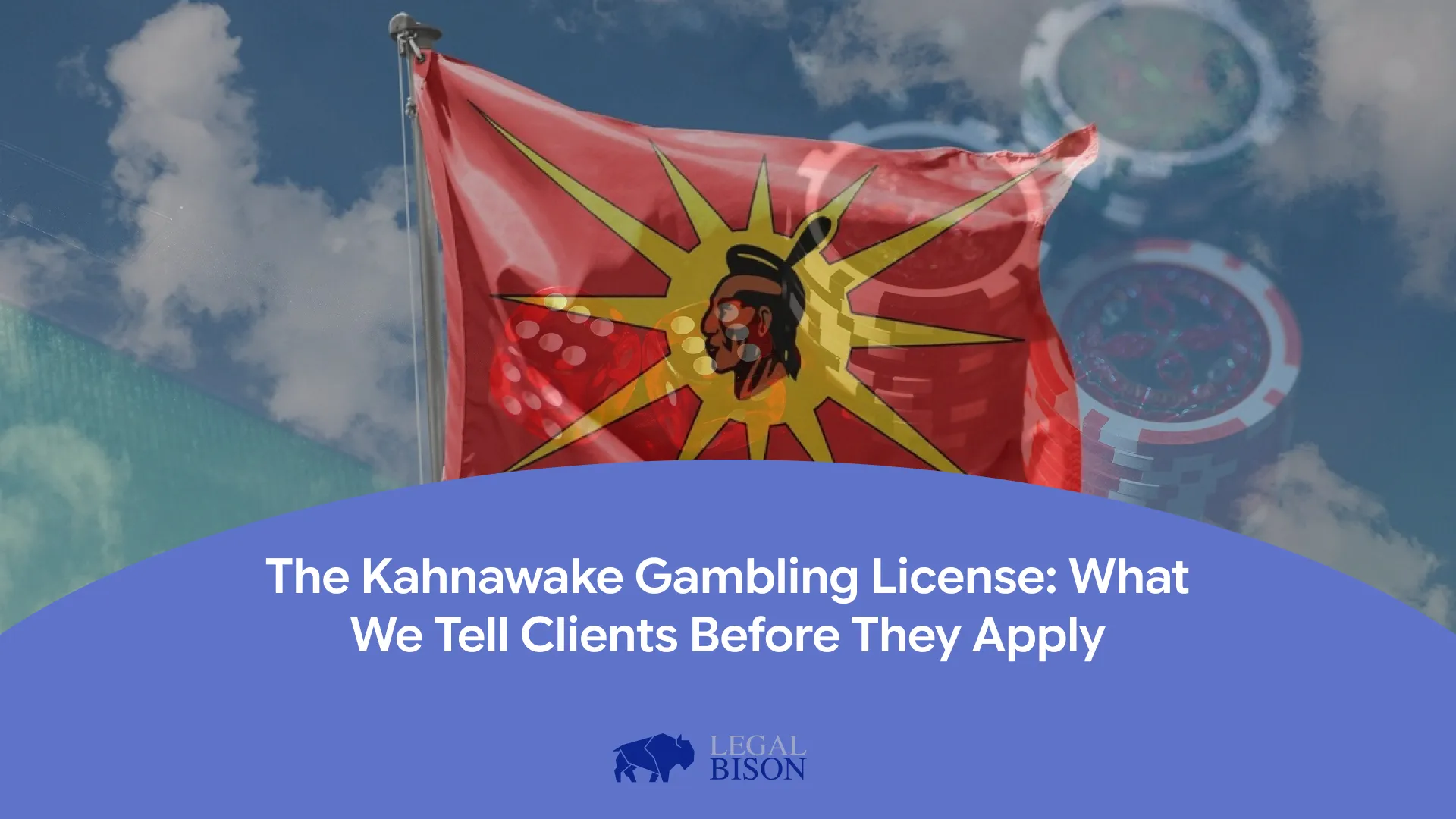
There’s a jurisdiction that’s been quietly powering online gambling operations for over two decades, and it’s not Malta, not Curaçao, not the Isle of Man. It’s a small Mohawk territory in Quebec, Canada, called Kahnawake. When founders first hear it, the reaction is usually skepticism.
It doesn’t seem to carry the brand recognition of an MGA licence. And yet it has served as the regulatory foundation for some of the largest online gambling platforms in operation today.
We’ve helped structure gambling operations across dozens of jurisdictions, and Kahnawake sits in a genuinely interesting spot on the licensing map. It’s not the right answer for every operator, and being upfront about that is exactly the point of this article.
What follows is our experience-based breakdown of what a gambling license in Kahnawake actually does, what it costs in practical terms, how long it realistically takes, and where it falls short compared to alternatives we’ve helped operators navigate.
The Kahnawake Gaming Commission (KGC) is the regulatory body established by the Mohawk Council of Kahnawake in 1996 to oversee gaming activities conducted from within the territory.
It was one of the earliest regulatory frameworks specifically designed for online gambling, which means it predates regulators that are now considered “mainstream,” like the Malta Gaming Authority (established as the Lotteries and Gaming Authority in 2001).
The Commission operates under Mohawk law, not Canadian federal or provincial law. That distinction matters enormously for operators. It’s the jurisdictional independence that allows the KGC to license online gambling operations despite Canada’s own gambling framework being, to put it diplomatically, a complicated patchwork.
The KGC issues two primary licence types: the Interactive Gaming Licence and the Interactive Gaming Operator Licence. The former applies to operators running gaming platforms directly; the latter to companies providing gaming services or software to licensed operators.
There’s also a Key Person Licence for individuals in significant control or management roles. Understanding which applies to your structure is the first call we have with operators who come to us asking about the Kahnawake gambling license.
Here’s what the jurisdiction gets right, and has gotten right for a long time.
Speed. Compared to the MGA’s notoriously meticulous review process (which can run 12 to 18 months for a new operator), the Kahnawake gaming license process moves faster. Realistic timelines for compliant applicants with clean corporate structures sit in the four-to-six month range. For operators who’ve been waiting on a Malta license and are watching market windows close, that’s a material difference.
Cost. The application and annual fees for a Kahnawake gambling license are significantly lower than European alternatives. MGA licensing involves application fees, compliance contributions, and annual licence fees that can stack up quickly. Kahnawake’s fee structure is leaner. We’re not going to publish specific figures here because the Commission adjusts them periodically and you should always work from current schedules, but the comparison is meaningful for early-stage operators watching cash flow.
Legacy credibility in grey markets. In markets where gambling sits in a legal grey zone, markets that haven’t explicitly licensed online gambling but haven’t banned it either, the Kahnawake gaming license has a 25-year track record. Payment processors know it. Affiliate networks recognize it. Banking partners have worked with it for decades. That institutional familiarity matters when you’re trying to get a merchant account opened.
No residency requirement for directors. Unlike some jurisdictions that require a locally resident director (a requirement that adds ongoing cost and complexity), Kahnawake’s structure is more accessible to non-Canadian operators building remote-friendly corporate structures.
Also read: What We’d Tell Every Operator Before They Start Their Malta Gaming Licence Application
We wouldn’t be doing our job if we only told you the upside. Here’s where the Kahnawake gambling license creates friction.
Restricted markets. Kahnawake explicitly prohibits licensed operators from offering services to residents of the United States and several other jurisdictions. If your target market includes US players, Kahnawake is not your answer. Full stop.
Declining payment processor acceptance. This is the operational reality that catches operators off guard. While the Kahnawake gaming license has legacy credibility, the past five years have seen major payment processors tighten their policies. Processors that previously worked comfortably with KGC-licensed operators have become more selective. Operators building high-volume player acquisition strategies in tier-one markets increasingly find that a Kahnawake license alone isn’t enough to open the banking and processing relationships they need.
Regulatory recognition in EU markets. If your player acquisition strategy targets EU residents, you’ll face advertising restrictions, payment restrictions, and in some cases outright blocks in regulated EU markets that don’t recognize the Kahnawake gaming commission’s authorisations. Germany, the Netherlands, Denmark, these markets are pushing operators toward their own licensing frameworks, and a Kahnawake license does not serve as a passport into them.
Perception in certain investor circles. This is more nuanced, but worth raising. If you’re building a gambling company with an eye toward institutional investment or eventual M&A, some investors and acquirers apply informal quality signals to your regulatory history. An MGA or UKGC licence carries different weight in due diligence conversations than a Kahnawake gaming license, regardless of what those two licences actually represent in operational terms.
We’ve seen Kahnawake work well in specific structural scenarios. Here’s the honest profile of operators for whom it makes sense.
Crypto gambling operators. The KGC has been relatively progressive about crypto-native gambling operations. Operators building crypto sportsbooks or casino platforms targeting markets outside the US often find Kahnawake’s framework more accommodating than early-stage European regulators who are still developing crypto gambling policy. We’ve structured several crypto gambling operations under Kahnawake while a parallel MGA application matures, the KGC license provides operational legitimacy during what would otherwise be a regulatory gap.
Operators using a multi-licence strategy. We rarely recommend Kahnawake as a sole licence for an operator with significant scale ambitions. We do recommend it as part of a layered structure, Kahnawake for early-stage or specific market segments, alongside an MGA, Curaçao, or jurisdiction-specific licence for regulated market access. The economics of the Kahnawake gaming license make this combination viable in a way that stacking two EU licences might not be.
Operators who need to launch fast. If you have a technology platform ready, a compliant corporate structure in place, clean beneficial ownership, and an AML/KYC program documented, Kahnawake’s comparative speed can get you operational in months rather than years. For operators with time-sensitive market entry windows, that velocity is worth something.
B2B gaming service providers. The Interactive Gaming Operator Licence is often overlooked but genuinely useful for companies providing gaming software, payment processing specific to gambling, or affiliate management platforms to licensed gaming operators. The KGC’s framework legitimises the B2B operation without requiring the operator-level compliance burden.
A gambling license in Kahnawake doesn’t materialise from a form submission. The KGC conducts meaningful due diligence, and operators who approach it unprepared create delays that defeat the speed advantage.
Corporate structure documentation. You need a clear, documented corporate structure with identified beneficial owners. The KGC requires disclosure of all entities and individuals with significant control. We’ve seen applications stall because operators couldn’t produce clean corporate registrations or couldn’t explain ownership structures that had been set up without licensing in mind.
Background checks on key persons. Every individual who holds a Key Person Licence, directors, CEOs, CTOs, compliance officers, goes through a background verification process. Criminal records, regulatory sanctions, previous licence revocations, all of it surfaces. This isn’t unusual by global standards, but operators coming from markets with lax corporate governance sometimes find it more rigorous than expected.
Technical compliance. The KGC requires that gaming servers be located within the Kahnawake territory. This is a hardware requirement that operators need to plan for operationally. It’s not a showstopper, but it’s not trivial either. We work with operators to map this into their technical architecture before the application begins, not after.
AML/KYC program. A documented anti-money laundering and know-your-customer framework is mandatory. The KGC has strengthened its requirements here in line with global standards. Operators who arrive with a generic compliance policy template rather than a purpose-built AML program for their specific business model create unnecessary friction.
Ongoing compliance obligations. The licence isn’t a one-time transaction. Annual renewals, quarterly reporting, incident notification obligations, and periodic audits of gaming systems are part of the maintenance burden. Operators who treat the licence as a destination rather than an ongoing relationship with a regulator tend to run into renewal problems.
Also read: Is the Tobique Gaming Licence Right for Your Operation? A Practitioner’s Assessment
When a client comes to us exploring a Kahnawake gaming license, our first step isn’t filing paperwork. It’s a thorough business model analysis.
We map the operator’s player acquisition geography, business model, payment processing needs, and growth roadmap. That analysis tells us whether Kahnawake is the right answer, whether it should be one component of a multi-jurisdiction strategy, or whether a different jurisdiction serves the client better from day one.
We’ve had that conversation with operators and recommended against Kahnawake when the business model pointed clearly toward a regulated EU market, even when the client came to us specifically asking about KGC.
When Kahnawake is the right answer, we handle the corporate structure first. We design the entity architecture with the licence requirements built in, not bolted on afterward. We prepare the AML/KYC program tailored to the client’s specific business model, coordinate the Key Person Licence filings for relevant individuals, and manage the technical compliance mapping for server infrastructure.
Our compliance and legal teams remain engaged through the KGC review process, regulatory bodies ask questions during review, and how those questions are answered matters. We don’t hand clients a document package and walk away.
Post-licence, we support operators through the ongoing compliance obligations: renewals, reporting cycles, and the regulatory monitoring that tells you when a change in KGC policy requires an operational adjustment.
Operators comparing their options typically look at Kahnawake alongside Curaçao, MGA, Isle of Man, Gibraltar, and increasingly, specific emerging market licences. Here’s how we frame the comparison based on what we see in practice.
Kahnawake vs. Curaçao: Both are offshore options with lower barriers to entry than EU licences. Curaçao recently underwent significant regulatory reform, the new Curaçao Gaming Authority framework that took effect in 2023 raised compliance requirements substantially. Kahnawake and Curaçao now sit in a similar tier in terms of compliance expectations, though their market recognition differs regionally. For operators targeting Asia or Latin America specifically, market-by-market recognition matters more than any generalisation.
Kahnawake vs. MGA: The MGA wins on regulatory prestige, EU market access, and payment processor acceptance. Kahnawake wins on cost and speed. If your business model requires EU player markets and major payment processors, the MGA cost and timeline are justifiable. If you’re building outside EU regulated markets or using crypto payments primarily, the MGA premium may not be operationally necessary at your current stage.
Kahnawake vs. Isle of Man / Gibraltar: Both IoM and Gibraltar licences carry stronger institutional credibility and better payment processor relationships than Kahnawake, but their barriers to entry and operational requirements are correspondingly higher. They’re appropriate for operators at a certain scale and with certain market strategies, not for early-stage launches.
The key insight we bring to this comparison is that licence selection is a business decision, not just a compliance checkbox. The wrong licence for your business model costs you more in operational friction than the right licence costs in fees.
The Kahnawake gambling license has earned its place in the global gaming licensing landscape through 25 years of consistent operation, and it continues to serve specific operator profiles genuinely well.
Crypto gambling operations, multi-licence strategies, fast-to-market launches, and B2B gaming service providers all have legitimate use cases for the KGC framework. But operators who approach Kahnawake as a universal solution, or who underestimate the operational planning required, tend to run into the friction points we’ve described above.
At LegalBison, our position is simple: the right licence is the one that fits your specific business model, target markets, and growth stage. For some operators, that’s Kahnawake. For others, it’s one piece of a broader jurisdictional architecture.
We map that picture before anyone files anything. If you’re evaluating a gambling license in Kahnawake or comparing it against alternatives, that’s exactly the conversation to start with.