
Author
No results available
Following the events of 2013, including the banking crisis and the haircut imposed on deposits held by Cypriot and non-Cypriot depositors, significant pressure was exerted by the European Central Bank and the European Commission on Cypriot banking institutions to address the extremely high levels of non-performing loans (NPLs) within their balance sheets.
Cypriot banks were therefore required to implement measures aimed at improving asset quality and reducing NPL exposure. This effort formed part of a broader restructuring of the financial sector following the 2013 Cypriot financial crisis.
In 2019, the European Union recommended that additional measures be taken to improve the functioning and effectiveness of asset management companies dealing with distressed loans. Subsequently, in 2023, a recommendation of the Council of the European Union highlighted that an effective foreclosure framework is a key element in encouraging borrowers to participate in loan restructurings and in facilitating the further reduction of non-performing loans.
Cyprus, being an economy where bank lending has traditionally constituted the primary channel of financing, implemented these recommendations through the sale of NPL portfolios by banking institutions to specialised entities known as Credit-Acquiring Companies (CACs). Such transfers were enabled through the enactment of the Sale of Credit Facilities Law 169(I)/2015, which provides the legal framework for the sale and transfer of credit facilities to third-party investors.
According to European assessments in 2025, non-performing loans held by banks in Cyprus have been declining significantly as a result of loan sales, write-offs, restructurings and repayments. NPLs held by credit-acquiring companies have also shown a gradual decrease, contributing to a broader deleveraging process within the financial system.
On 18 February 2026, the Central Bank of Cyprus announced that the country’s banking sector NPL ratio had fallen below the European Union average for the first time since 2014, when the definition of non-performing loans was harmonised across the EU. Cyprus’ NPL ratio fell to approximately 2.1% by the end of 2025, representing the lowest level recorded since the country joined the eurozone.
Nevertheless, many economists and journalists point out that the significant decline in bank NPL ratios does not necessarily indicate that the underlying debt problem has been fully resolved. Rather, a substantial portion of distressed debt has been transferred outside the traditional banking system to credit-acquiring companies. This phenomenon has led some commentators to refer to the existence of “hidden” or “shadow” NPLs within the broader economy.
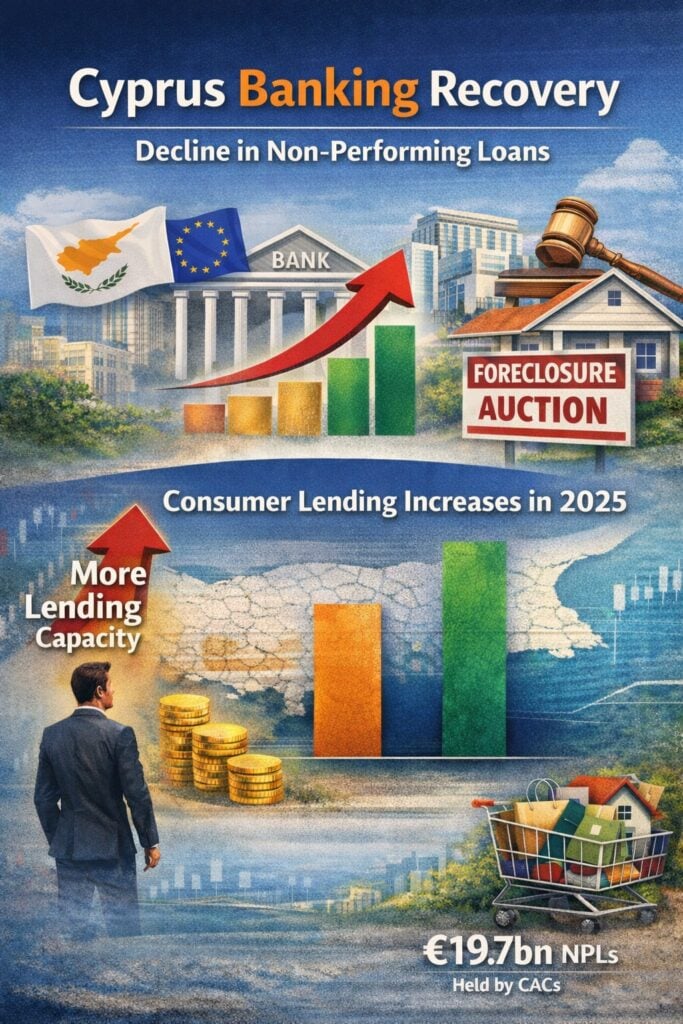
As of 30 June 2025, loans held by CACs amounted to approximately €19.7 billion, of which €9.27 billion were classified as non-performing. By the end of September 2025, restructured loans held by such entities amounted to approximately €0.8 billion.
Press reports further indicate that CACs acquired approximately 141,478 Cypriot loans for a purchase price of around €3.2 billion and have since collected approximately €5.7 billion through repayments, settlements and asset recoveries. Despite these recoveries, the overall nominal value of the loan portfolios has not diminished significantly. On the contrary, due to the accumulation of contractual interest and charges, the value of such portfolios has reportedly increased to approximately €18.5 billion.
As a result, credit-acquiring companies have increasingly resorted to foreclosure procedures as a means of recovery. A considerable number of immovable properties have either been sold through auction or repossessed by CACs in order to satisfy outstanding debts. This development has generated significant public debate, prompting the Cypriot Parliament to seek an appropriate balance between the operational role of CACs in the financial system and the protection of borrowers.
In response, the Cypriot government has introduced several support mechanisms aimed at protecting vulnerable borrowers. Since 2019, four major schemes have been implemented: the ESTIA Scheme (Cyprus mortgage relief programme), the OIKIA Scheme (Cyprus mortgage support programme), the Plan for the Management of Delayed, Expired or Terminated Loans, and the Mortgage to Rent Scheme (Cyprus). Members of Parliament have recently urged the government to reopen the Mortgage to Rent Scheme until the end of 2026 in order to provide further support to vulnerable borrowers.
Despite ongoing concerns regarding foreclosure activity, the gradual clarification and strengthening of the legal framework governing loan recovery has had certain positive effects. In particular, the increased certainty surrounding enforcement procedures has encouraged borrowers to engage more actively in loan restructurings and repayments prior to the initiation of foreclosure proceedings. This has contributed to greater payment discipline and has functioned as a mechanism supporting the stability of the credit system while also preserving the value of immovable property assets.
The significant reduction of non-performing loans within the Cypriot banking sector represents an important milestone in the country’s post-crisis financial recovery. Through regulatory reforms, portfolio sales to credit-acquiring companies and improved restructuring mechanisms, Cypriot banks have managed to substantially strengthen the quality of their balance sheets.
The decline in NPL levels also creates additional capacity for banks to expand their lending activities. With fewer distressed assets weighing on their balance sheets, banks are now in a stronger position to allocate capital to new financing, thereby supporting economic growth and investment.
Recent data appears to confirm this trend. Central Bank statistics and financial press reports indicate that consumer lending increased slightly in 2025 overall. In particular, consumer loans rose to approximately €263.5 million in 2025, compared with €250 million in 2024, reflecting a gradual recovery in credit demand.
Although challenges remain — particularly regarding the management of distressed debt held by credit-acquiring companies — the improvement in bank asset quality and the gradual increase in lending activity suggest that the Cypriot financial system is moving towards a more stable and sustainable phase. If accompanied by prudent lending practices and balanced borrower protection mechanisms, this development may contribute positively to the continued strengthening of Cyprus’ banking sector and broader economy.

posted 15 minutes ago

posted 40 minutes ago

posted 1 hour ago

posted 1 hour ago

posted 2 hours ago

posted 2 hours ago

posted 3 hours ago

posted 3 hours ago

posted 3 hours ago

posted 4 hours ago

posted 4 hours ago

posted 5 hours ago
No results available
Find the right Legal Expert for your business
Sign up for the latest legal briefings and news within Global Law Experts’ community, as well as a whole host of features, editorial and conference updates direct to your email inbox.
Naturally you can unsubscribe at any time.
Global Law Experts is dedicated to providing exceptional legal services to clients around the world. With a vast network of highly skilled and experienced lawyers, we are committed to delivering innovative and tailored solutions to meet the diverse needs of our clients in various jurisdictions.
Global Law Experts is dedicated to providing exceptional legal services to clients around the world. With a vast network of highly skilled and experienced lawyers, we are committed to delivering innovative and tailored solutions to meet the diverse needs of our clients in various jurisdictions.

Send welcome message