
Author
No results available
Commercial real estate in Poland continues to attract international capital because it combines EU-market fundamentals with pricing that can still be compelling on a risk-adjusted basis. “Profit,” however, is not only about headline yield. In practice, returns depend on how efficiently you structure tax, how well you manage VAT cash flow, and how cleanly you design the holding and exit path.
Just as importantly, tax and corporate structuring is also dispute prevention. If the structure is robust, you reduce the risk of conflict with tax authorities. If the transaction documents are robust, you reduce the risk of disputes with sellers, contractors, lenders, and tenants.
This guide focuses on the tax framework and the practical structuring points that matter most.
In recent market cycles, many investors have targeted Poland for a combination of income and potential value creation through active asset management. Prime yields vary by asset type, location, lease profile, and financing conditions. As a broad market indication, “core” income-producing assets have often traded in the mid-single-digit yield range, while assets with more leasing, capex, or repositioning needs may price wider.
For investors, the practical message is simple: the yield is only the starting point. The “real” profit profile is driven by:
after-tax cash flow (CIT base management, interest deductibility, depreciation),
VAT recovery on development and capex,
exit structure (share deal vs asset deal),
and enforceability of rights across the asset lifecycle.
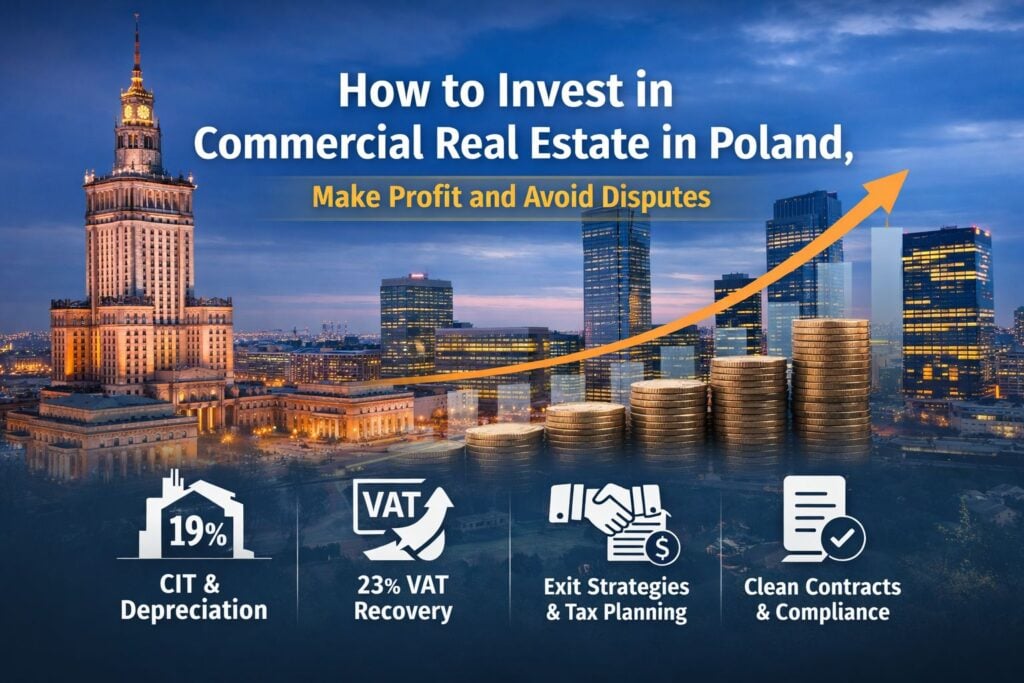
Poland’s standard corporate income tax rate is 19% and is flat (not progressive). Commercial real estate investments are commonly structured through special purpose vehicles (SPVs) because SPVs:
support efficient financing structures,
allow flexibility at exit (especially for share deals),
and ring-fence operational and project risk.
For foreign investors, the SPV approach also helps keep governance clean: decision-making, cash flow, and liability are easier to manage when the asset sits in a dedicated vehicle.
Commercial buildings are subject to tax depreciation. A common standard rate is 2.5% per year (a 40-year depreciation period). Accelerated depreciation may be available in specific circumstances.
Depreciation matters because it reduces the taxable base and improves after-tax cash flow. This is especially valuable in long-hold strategies where the investor prioritises stable distributions and a predictable internal rate of return.
Interest on bank financing is generally tax-deductible, subject to limitations aligned with EU anti-avoidance rules. In practice, the key limitation is typically the interest cap based on 30% of tax EBITDA, with a safe harbour threshold of PLN 3 million.
This is why a well-designed debt + equity structure can materially improve tax efficiency. Poland’s banking market for commercial real estate financing is mature and competitive, and financing terms can be a meaningful part of the overall return story.
Poland applies a minimum income tax regime for certain commercial properties. As a general rule, it is calculated as 0.035% per month (0.42% per year) on the initial value of buildings exceeding PLN 10 million.
In practice:
the minimum tax is generally creditable against standard CIT,
it is not intended to create a “second layer” of tax for profitable projects,
and it operates primarily as an anti-avoidance mechanism.
Investors should still model it properly, because it affects cash flow timing and compliance processes.
Poland’s standard VAT rate is 23%. VAT is often one of the biggest practical differences between “good” and “bad” investment execution, because it affects cash flow during acquisition, construction, and capex-heavy repositioning.
Key investor considerations include:
Full VAT recovery on construction costs may be available if the asset is operated as a VAT-taxable business and the documentation and invoicing chain is clean. This is a major driver of cash flow efficiency in development and heavy capex scenarios.
Lease income in commercial real estate is generally VAT-relevant, and lease structuring should be aligned with VAT recovery goals. The practical point is governance: VAT works when the asset is run as a VAT-compliant business with consistent invoicing, reporting, and contractual alignment.
Exit planning should be built into the structure before capital is deployed. Otherwise, investors discover late-stage tax friction that either reduces proceeds or delays closing.
Dividend distribution is typically subject to 19% withholding tax, with potential reductions or exemptions depending on the holding structure. In some cases, EU-based exemptions may apply, and treaty-based relief may be available depending on the investor’s jurisdiction and conditions satisfied.
The practical message: do not treat dividend planning as an afterthought. Holding structure, substance, and documentation often determine whether relief is available.
Both share deals and asset deals are used in Polish commercial real estate exits. The best structure depends on the asset profile, the buyer universe, the seller’s tax position, and the desired speed of closing.
Share deal (sale of shares in the SPV)
Seller-side taxation may apply, typically in line with the 19% CIT framework for Polish tax residents.
For non-residents, taxation depends on applicable treaty rules; Poland may retain taxing rights in certain structures, particularly where value is predominantly derived from Polish real estate.
Share deals are generally outside VAT scope; transactional taxes on the buyer side may apply.
Share deals can be attractive because they often support cleaner continuity of contracts and permits and may simplify operational transition.
Asset deal (sale of the property/asset)
Seller-side taxation generally applies to the gain (fair market value minus deductible costs, subject to the specifics of the seller’s tax profile).
The transaction may be VAT-able or VAT-exempt depending on the factual and legal configuration; transactional taxes on the buyer side may apply.
Asset deals can be attractive where the buyer wants to “pick” the asset but not the vehicle, or where risk allocation is better achieved through an asset transfer structure.
For foreign investors, the key is timing. Proper planning is easiest before the structure is locked in and before financing and leasing strategies are finalised.
Poland offers investment incentives that may provide CIT relief up to a defined regional aid threshold in qualifying cases. While classic “pure” commercial real estate may not always fit the standard profile, mixed-use and operationally intensive projects can sometimes be assessed.
If incentives are part of the investment thesis, they should be evaluated early, because eligibility and documentation requirements can influence project design.
Real estate tax is payable to the municipality. Rates vary by municipality and are calculated based on area and classification. In commercial leases, this cost is typically recharged to tenants as part of service charges, but the contractual mechanics must be drafted carefully to avoid leakage or disputes.
We always favor dispute avoidance over dispute resolution. And dispute avoidance is the natural by-product of good structuring.
Most tax friction in real estate is avoidable. It usually arises from:
inconsistent VAT treatment across contracts and invoices,
weak substance and documentation for withholding tax relief,
poorly modelled interest deductibility limits,
or misalignment between accounting, tax, and operational processes.
If you align these points early, you reduce the probability of costly controversy later.
Commercial real estate projects generate disputes when core mechanics are unclear:
seller warranties and disclosure,
conditions precedent and closing deliverables,
financing covenants and information undertakings,
lease documentation and service charge architecture,
capex responsibilities and handover protocols.
Strong corporate and contract design reduces conflict with sellers, lenders, contractors, and tenants. It also improves the investor’s position if a disagreement does arise.
We have advised international clients across the lifecycle of commercial real estate assets—from land acquisition and zoning, through construction and leasing, to disposal—across a wide range of sizes and locations. That lifecycle experience typically translates into fewer surprises, cleaner execution, and better outcomes at exit.
Before you deploy capital, pressure-test the structure against these questions:
1. Holding structure: Is the asset in an SPV with clean governance and ring-fenced risk?
2. CIT model: Have you modelled depreciation, interest limitations, and minimum tax cash flow impact?
3. VAT strategy: Is VAT recovery designed and documented from day one?
4. Lease economics: Are service charge and tax pass-through mechanics enforceable and auditable?
5. Exit plan: Is your preferred share deal vs asset deal pathway realistic for your buyer universe?
6. Compliance discipline: Are reporting, invoicing, and substance requirements operationally achievable?
Profit is created by details. Disputes are also created by details.
If you are considering a commercial real estate investment in Poland—or you are already in the market and want to optimise tax efficiency and reduce execution risk—our team can support you across tax structuring, corporate setup, transaction documentation, and lifecycle management. Please reach out via the contact details provided in the page footer.
This publication is for general information only and does not constitute legal or tax advice.

posted 12 minutes ago

posted 34 minutes ago

posted 39 minutes ago

posted 1 hour ago

posted 1 hour ago

posted 2 hours ago

posted 3 hours ago

posted 5 hours ago

posted 6 hours ago

posted 6 hours ago

posted 6 hours ago

posted 6 hours ago
No results available
Find the right Legal Expert for your business
Sign up for the latest legal briefings and news within Global Law Experts’ community, as well as a whole host of features, editorial and conference updates direct to your email inbox.
Naturally you can unsubscribe at any time.
Global Law Experts is dedicated to providing exceptional legal services to clients around the world. With a vast network of highly skilled and experienced lawyers, we are committed to delivering innovative and tailored solutions to meet the diverse needs of our clients in various jurisdictions.
Global Law Experts is dedicated to providing exceptional legal services to clients around the world. With a vast network of highly skilled and experienced lawyers, we are committed to delivering innovative and tailored solutions to meet the diverse needs of our clients in various jurisdictions.

Send welcome message